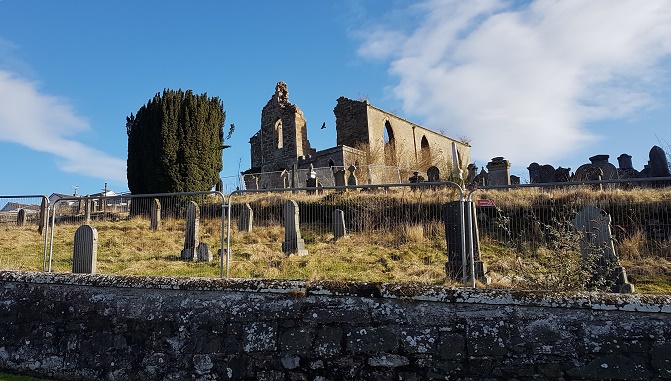
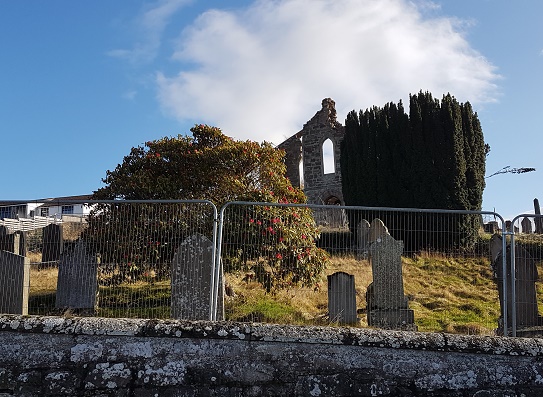
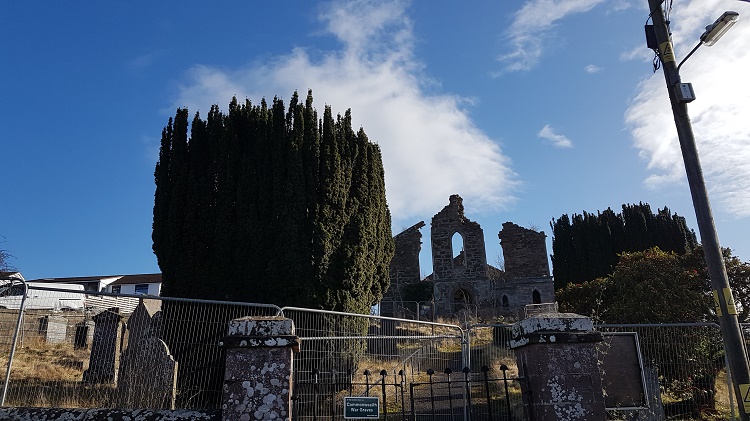
Now the Irish yews are surging skywards, thrusting out dark flames of leaf and stem. They are slow, but it’s been over a decade now, trickling from flame to flame.
There is a blurred line where a century of tidy head-height tinkering ended, and a tight sea of brooding, black-edged green foliage has broken through, and swept away order. The yews erupt, as stone crumbles and falls. Birds roost in them at twilight in scores, warm, undisturbed, by gale or snow.
Behind the safety fencing, beyond the do-not-pass and danger signs, is a place where no man goes. Gravestones lean, tip and tumble; make new, safe alcoves, tunnels and tiny shelters for unregarded lives. Grass rises, dances with nettle and willow herb, falls, forms dense mats and decomposes slowly.
Rhododendron Elizabeth, first red fire of February, sprawls and spreads and flowers on, uncorseted. But most of the orderly and well-tamed shrubs they planted by the paths and over loved ones shrink and cower now beneath the onslaught of bird-borne buddleia, bramble and insidious sweet elder.
Secrets are kept here among the dead. Trysts are made between fungus and flowers, moss and bird, animal, alga, insect, lichen and all the free flow of life invisible, multiplying, dividing, swarming, with the Irish yews, making universes from perceived dereliction.
Photo: Kate Jewell / Comfrey (Symphytum officinale)
Comfrey is in the Borage family of plants. There are various species, strains, and cultivars, which all have similar properties. The one which spreads unrelentingly in my garden is the Tuberous Comfrey (Symphytum tuberosum), which is low growing, spreading (via its knobbly, tuberous roots), and has dingy off-white to cream flowers. I am in negotiations currently with Tuberous Comfrey to spread unrelentingly where it can out-compete the ground elder, rather than among the potatoes. This species, along with Common Comfrey (S. officinale) is a native of Britain. A number of imports and acquisitions by Henry Doubleday in the 1870s led to an important cross between Common Comfrey and a Russian species, S. asperum. The hybrid became known here as Russian Comfrey (S. x uplandicum).
Common Comfrey has other common names: Knitbone and Boneset. The generic name Symphytum means “to join together”. The specific name “officinale” indicates medicinal value. (Readers of my last post may see where I’m going here!). Comfrey roots and leaves have been used for many, many centuries in poultices (mainly) to treat sprains, bruises, inflammation, cuts and sores. Comfrey contains allantoin, a chemical which is crucial to cell regeneration and healing. In my garden, the unruly Tuberous Comfrey disappears during winter, but I also have two Russian Comfreys which don’t. One of them used to be variegated, but soon reverted to green and vigorous.
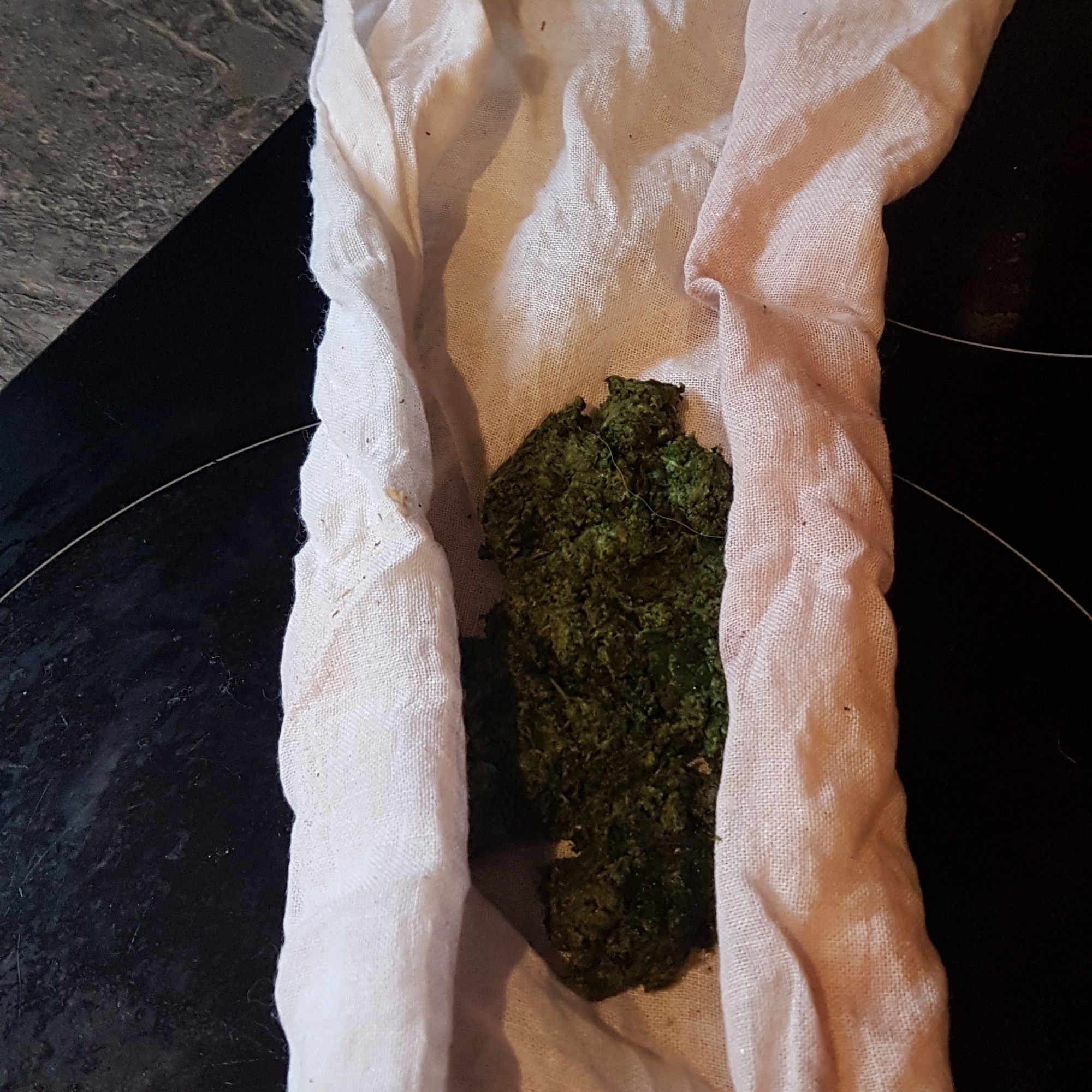
Therefore, in the mild weather between Hogmanay and the end of last week, I manoeuvred myself laboriously up the garden on my crutches, to pick the freshest leaves (yes, there were some!) from the plants. Roots may have been better, but digging isn’t in my current skill-set. A knee with anonymous sprains and tissue damage and a minor fracture of the tibia was going to get the comfrey treatment. I made the poultice very easily, by zapping the fresh leaves to a dark green liquid and mixing it with flour. A square of muslin, folded at the edges to stop the poultice oozing down to my ankles, held the comfrey against the affected bits of knee. An elastic tubular bandage kept it in place, over which went trousers and the leg brace. I did this for 4 days consecutively, but removed it from sight when I went for the fracture clinic appointment. (Self-treat? Who, me??)
On the X-rays, it was very hard to see where the fracture is now, but the doctor pronounced everything was well placed to heal completely, given time. Leg brace for at least another month! Then the weather turned snowy, followed by the customary January freeze, so the Comfrey pharmacy is temporarily closed. I’ll never know for sure how far it is contributing to healing, but that’s no problem, I am happy to be my own experiment in this.
Now to the other uses of Comfrey, including compost. The extravagant growth of the various comfreys which Henry Doubleday imported and which interbred led the organic movement pioneer Lawrence D. Hills to found a field station in Bocking, Essex, dedicated initially to research and breeding of comfrey strains for agricultural and horticultural use, named the Henry Doubleday Research Association. The best-known strain is probably “Bocking 14”. Later, HDRA became the influential Garden Organic charity, with thousands of members. I met Lawrence Hills a couple of times, when I switched from teaching to horticulture and was looking for a year’s work placement as prerequisite to starting a course at Writtle Agricultual College. He was so charming, so enthusiastic, so hard-working – and I was so looking forward to working and learning in an organic garden and taking part in field research. But organic was still considered the domain of hippies and weirdos as far as Writtle was concerned. I was told that HDRA was NOT ACCEPTABLE as a PROPER horticultural placement, and I ended up on a bedding plant nursery. Learned a lot, but you know how I just adore bedding schemes……!
A Much-thumbed Reference for Improper Horticulturists
But I grow Comfrey. I would never be without it in the garden. The lovely purple, red and white flowers attract every kind of bee in the district, it suppresses weeds, and is so vigorous I cut both the Russian and Tuberous back several times during the year. Most of the green material goes into the Comfrey bin (joined by excess nettle tops). The bin has a lid but no bottom, and it stands on a perforated metal square (actually a redundant queen excluder from beekeeping), which is balanced on an old washing-up bowl. Into the bowl collects a dark, viscous, evil-smelling liquid – Comfrey tea! NOT for drinking, but for use, diluted, as a liquid feed for tomatoes, vegetables and any plant looking under par, just as Lawrence Hills told me all those years ago. Many gardeners believe Comfrey tea confers disease resistance to plants as well as a nitrogen boost. I don’t add any water to the bin, and the dry material left goes onto the adjacent compost heap. Sometimes I add fresh Comfrey to the heap if it’s being a bit tardy in decomposing – it acts as an activator. Another great thing to do is liberally cover the ground between developing plants such as courgettes with fresh Comfrey leaves as a mulch. Not only will they decompose happily in situ and directly feed the plants, they help to warm the soil and stop weed seeds germinating. (TIP: Don’t accidentally mulch with tubers still attached!)
Fresh Comfrey Boost for Peely-Wally Sweet Corn!
I also eat Comfrey leaves. Now, my herbalist friends will tut-tut, because Comfrey also contains alkaloids which can damage the liver, to a point where cancerous tumours may develop. I can understand reluctance to prescribe it for internal use. Most of the alkaloids accumulate in the roots and the older leaves, and laboratory trials on unfortunate rats indicate that you’d really need to eat or be injected with an impossible amount of Comfrey to have such a reaction. Nevertheless, I stick to young leaves, in moderation, as a delicious vegetable in combination with nettles and other spring greens. They fill the so-called hungry gap abundantly well, and are a tasty substitute in any recipe involving spinach. Covered in beer batter and deep fried, individual leaves are a really, really bad-for-you treat!
But whether you eat it or not, Comfrey is for life – in more ways than one.
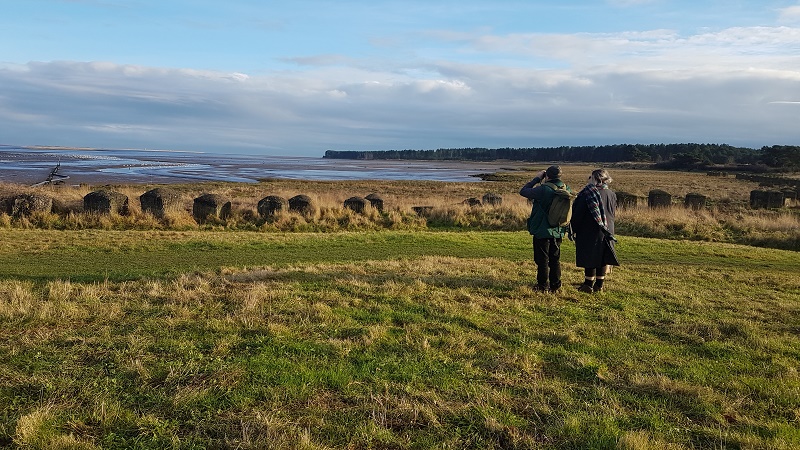
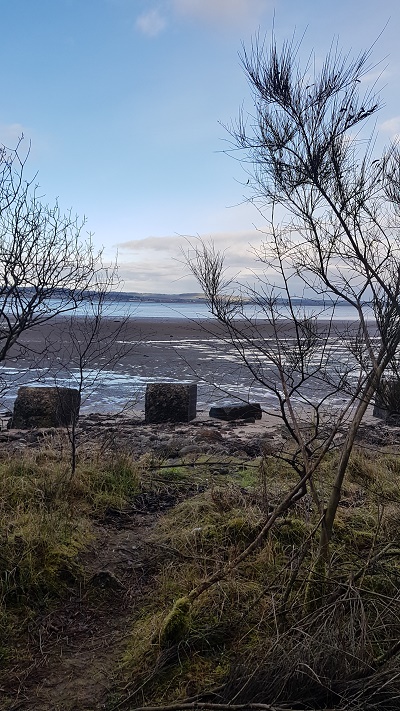
Three days of Christmas torpor, punctuated by food, beer and Irish cream liqueurs, two days of damp murk – what happened to the pretty snow that began falling so seasonally on Dunkeld Cathedral at midnight Christmas Eve? – then Tuesday dawned with clear-ish skies and a watery sun. Finally, an opportunity for a decent walk, and a collective itching for sea air drew us like a magnet to Tentsmuir Forest.
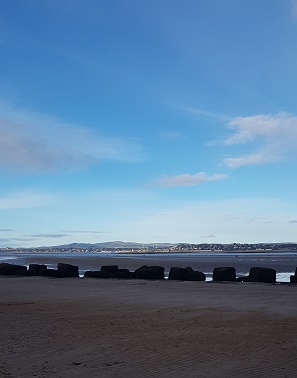
I consulted my knee, which has been challenged by non-specific pain since I fell onto it while raspberry pruning at the end of October. My knee said in no uncertain terms that those strong anti-inflammatories from the doctor had worked miracles in the preceding week, and it was quite sure any torn ligaments, lumps of cartilage etc. were virtually mended. It also said forget the looming possibility of the onset of osteoarthritis, let’s not even go there. The beach calls. So we drove – no, I drove, another possibly poor decision – to Tayport and marched across Tayport Heath with a head-clearing north easterly behind us, and the sun making Dundee all sparkly. Tide was out; wide sands, gleaming waters, massive blue skies splashed with the long brush-strokes of brazen clouds.
Sun always shines on Dundee…
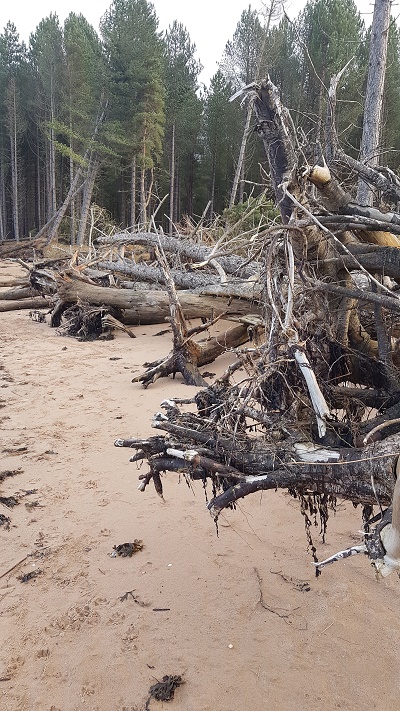
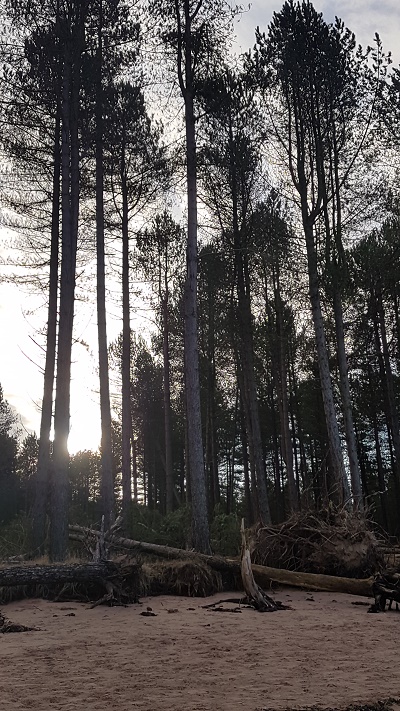
Getting to the forest, we saw many of the pines that cling to the edge of the sand had been toppled by recent storms. In a hollow of dunes, the trees had fallen in to the centre. The upended roots, with the sandy soil washed or blown off them, were a fierce tangle a-top the weathered trunks and skeletal remains of earlier storm victims. It became clear that the parallel forest track inland, which would have been our easy and shorter return route, was blocked.
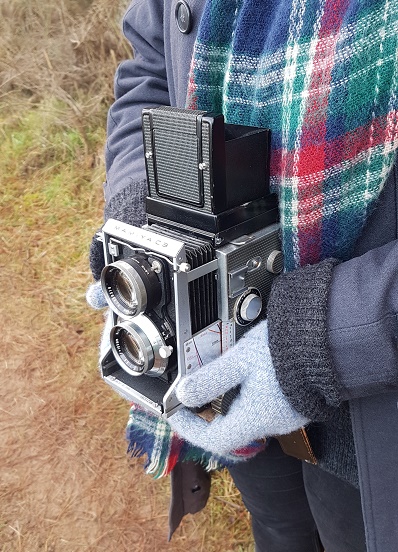
Rowan spent an age taking black and white photos with an antique film camera, unloading the film and loading a new one. I took photos of the camera on my phone in an instant, and was glad to wait and rest a slightly uncomfortable but not yet painful knee, while reflecting on the different mental input and rewards of each method.
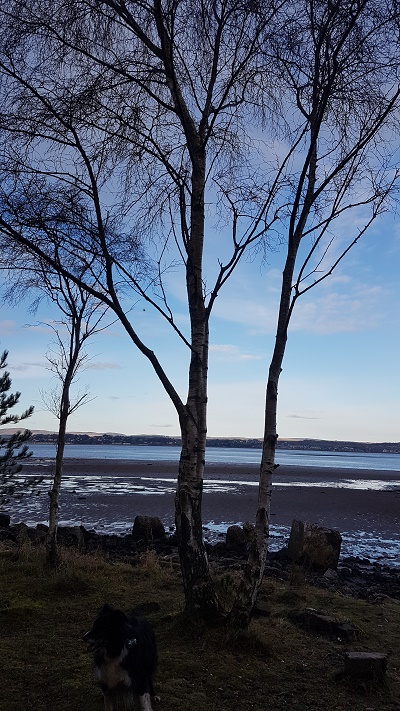
Afternoon light on the estuary emphasized the form and movement of the bare birches and broom in silhouette, as the tide turned. When we reached Tentsmuir Point, the knee was starting to think maybe it should not march on to Kinshaldy Beach as planned, but turn around now. After all, that would still be 5km of exercise and fresh air in total, though I dearly wanted to paddle in the distant, sparkling waves. Pausing to decide, I stepped down a 45cm bank, bad leg first.
There was an audible explosion in the knee, and I was no longer standing up. Actually, I couldn’t. We sat for a while, till I felt the pain might just be away, but that I should definitely head back. When I tried to walk, that became “we should all head back”. Various efforts at walking supported by one or both of my familial companions were not very successful on the uneven, up-and-down path – someone was always either the wrong height or moved at the wrong time, and any sideways movement, flexing or bending of the knee was pretty agonising. We minimised such movement with my new Christmas walking socks and a filthy and disreputable Tay Landscape Partnership buff, belonging to Andrew. (I wash mine.)
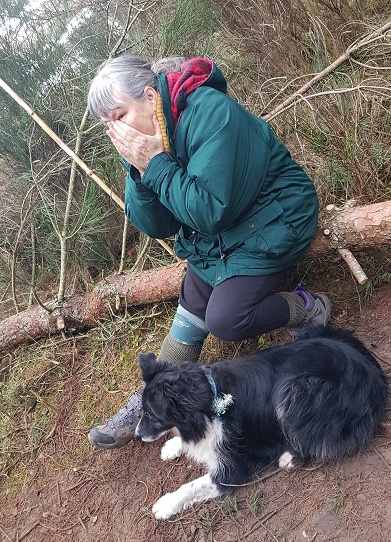
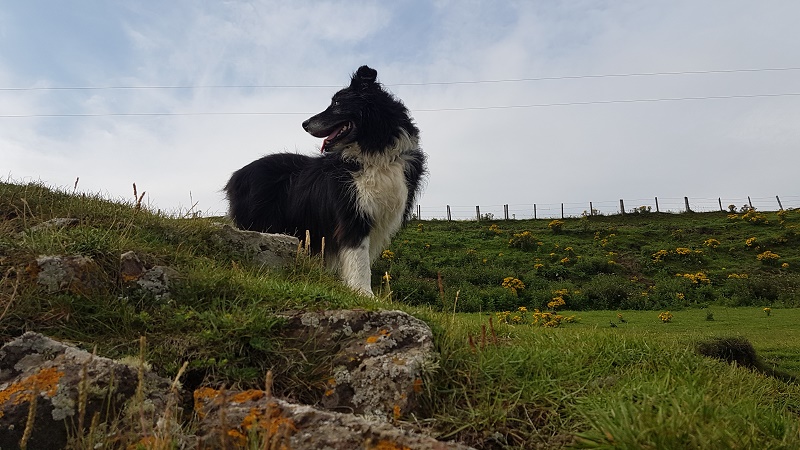
Infinitely helpful collie dog
There were lots of folk out on that path (all others being closed off), and many of them were wonderful. Jolly Fifers and Dundonians with sympathy, but a strong sense of the ridiculous kept my spirits up with their black humour and all kinds of offered help and advice. To the lovely man who had collected a polished peeled pinewood stick and surrendered it to me before going off to see if there was any way he could get his car into the forest to pick me up, my grateful thanks. That stick (pictured above, behind) was a real help and enabled me to avoid the shifting sands of human support. People, so often, are just brilliant, something we forget too easily, confronted as we are by insensitive, heartless, mindless acts – not infrequently by politicians.
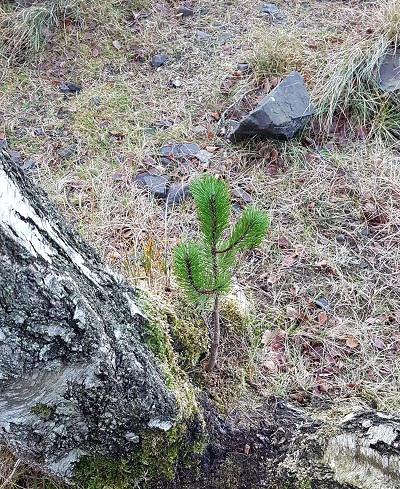
However, light was starting to fade, and progress was slow. I had to keep stopping to recover. One long stop was by a heart-searingly beautiful birch tree on which I leaned. Tucked between its twin trunks was a little pine seedling. I wished it every success, while Rowan rang 999 and Andrew marched off to meet the emergency services back at Tayport.
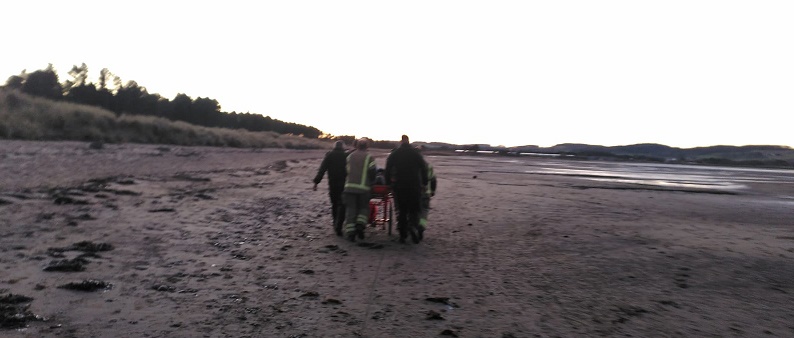
Getting an ambulance in to where I was proved impossible because of the windthrown trees. The ambulance people called on the fire service who have the keys to the gate at Lundin Bridge, and on their colleagues in Edinburgh to come up to Fife with an all-terrain vehicle to get me. Meanwhile, two paramedics and 4 fire-people set off with a narrow-wheeled stretcher trolley, while Rowan kept everyone updated with a brilliant App called Three Words which can pinpoint location accurately.
It took a long time. Wistfully, I dreamed of a helicopter air-lift (which was considered, I learned later, but they said it couldn’t land on the estuarine sands) or a Bond-style speedboat rescue. The tide was visibly rising and although still a way off I knew that at high tide the sea washes the track. And it was getting cold. So, when I could, I kept moving on, in the crab-walk sideways step I’d almost perfected, leaning on the stick for dear life in front of me, dragging the damaged right leg up to join the poor, put-upon left. (It was ever thus.) We noticed that the movement was in waltz time, and tried humming the Blue Danube by Strauss for encouragement. That was too corny, so Rowan found Iron Maiden on her phone and I crab-danced along quite the thing for a good while to Dance of Death…..
“Feeling scared I fell to my knees As something rushed me from the trees Took me to an unholy place That is where I fell from grace” (lyrics, Iron Maiden)
Appropriate, or what?
Getting carried away…
When we met the brilliant team of combined emergency service people (yes, I know, but they bloody were), I opted to be carried on the jolting trolley (apparently a wheel came off at one point) till we met the ATV. The ATV got lost (“Edinburgh folk” tutted a Dundee fireman, as if he’d not really expected anything better), so didn’t arrive till we were out, but I enjoyed passing under the overhanging pine branches, set against a darkening sky, and the vivid sunset over the flat and increasingly wet estuary. There are worse settings for being a casualty.
The two Edinburgh paramedics transported me to the car and thence off to A&E. Five hours later, and more hats off to the NHS, I left, with a pair of crutches, a fractured or chipped shinbone in the knee joint encased in a massive Velcro-assisted immobiliser, and a probable torn-asunder lump of cartilage called the medial meniscus. Which came first, and whether one caused the other, I hope to learn next Wednesday at the fracture clinic!
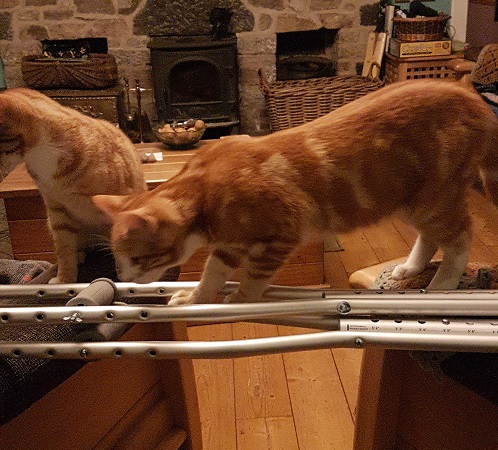
Fringe benefits: 1. Gas and air! Happy memories (?) of childbirth! 2. From the Xrays, my knee “is like that of a young woman” said the doctor. No osteoarthritis yet! 3. The kittens like tight-rope walking on the crutches more than I like using them. 4. Time to write my blog, which I signally failed to do before Christmas. Too late for Christmas greetings, but have a good Hogmanay and new year when it comes…..everyone, but especially two doctors (one of Philosophy with heavy metal expertise), all the happy walkers in Tentsmuir Forest, three firemen and a firewoman, four paramedics, innumerable NHS staff from the reception desk to the porter, one man with a stick (which I’m keeping unless he wants it back), and a partridge in a pear tree……(imagined.)
This week my Google Tasks told me I had to turn the compost heap. I assume I told it to tell me that at some point. I have two largish compost bays (minute in comparison to some, such as the magnificent compost-heaps-from-heaven at the community garden at Hospitalfield in Arbroath – you could bury a small house in each of their bays). I also have several bays and bins for leaves, imports of dung, and bulk biodegradeable materials in waiting, but it is the management of these two main piles that coincides with that moment when summer and autumn are subtly but surely dissolving into winter. For many reasons, I see winter as the start of a new year, and turning the compost always signals new beginnings, new plantings.
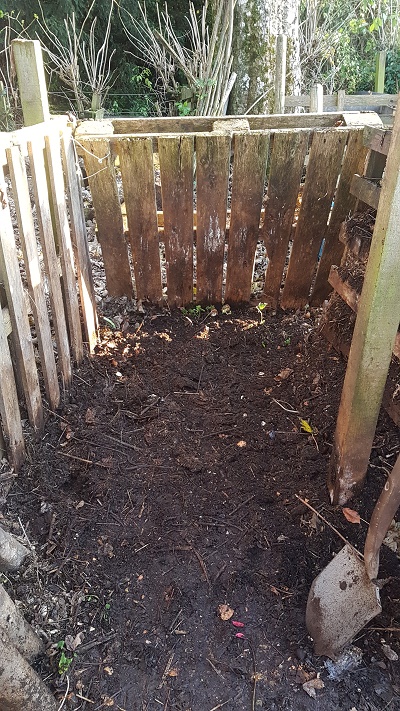
The first stage, actually, is barrowing and spreading all the finished compost in bay 2 onto beds and borders around the garden. This has been going on in stages for a couple of months, with sticks and undigested material being thrown back into bay 1. Bay 1 is starting to groan under the weight of future compost, as annual vegetable plants, bean and pea debris and a mountain of weeds from tidying up raise the height to almost unreachable. Once bay 2 is empty, everything in bay 1 can be moved over, introducing oxygen and stimulating breakdown. The topmost material is pitchfork stuff – or even just grabbing arms-full of dry debris and chucking it into bay 2. I try to put the most fibrous material in the middle, where the heat will be highest, making it in theory the best place to break everything down. If I can clean out the chickens just after all this top layer has gone on the bottom, the aromatic stew of chicken poo and wood shavings works as an activator.
The middle layer next, and it becomes more interesting. Here the brandling worms that thrive in the warm centre are busy at work, oodles of them, squirming voraciously in the decomposing mire. They are the visible agents of change, but unseen workers include many kinds of fungus and bacterium, at least as important. The middle layer is a seething mass of activity, and I make sure that on transfer to bay 2, the “working layer” maintains most of its integrity. Composter organisms are forgiving, though, and will migrate to the part with the right temperature if they find themselves compromised. Meanwhile, the garden robin and blackbird perch nearby, popping down for a feast of something whenever I pause to straighten and stretch.
Now the two piles are roughly the same height and I get into a rhythm with the pitchfork. The work is easier. I reflect once more how well yoga practice fits me for gardening – turning compost means twisting without injuring your back, and balancing on wobbly compost to reach the stuff at the back and sides of the bay. I work away getting the compost from the cooler edges into the middle and am left standing on a small pinnacle in the middle of bay 1.
Delving down the pinnacle, the number of compost worms decreases, and the ability to combine a twist with a forward bend comes into play…..work is getting harder again and I don’t want to suffer later! I start to turn out large numbers of wonderful centipedes. Centipedes are carnivores, not detrivores – they are not adding to the composting process, but hunting smaller creatures who live on bits of decomposing plant and humus. In the garden they are generally really good news, as they also eat the invertebrates who want to steal our crops. I try to catch one or two for a photo, but they are camera shy, and very, very fast on all those legs – as true hunters should be.
Photo by u0413u043bu0435u0431 u041au043eu0440u043eu0432u043au043e on Pexels.com
So, near the bottom of bay 1, the compost is as complete as it will be, and ready to use without being turned. I start to fill barrows of the good stuff, rejecting some unprocessed bits and pieces but not worrying too much – any unfinished business should happen in situ, over the course of winter. I dump and spread the compost on beds and borders. I don’t dig it in – no need. I have earthworms for that. It isn’t perfect, my compost. Eggshells hang about for ages, for example, and every autumn I dredge up a few well-rooted avocado plants which have grown from stones that never seem to decompose. (Neither do the skins). The heat given off by decomposition enables them to germinate. This year is no exception, and as usual I take pity on one, pot it up and take it into the warm greenhouse, where it will grow into an untidy, straggly, leaf-spotted pot plant with no hope of bearing fruit, and I will start trying to give it away to unsuspecting friends with more optimism than I have about its value.
The last few shovelfuls, the final pitchfork-loads, and lo! I discover that the sticks I placed at the base of bay 1 last autumn because in a whole year they had failed to become compost are still there, barely altered….. I spread them across the base, along with the 3 year old thick cardboard tubes from inside the new polytunnel cover… they ARE biodegradeable, and I WILL win this battle….one day! On the plus side, after years of running a nursery here when thanks to lack of time and the vagaries of some of our volunteers, my compost heaps produced more plastic than a supermarket, this year my accidental plastic input and retrieval is minimal – and I can re-use the two ties and labels. And only one unreconstructed plastic-reinforced tea bag, right at the bottom, since we have found plastic-free brands.
Plastic pollution in decline!
I level the top of bay 2, and cover it with carpet. I know that within weeks, heat will build up and by spring it will be less than half the height it is now.All is done, and so am I, yoga or no yoga. And yet I’m incredibly happy with today’s work. Compost-making is the heart of my gardening life, the most satisfying, the most compulsive work, returning to the earth the things of the earth. I hope I have a good few years of compost-turning left!
There are different kinds of walks-with-mushrooms. My first, fifty years ago, were cataloguing walks, an academic exercise that became an obsession. A specimen of each would be removed and bagged (no smartphones then, and my Kodak Instamatic didn’t really cut the mustard, though I did try), taken home, pored over for hours to try to identify it, and then a spore print taken. This was all in the cause of a college Rural Studies project that I somehow never grew out of.
When I began to differentiate the ones I could eat from the poisonous ones, foraging AND cataloguing walks happened – a basket for the ones I knew I could eat, and another for the unknowns. Many remained – and remain – unknown, something which used to really bother me. However much later when I was regularly leading foraging walks, I realised that so long as I could recognise the “edible and good” fungi and the poisonous and dodgy ones, most people were happy if we could pin the “small brown jobs” down as far as a genus.
I still take huge interest in identifying weird or remarkable specimens that I’ve never seen before, but these days I’ve discovered the pleasure of walks-with-no-purpose-with mushrooms. This walk, meandering along the River Tay from Dunkeld, had no particular object but to be captivated by the surprise and beauty of the fungal kingdom – so often misrepresented, under-valued, the importance of which is not understood by the majority of humans.
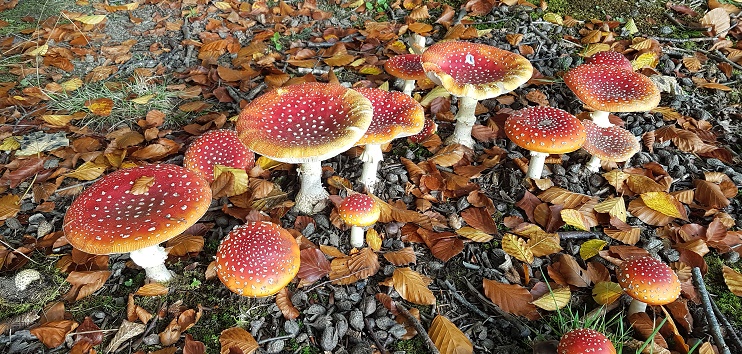
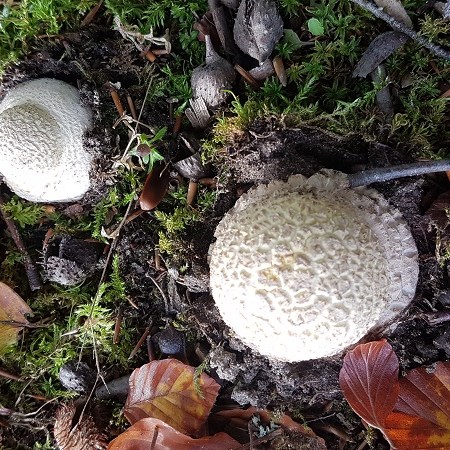
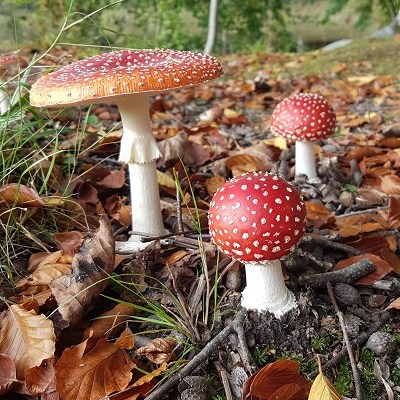
First came a phenomenal display of Fly Agarics, the mushroom of the shamans, too exquisite to pass by, shouting their wares, nestling in ground which was once birchwood. Their mycelium is always entangled with the roots of birch; from the beginnings of plants on dry land they have needed each other. They start as big white crusty buttons, the red skin of the cap breaking through the veil to leave those fairly-tale white “spots”. The cap expands, the spores fall. One was nearly as big as my head.
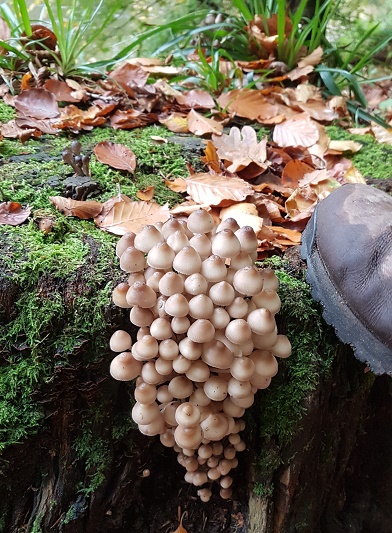
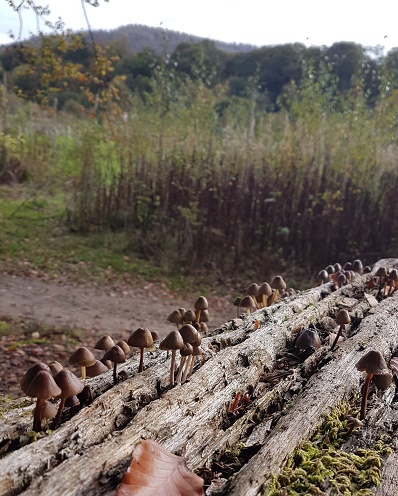
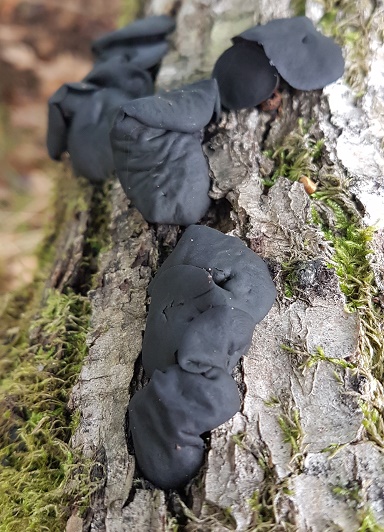
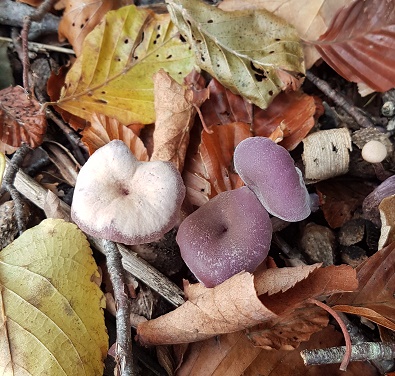
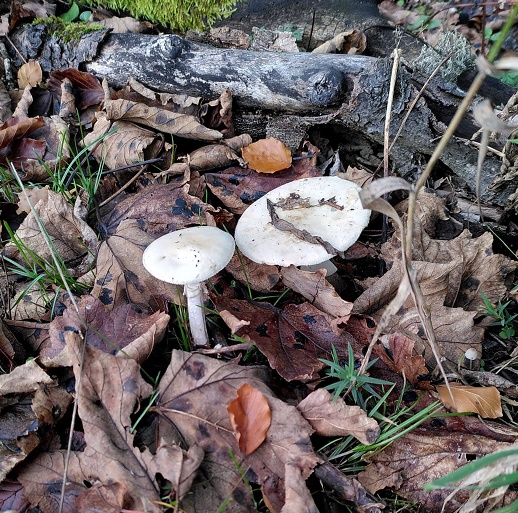
Troops of Bonnet mushrooms, various types, marched over fallen trees and gossiped in crevices of stumps, glistening in the sunlight. Shiny black excrescences of Witch’s Butter erupted from dead wood. Amethyst Deceivers – which I could have picked for eating but didn’t – showed all their colour range from vivid purple to washed-out grey. In the leaf-litter, the Destroying Angel, related to the Fly Agaric but far more deadly, glowed purest white. Such a potent name for a poisonous mushroom!
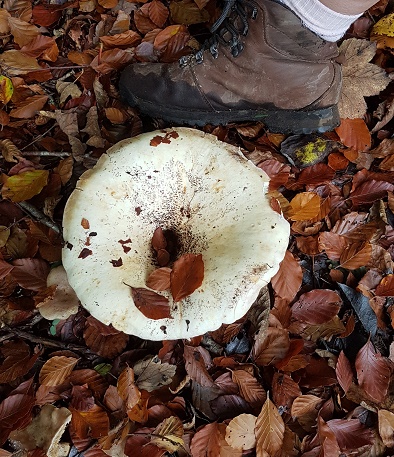
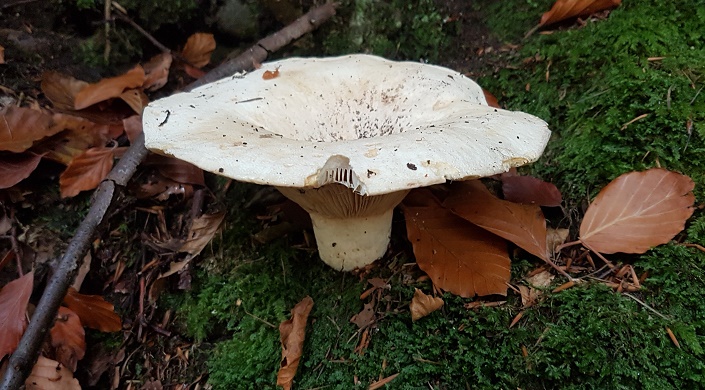
Giant Funnel Cap (Clitocybe gigantea)
Across the track lay a small segment of a huge fairy ring of an enormous mushroom commonly called the Giant Funnel Cap (check the size 8 boot in the photo for scale). This took me immediately back to those student Rural Studies Days, when I first saw this mushroom in local woods, in a ring that was actually measurable. From the fresh fruiting bodies came a strange, un-mushroomy smell. I took one home, identified it easily and, as the book said edible, fried it in slices. It tasted like its smell – like nothing I’d ever encountered. To this day, I’m still trying to work out if I actually like it! But size-wise, they are easy pickings, and it’s fun to estimate the equally astounding diameter of their fairy-rings and plough through the woods to try to find the mushrooms on the other side of it.
This walk wasn’t for foraging, for worrying about what I was looking at, and I haven’t bothered to tease apart the various fairy bonnets. Old habits die hard, but really, I don’t need to know!
The turn of the season is felt, not so much as a drop in temperature or the way the need for warm socks and waterproofs creeps up on you, but in the way the woods smell different. Decaying leaves, leaves still on the trees but for whom decay is imminent: the smell, for me, of being 11 years old and at a new school, where our introduction to Biology was the invitation to compile a Biology Scrapbook over the course of a year. Diligently, I collected all those leaves on the point of rotting, pressed them in encyclopedia volumes, and learned, when I next opened the books to mount them, the subtle distinction between the smell of sycamore, poplar and oak leaves in autumn.
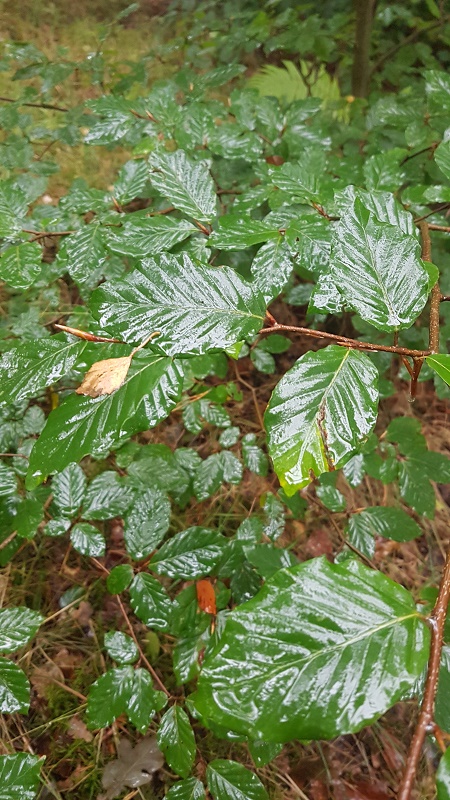
Today, a soggy Saturday in October, Five Mile Wood smells again of the Biology scrapbook. Weaving in and out of the olfactory hamper of autumn comes the odour of wet grass, heavily trodden, and the varied aromas of dozens of species of fungi, seen and unseen. It is raining, softly but insistently, the rain bringing its own subtle influence on how each smell is perceived, like a wash applied over a freshly executed painting. Beech leaves, nowhere near inclined to fall, glisten with rain. I am challenged to keep the rain from running down my neck, challenged by the chill in the air, challenged by the distraction of mushrooms, all of which breathe of magic, and the resulting lack of time that cut this walk a wee bit short.
I won’t bore you with more gratuitous gloating about the basket of edible mushrooms I took home to dry or make into fungus and ale pies, nor with more photos of the ones I can identify! But today, the woods presented me with an excitingly unknown fungus, the likes of which I’d never encountered in decades of mushroom-hunting.
(Actually, the woods do that every time I go foraging, for there are many, many mushrooms I cannot differentiate. But as I know they’re not on the “edible and good” list which is tattooed into my brain, I indolently dismiss them as “small brown jobs”. Which they usually are.)
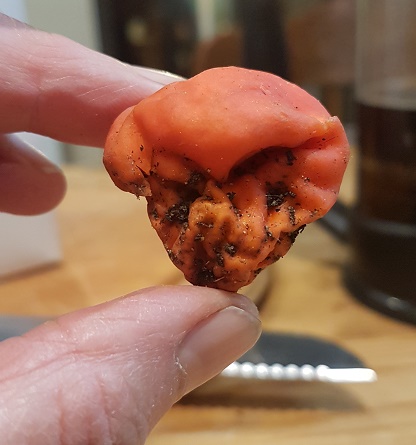
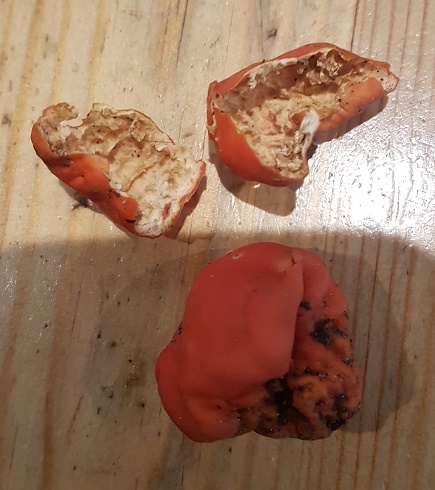
Today’s find was different, a real unknown unknown, to quote Donald Rumsfeld. Bright orange-red balls popping up through the grassy banks between the path and the ditch; I first mistook them for discarded tomatoes. But they were fungi, no question, and when I cut one open to help identify it, it was hollow, with pale coloured ribbing inside. I had never seen anything like it, but as it was so distinctive, I expected identification to be straightforward.
So far, I have not found this species in any of my books, and have drawn a blank from the social media mushroom groups from whom I begged enlightenment. Someone said they’d once seen something similar, but yellow, only got distracted by all the edible ceps nearby. Easily done! I have contacted the Tayside & Fife Fungi Group, and wait in hope. I will find out…. Perhaps someone reading this will have the name, and be laughing at my ignorance?
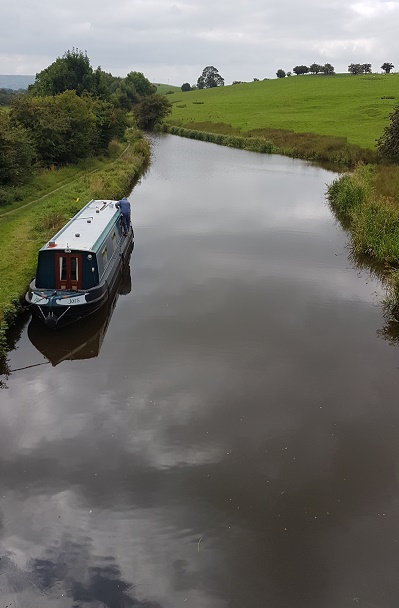
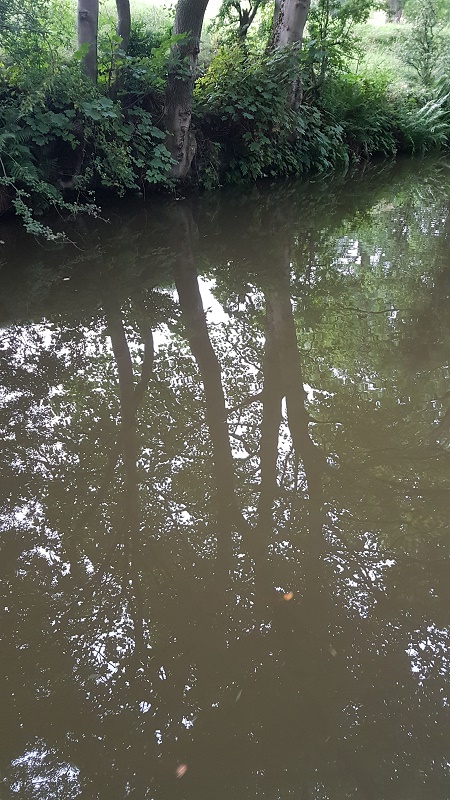
Moving – scarcely as we are – at something slower than walking pace, the beech trees at Farnhill this early morning are reflected with precision in the still, opaque water. Here in the bows, the faraway engine cannot be heard, and barely a ripple anecdotes the boat’s gliding passage. Gnarled, knobbly roots cling to sandy banks, equally above and below the waterline, making dense and mysterious holes of darkness and nudging great trunks upwards and downwards at matching speed.
Though we pass each tree at a ceremonial pace, none bow, none scrape. There is no concession, no acknowledgement. The suspended branches scarcely move. Body of tree fires into its mirrored trajectory skyward and earthward, as if all its electrons had simultaneously collided on the grey-brown meniscus of the canal.
Into the open, and we hear the awakening traffic on an adjacent trunk road. But the commuters and their noise are from a different universe. A shimmering sleight of time and speed separate them from us. Thistledown and tall spent grasses, immobile, catch the light, all shades of cream and grey.
And that most imperturbable of birds, the heron, cranes his long neck to the minutest degree from the bank, but also declines to move.
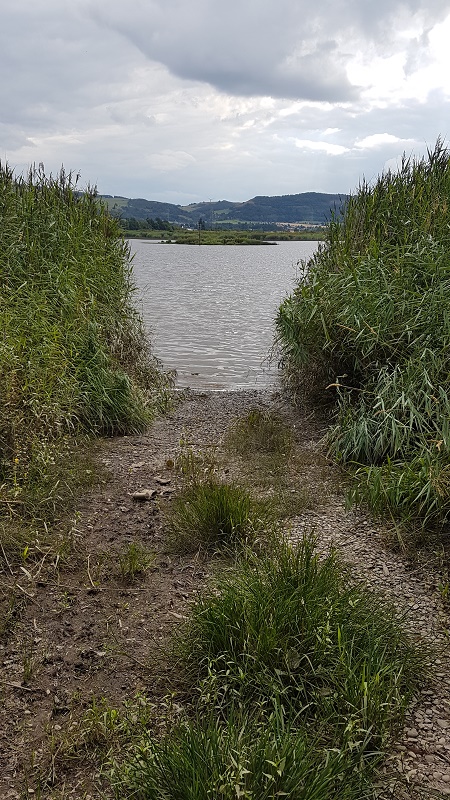
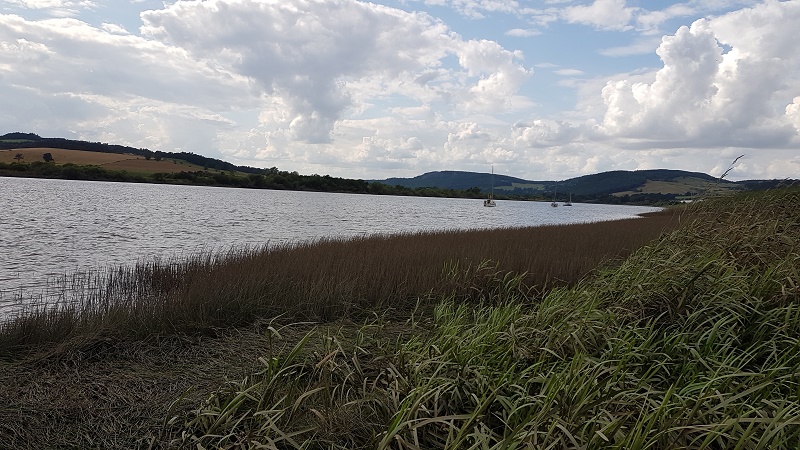
I wanted to walk from Cairnie Pier near St. Madoes west to Inchyra on the Tay estuary. My old map (old being the operative word) said there was a path, but it says that about a lot of stretches of the Tay along the Carse of Gowrie that it would be nice to walk, and it’s often mistaken. Google Maps hinted that if you got really, really close to the ground, there might even be two paths, but it wasn’t committing itself. At Cairnie, the existence of a small car park looked promising, and I found the great river hiding among its own reedbeds as usual, lapping quietly at a little inlet whose stones oozed mud. Fishermen’s paths trailed off in both directions.
Cairnie Pier
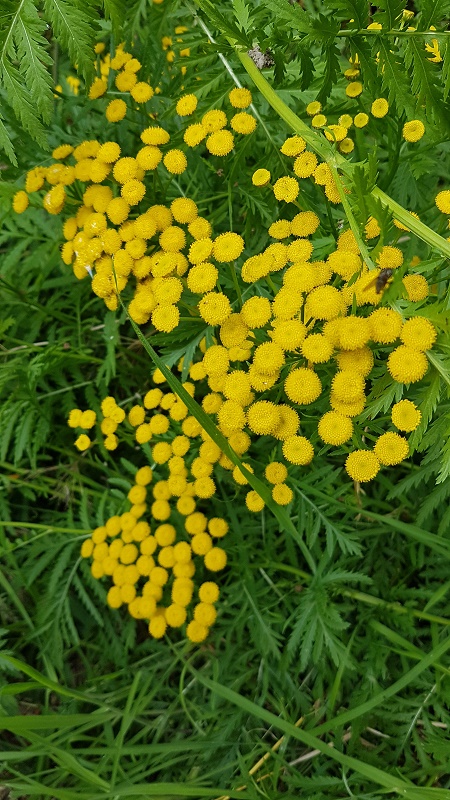
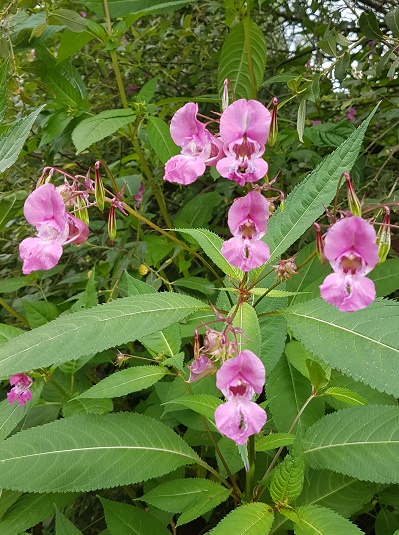
It was drowsy-hot, an afternoon of hoverflies and docile wasps, intent on the many flowers that lined the path. The river is a conduit for all kinds of unexpected vegetation, which thrive in the tidal mud and lovely untidy, unsanitised, hedgebanks and verges. The yellow buttons of Tansy pop up everywhere along the Tay, together with the silvery Mugwort, a long-ago Roman introduction, allegedly a cure for sore feet. Warm and spicy, the scent of Himalayan Balsam over-rode the scents of native flowers, and its spectacular flowers trumpeted a welcome to pollinating insects. This “alien invader” has been around a good while, anywhere near to water, and it’s a Marmite plant. Speak to any beekeeper and she will wax lyrical about the “ghost bees” who return somnolent and satisfied to the hive, covered in its dense white pollen. Speak to most mainstream ecologists and they will say it’s invasive, outcompetes “our” native flora and has no place in “our” countryside. I love its other name – Policemen’s Helmets – does anyone remember when policemen wore helmets? The top and bottom lips of the flower are encased in a helmet-like fusion of the other petals. I’ve happily pulled it out of ancient oak bluebell woodland, but I can’t say it bothers me too much today. I munch a couple of the peppery-pea tasting unripe seedheads, out of duty.
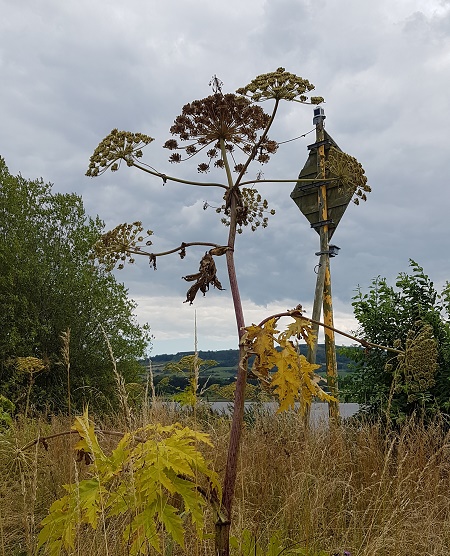
But then arise the forbidding, towering structures of a harder-to-love alien. Giant Hogweed, introduced by gullible and novelty-obsessed Victorians to adorn their fancy gardens. Apart from its spectacular, H.G. Wellsian-Martian structure (still being extolled by lecturers when I learned garden design), it is low on redeeming features. It is truly rampant, flowers and seeds everywhere and delivers serious burns to anyone brushing against it in sunny weather. It’s a property called phytotoxicity, and today the sun was shining and I passed gingerly.
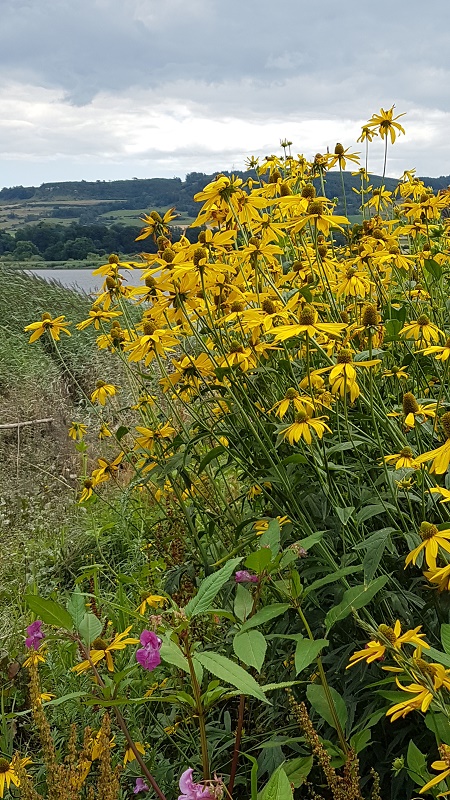
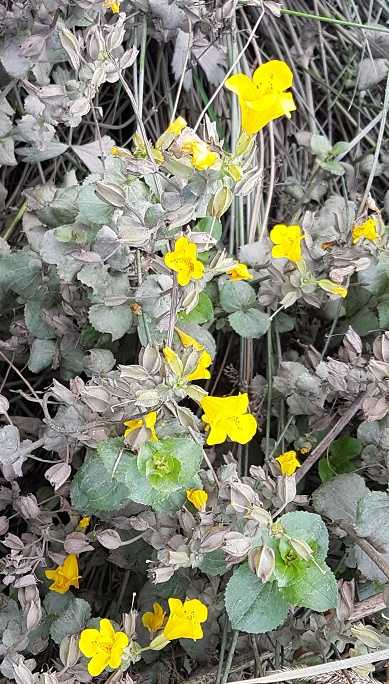
Far more attractive, and indeed glorious were the bright yellow, sunny Monkey Flowers, coated in tidal mud, and the clumps of tall Rudbeckia, both garden escapes, that sway gently in the breeze up the river. They are dotted all along this stretch of the Tay. I remembered another sunny day talking with David Clark of Seggieden – a great botanist and a man who so loved this river – about whether they “should” be there and what exactly was native anyway, since both of us could be labelled aliens ourselves. We agreed that neither of us were fanatical about racial purity in plants or anything else, but weren’t fond of Giant Hogweed, nor the next invasive alien to show its face on my walk, the Japanese Knotweed. This monster would out-compete the miles and miles of Norfolk Reeds themselves…..oh wait, did I say Norfolk Reed?
Yes that’s right, the incredible Tay Reedbeds, home to rare marshland bird species and a complex, life-affirming ecology, are the result themselves of the introduction of a “non-native”.
My fishermen’s path had petered out, and an attempt to reach Inchyra along the edge of a field also met with failure, so I drove back towards St. Madoes and took a side road left. Thus I reached Inchyra, a beautiful little village of low houses, pretty gardens and derelict farm buildings looking, as they always do, as if a quick afternoon’s work would put them back into service. From this hamlet, crouching among tidal lands as if in terror of sea-level rise, I found a wild garden overlooking the estuary and across to Rhynd, and small moored sailing boats bobbing in the rising tide.
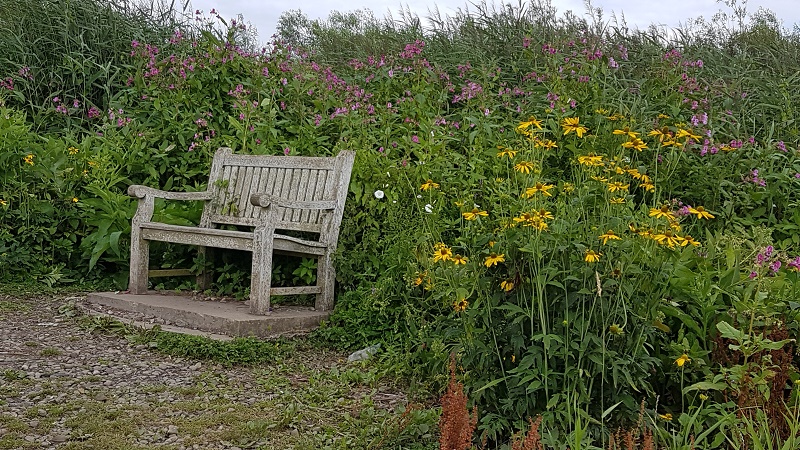
Here was a seat, to the memory of a daughter of a local family, and I sat in complete peace among the reeds, with flowers – native, non-native and all the gradations in between – blessing the air with scent and colour. Even the busy tractor across the water hummed to itself. Rain was forecast; I watched silver-lined thunderclouds pile up on themselves, shift and mutate, and then dissolve again into the blue sky. It was so good to be here.
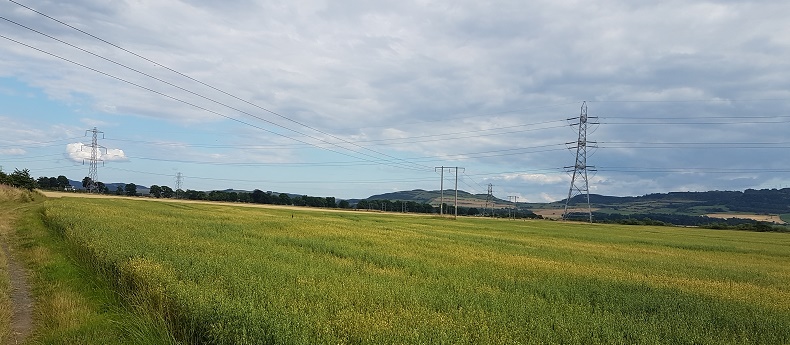
When it seemed the clouds were getting serious, I found a path that ran beside Cairnie Pow, giving me a good circular walk back to the village. The pow is a local name for a drainage channel, often of ancient origin, that was created to free the fertile soils of the Carse of Gowrie from being marshland. They litter the Carse, and give a sense of being neither quite on dry land nor in water. This one tracked parallel to the path I didn’t find earlier from Cairnie Pier, and then swung left at the point I’d almost got to, where a host of overhead power lines had got together for a gathering. They sky darkened, and the air, hot and still full of the damp scents of flowers, smothered the senses. Young trees, planted by the nearby farm, gave welcome shade. A big, old house rose out of the marsh with no obvious gateway or entrance. It looked dark, empty, full of tales and secrets. I wondered, made up stories in my head, began hearing things and holding imaginary conversations with people who did not exist. Perhaps it was as well that heavy, ponderous raindrops deterred me from more exploration that day.
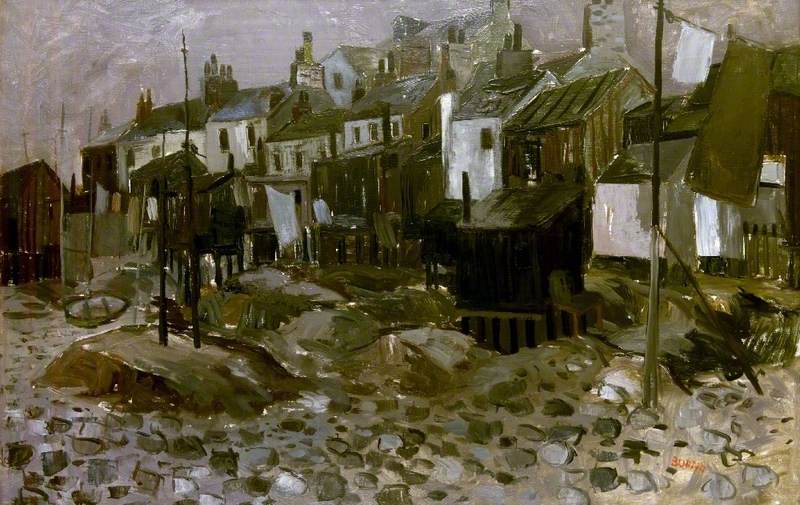
Ferryden by William Alexander Burns (1921-1972) Photo: Glasgow Museums
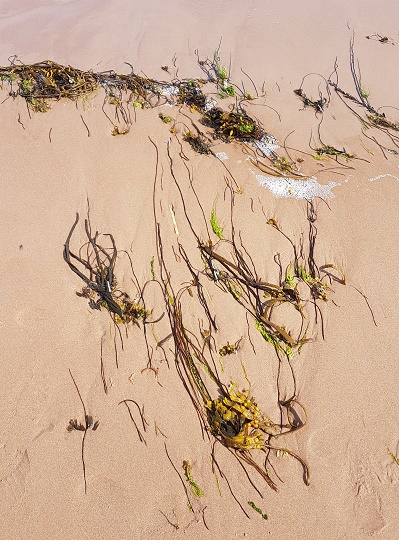
It’s often the places you didn’t mean to visit that become the ones you will always remember. It happened to me this weekend. Dropping our daughter off in Arbroath for a summer school gave us the perfect opportunity for a weekend mooching around Angus, camping overnight, visiting favourite haunts and exploring ones we didn’t know so well. So, out from Arbroath (reluctantly missing one of the favourites, the pie shop, on account of a planned visit later to another, the chippie) and a bask and paddle at Lunan Bay, my number two go-to beach for restoration of equanimity and sea watching. The tide was higher than I’ve ever seen; words were spoken of exceptional lunar activity sooking the sea up high then dropping it again, along with torn up seaweed and the corpses of seabirds. Less beach than usual then (and therefore more people per square kilometre); the dog confused by reaching the water’s edge so soon, but gratified to find long tangles of bootlace weed which he proceeded to bring to us to hurl into the surf. Heaven knows how much seawater he guzzled retrieving them, but he was happy.
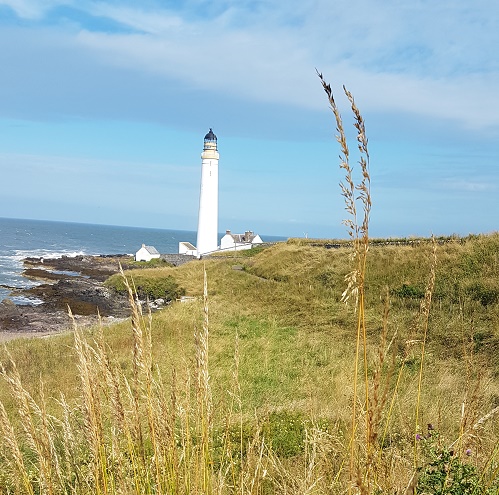
Heading vaguely towards Montrose, because that’s the way we always go, unravelling a dog-eared and out of date Ordnance Survey map and checking the terrain on Google maps, we took a notion to go to see the Stevenson lighthouse at Scurdie Ness. To get to the coastal path which would take us there, we decided to park at Ferryden. Lying on the estuary of the River South Esk, opposite the unappealing industrial sprawl of waterside Montrose, it wasn’t a place we’d ever bothered to visit before. But what a lovely surprise – who knew!
Crouching three or four deep, back from the harbour wall were the small, varicoloured and practical houses that once belonged to fishermen; front doors on the first floor and accessed by stone stairways up the sides or fronts of the cottages. The roadway between the first row and the water was a free for all – someone was in the middle of chopping wood, children played and neighbours gossiped. Pots and planters of flowers and vegetables spilled out from house to road, and there was clearly some neighbourly competition in the landscape design and artistry of the stretches of wall belonging to each house along the harbour. Almost every house had a seat, table, bench or furniture of some kind marking their spot. Ramshackle sheds and crumbling huts rubbed shoulders with homes and bits of old boats. From the wall, washing lines extended out over the water, children’s clothes, bright towels and lines of smalls bouncing like bunting in the sunshine. The washing was reeled out and later retrieved by a pulley system which I’m guessing was once used to dry nets, and I suppose they have sturdy storm pegs to avoid knickers blowing out to sea in a gale.
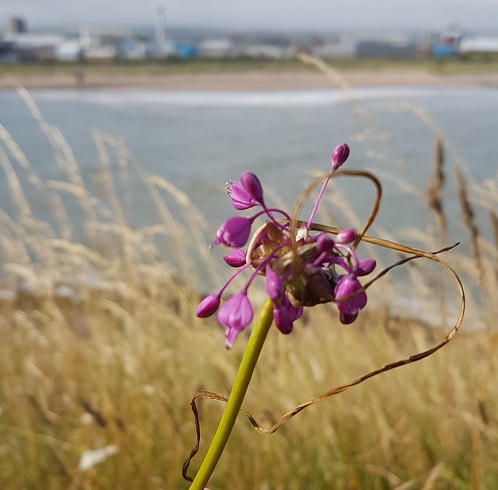
If we’d been in the East Neuk (of Fife), or a Cornish tourist honeypot, I suppose I’d have taken photos. Ferryden doesn’t present as “quaint” or a tourist attraction, despite the inevitable interpretive boards, and it would have felt rude. So sorry, no pictures! We guddled our way up to the coast path and had a lovely walk to and beyond the lighthouse, which got bigger and bigger as we approached until it was overwhelming. The hot sun released the scent of thistles, while ragweed and clumps of Keeled Garlic jostled in flower. Down on the little rocky beaches, my mother joined me in my head to exclaim, as she ever did on seaside holidays, at the winkles, periwinkles, limpets and small darting creatures in rock pools, and to gently tempt the waving tentacles of plump sea anemones and feel them sucker briefly onto my little finger. I collected pocket stones, which I did not add to the wonderful collection of painted and decorated stones on the wall by the path, left by residents and visitors.
Back to the old fishing village of Ferryden and its quirky charm, we had a campsite to find and it was past six o’clock. Was that really the smell of salt and vinegar wafting over the South Esk? Montrose this time for the fish suppers!
Midsummer, June, and roadside verges, hedgerows and path edges are brimming with life and good things to eat. Well, they should be, if you’re lucky, and some fusser hasn’t gone forth with strimmer or spray gun to transform the riot of green and gold, the effusion of flowers, seedheads and shoots to bare brown, sad-looking blankness or close-mown, stressed-out grass. I can never comprehend the small suburban minds of householders who would rather gaze out on monochrome than the living proof of life on earth. It’s one thing to keep your own verge tidy, and occasional cutting can increase the range of flowers, but it’s galling when people attack verges opposite or near their houses but which they don’t actually own. I confess, I get quite bitter about it.
During the 2020 lockdown, I embarrassed my family by taking to task a poor, misguided woman who was wielding herbicide along the route of a long-distance footpath. Granted, it was a stretch bordering her own property, and right enough, as she protested, she wasn’t killing everything…..
No, she was only killing what she called “the ugly, untidy species” that she had no use for. These were Dockens (have you ever looked at the intricacy of the flower structure in the Dock family?), and Hogweed. That’s where I really saw red.
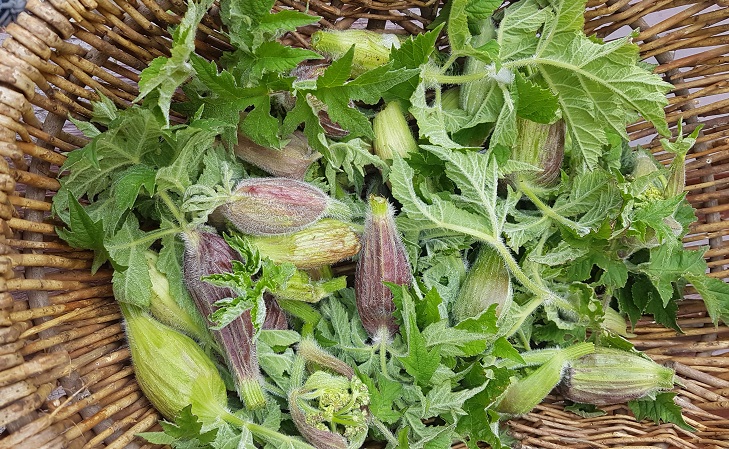
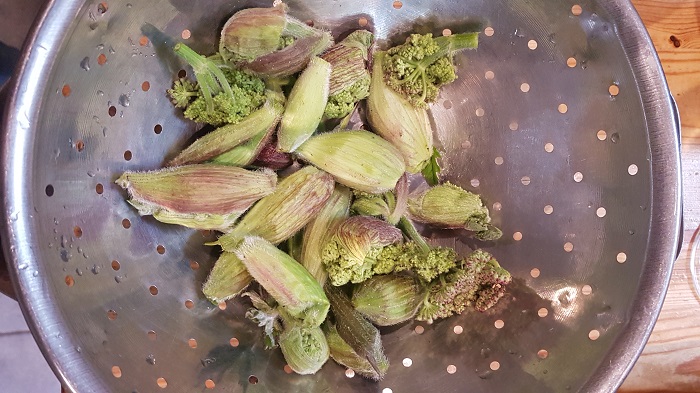
NO!!!! I don’t mean “Giant Hogweed” (Heracleum mantegazzianum), an invasive non-native plant known to cause serious skin burns and out-compete other plant species. Even I acknowledge that’s a nightmare, albeit a spectacular one. I mean Common Hogweed (Heracleum sphondylium ) a soft-leaved, far smaller native plant, with edible leafstalks and, at this time of year, the most delectable “broccoli” or unopened flower heads. Very few people have a skin reaction to this plant (far fewer than do to tomato plants for example), and I look forward to eating the broccoli every June.
“But it’s too tall, too big, too ugly and the bees and butterflies don’t visit it!” I was told. So then, we eradicate all the living things that we personally don’t like the look of, do we? What is ugly, anyway? Do we have to apply our personal prejudices to plants, other animals… humans? Sadly, many people do…..labelling leading to intolerance leading to hate crime leading to… genocide? And if a flower is constructed to be pollinated, not by the human species’ cosy favourites of bee and butterfly, but by beetles, flies or (perish the thought) wasps, does that make them useless, unworthy or ugly?
No, it darned well doesn’t. If Hogweed, Dockens or any other species becomes a weed in your carrots or undermines your potatoes, fair enough. It’s not because they’re ugly, they’re just doing what they are supposed to do. But leave them in the waysides that are their habitat. Before anyone gets horticulturally imperialistic ideas locally, I’m gathering hogweed broccoli. Just trim away the leafy shoots to prepare. Sauteed in butter with a little water and sprinkled with lemon juice and salt, they are a summer treat.
All prepared for braising or battering…..
Last night I made hogweed pakoras – coated in spicy chickpea flour batter and deep-fried – to go with the curry. I meant to take a photo for the blog, but suddenly, they were all gone. I need to get some more. Long live hedgerow delicacies!