Bees, Butterflies and an Old Straight Track

5mile wood1

The things you do in a lockdown. I wouldn’t normally walk from the house to Five Mile Wood, I’d call in on my way to somewhere else, parking the car. It’s not an especially long walk, but since they felled most of the trees on the Bankfoot side, cavernous ditches and hollows have made the entrance to the wood treacherous, wet and debateable, and the track to get there goes on a bit and is not especially interesting.

Or so I thought.

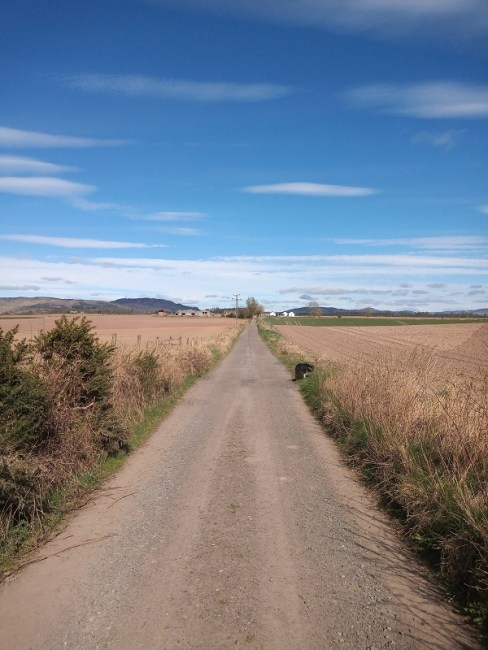
I marched out from Bankfoot on one of those dazzling, sun-struck mornings of which we’ve seen so many this April. We crossed the pleasantly deserted A9 and the field to the edges of Cairnleith Moss and turned right along the track to North Barns. The path stretched ahead in a tediously straight line, the wood in the far distance looking nearer than it actually was. At some point, I turned round to let the dog catch up.
5mile track1

It was a VERY straight track. North, it pointed directly at Birnam Gap, the space between the hills where every Great North Road is forced to pass. Ahead of me, beyond Five Mile Wood, the conical East Lomond Hill in Fife lay in a direct line. Suddenly, it fell into place. With these landscape markers aligned, this was the ancient route north – preceding the drovers’ track above my house, which preceded the winding old A9 through Bankfoot village, which went before the current A9. They all run roughly parallel, and all have to go through Birnam Gap. (Later I consulted the maps: this old straight track seems to have continued beyond the wood to meet the Tay at Waulkmill, then probably followed the straight road through Stormontfield, and on to Perth or beyond).

5mile track2

On either side, vast, treeless fields stretched forever, brown, homogenous, dusty and devoid of hedges. In a hollow beside the track were a dozen beehives. I realised the field I’d just passed did contain a crop – oil seed rape, yet to flower. That’s why the bees were there. A farm vehicle traversed the horizon on the other side, trailing an enormous boom sprayer. Dust and chemicals billowed behind it. The smell in my nostrils was like an airport runway. How on earth, I thought, did the bees keep going, while waiting for the rape to flower? There were no wild flowers in this agricultural desert.
5mile entrance           5mile gorse

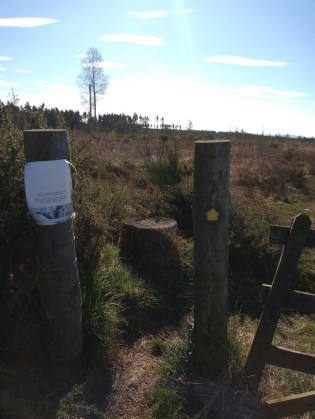
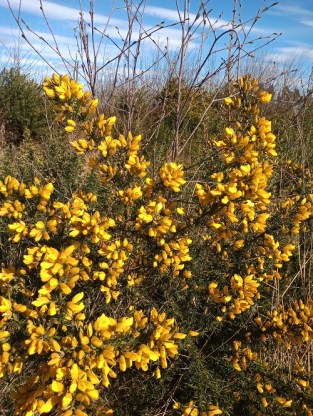
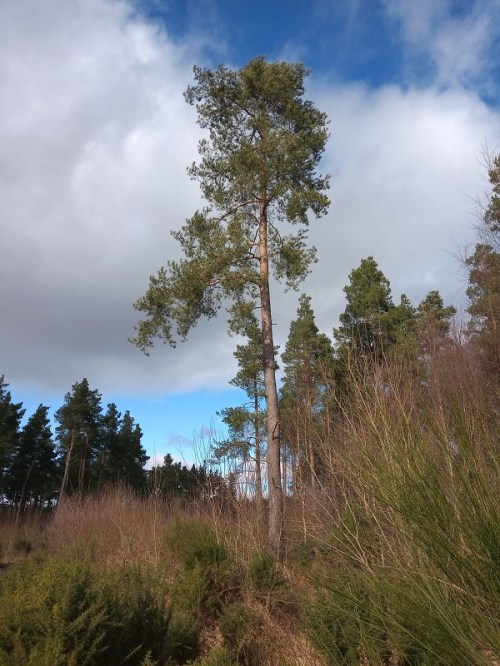
Reaching the edge of Five Mile Wood, I crossed the gate into the ravaged landscape of felled trees. The footpath sign directed me, and I could see where I needed to be, straight ahead on the old track, but a new route had to be picked to get there. Others had succeeded; makeshift log bridges across water-filled ditches, meandering paths that skirted the boggy areas. I reached the main path which circles the interior of the wood amid the heady coconut-scent of gorse – and there I found the bees, working the flowers sprung up in the new heathland created by felling. Beautiful birches, freed from forest, leaves just opening against a vivid sky. A border of dandelions edged the path, dancing golden and perfect in the sun of noon. Goat willows, pioneer trees of clearings, still in flower, had attracted a small swarm of peacock butterflies. In the new landscape of a one-time forest the bees and butterflies and all the creatures of the heath found sanctuary.

5mile birch     5mile peacock

Returning home, I thought about how important this chameleon landscape is, set against modern farming. I thought, too, about the old straight track that entered the woods, and how its purpose was muddied by activities that had made it so hard to follow. I thought how approach and access is so important, in any plans we may have for these woods in the future.

5mile dandelion

Ambushed by Birdsong in Taymount Wood

“Much laid plans” and all that. I knew exactly what I was going to write about in my second post for West Stormont Woodland Group. It involved walking quickly and without distraction to King’s Myre in Taymount Wood.

But on this sunny, yet briskly chilly morning in March, the birds had other plans for me. We hadn’t got far when the dog was infuriated by an ear-piercing whistling made, apparently, by a bush. Eventually a tiny bit of the bush detached itself and was revealed as the smallest bird with the loudest voice – the wren, bustling ahead of us from twig to twig. The dog hates wrens. They scold, scoff, and shout at him, warning everyone he’s about.

TW scotspine

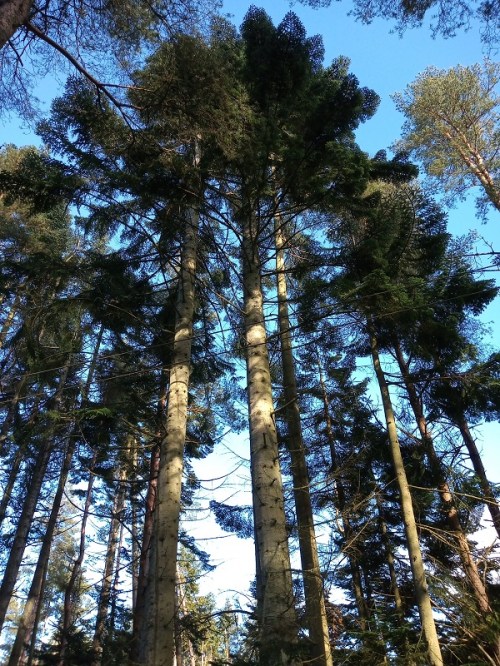
We dawdled on. Taymount contains a fair variety of tree species for a plantation. Tall Scots Pines lifted their crowns to the sun. Here and there, where selective felling had left a pine with elbow room, the narrow confines of its growth could be seen morphing into the mighty spread of the Caledonian pines. Larger clearings now host dense, self-seeded birch, through which a flock of greenfinches scurried. Brown bracken, unusual in this wood, lay beneath, thick enough to bed a herd of beasts.

TW bracken

We were on the cusp of spring. Robins proclaimed territories sweetly, compellingly, from field walls. We saw and heard shrill blue-tits, piping long-tails, busy coal-tits, always on the go. Great tits were most strident, high in the trees. “I’m yours! Look at me!” they seemed to cry in their repetitive, compulsive mating calls. Gazing up focused my attention on the trees, too, as silver firs soared into the blue sky. We fantasised about crested tits, one day, coming here.
TW silver fir

We came to some Sitka Spruce which had evaded felling. Sitka is a splendid, statuesque tree when grown as a specimen. If it has no place in the Scottish ecosystem, tell that to the coal-tits. These spruces were laden with dangling ginger cones and coal tits moved systematically from branch to branch, eating the seeds. Then a spotted woodpecker, who’d been ever-present with his drumming, exploded out of hiding and passed right over our heads, a massive spruce cone gripped in his bill.

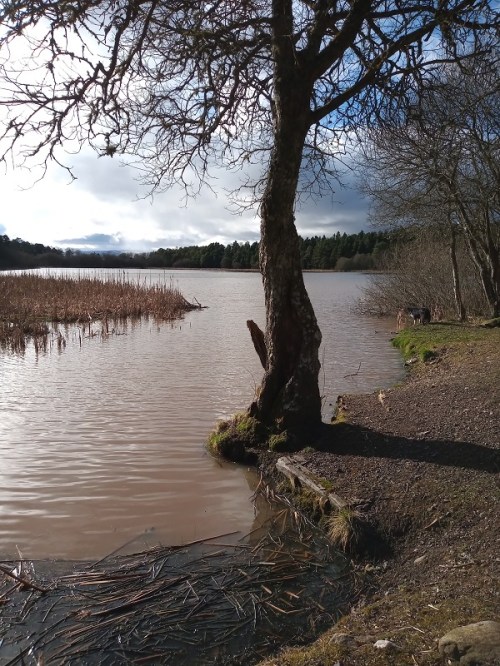
By the time we got to King’s Myre, we just enjoyed the sunshine by the loch. Another day for that tale!

TW kingsmyre1

The Rookery. A Short Update.
IMG_20200319_095953182

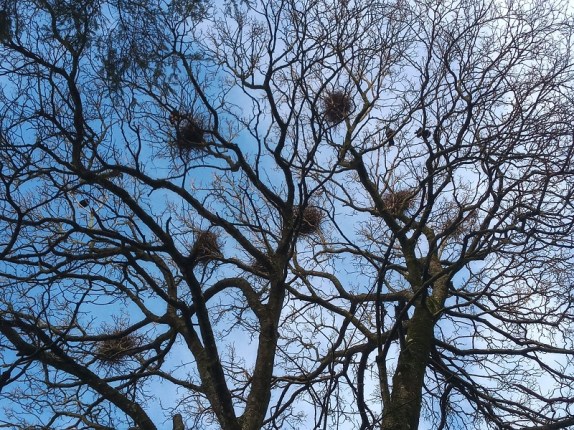
Work commenced again this morning on nest number eight. It was started a few days ago, but after much debate was dismantled back to nothing. I’m not sure if one of the other pairs plundered it when the builder wasn’t looking (because neither was I), or whether the materials didn’t meet with Rook Building Standards. But at six o’clock this morning, the early shift arrived and a new foundation was in place. By three this afternoon, it was already looking pretty solid.

(How do I know the early shift arrives at six in the morning? I’ve unobtrusively left the bedroom window open a crack, so I can hear them arrive. My partner won’t notice, because his ears block up overnight, and he never reads my blog.)

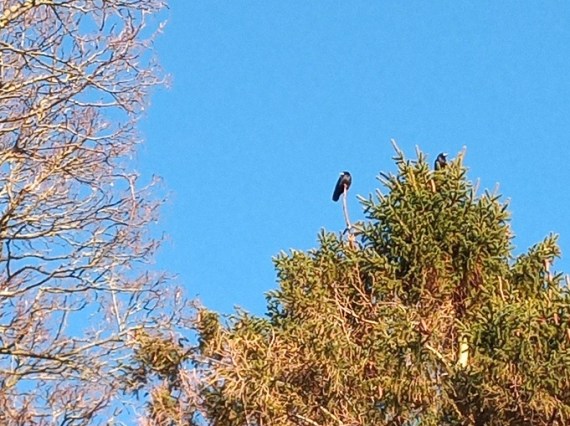
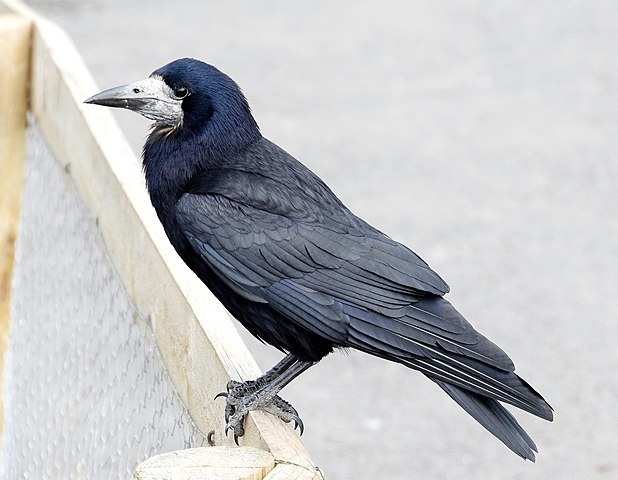
The rooks are busy most of the day, apart from an excessive break for an afternoon siesta. Not that they sleep. They eye me with amusement as I gaze up adoringly into the tree. (One day, I’ll regret doing that). Then they’re off again to the stubble field, competing with a huge flock of quarrelling crows for something. I can practically tell them apart at a glance now. The rooks have a greater sense of purpose; they look quietly industrious, with their lovely baldy grey faces. The crows mass about in a state that looks random and noisy. I liken rooks to the people carefully getting in sufficient stores of useful stuff, and making sensible preparations. The crows are the panic-buying toilet roll hoarders.

They are messy, careless builders, my rooks. On my way to the compost heap, I suddenly realised I was ankle deep in discarded or accidentally dropped sticks . Then I noticed a layer of them is starting to resurface the road under the rookery. Hopefully, it will slow down the delivery vans using the Brae as a shortcut.

rookmess

One other thing I’ve noticed. They are well sorted into pairs now. One messes about with twigs, weaving them into increasingly solid nests. The other watches, argues a bit, does acrobatic twirls and nearly falls off the branch, and acts as quality control. I’ll say no more. The buds are swelling green on the sycamore; spring will come (“as come it will, for a’ that”) and they’ll be hidden from my prying eyes. I’m making the most of rook-watching.

My favourite Parliament

rooks2

I’m infatuated with the much-maligned Corvidae, or crow family. There’s a stag-headed oak at the top of the Brae where they hang around as winter drags on, reminding me always of the poem “February” by Edward Thomas:

Over the land freckled with snow half-thawed
The speculating rooks at their nests cawed
And saw from elm-tops, delicate as flower of grass
What we below could not see, Winter pass.

A couple of years back, a pair of crows made a nest in the big sycamore tree that dominates the top end of my garden. In 2019, they returned with their pals. There were five nests under construction before my bird expert neighbour confirmed that I was wrong, Andrew was right, and these were not crows, but rooks. I had a rookery! Seven pairs nested last year, and the cacophony of feeding and fledging times was a raucous delight.

Last month, the rooks came on a visit. It was shortly following one of those weirdly named storms that have been the scourge of late winter here, and there was very little evidence left of last year’s colony. The rooks, about ten or a dozen of them, sidled about all day from branch to branch, engaged in some heated debate. Bits of twig were moved about, for no apparent reason. Several birds were seen bearing off the last remnants of a nest to some other location. Then they all flew off.

The collective noun for a group of rooks is a parliament. I can see why. That day, the debate went round and round in circles, no consensus was reached, and the parliament was either adjourned or illegally prorogued while certain individuals went off, presumably to feather their own nests. Although the odd rook came back to cark dismally during the next week or two, I thought that was the end of my rookery. A decision had been clearly made that the cost of rebuilding and renovation was too high and too risky, and they’d be better together with the big rookery at the other end of the village, established as long as humans here can remember, and probably longer still.

(I’m really, really trying not to be allegorical here, but it just keeps happening.)

rooks3

However, last week they returned, and resumed the debate with alacrity and much carking and cawing, retiring into the division lobbies in the neighbouring fir tree whenever the wind blew. Samples of twigs were brought in for inspection, passed around and tested for strength and engineering capacity. Rook nests are built near the top of a tree, and construction is meticulous, more complex than it looks, and uses only the right materials. Fortunately, rooks are among the most intelligent birds on the planet. In hopeful enthusiasm, I pruned the remaining pear and apple trees and left the twigs lying under the sycamore for the parliament to debate. They ignored them.

I could see the parliament was beginning to divide on party lines – lots of parties, each consisting of only two birds. Rooks are monogamous and mate for life. If this parliament consisted largely of last year’s babies, they were choosing their partners. Older birds were teaming up with theirs, and after a year of (presumed) abstinence, were making up for lost time. The branches rocked and see-sawed. Loud carking was sometimes interrupted by a melodious burble like a badly-tuned harp. The debate sounded more purposeful, and a nest began to appear.

I’ve been trying to fathom whether a parliament of rooks works collectively on one nest at a time. I can find no reference to such behaviour, so probably it’s just my fond imagination that sees the construction of a rookery as a kind of avian barn-raising. But there seemed to be twigs coming in from all directions, borne tenderly in those heavy grey bills and placed on or near the nest.

rooks4

Yesterday, a second nest was well under way. This morning, there were the beginnings of a third. I met four of the construction team in the stubble field as I was walking the dog. They were gathering bills full of short pieces of straw and flying directly to the building site. So much for the basket of dog hair I put out for them to line nests with! Maybe the blue tits will make use of it. I went out to check on progress just now, and counted ten birds in the tree, at least another ten supervising from the air, plus two fat wood pigeons fornicating aimlessly as they do. I’m pretty certain there’s at least one nest in the fir tree too, as two rooks dived in there, trailing long bits of stick behind them.

The other collective noun for these birds is a Building. I think my small (but fiercely independent) parliament has assessed the weather damage and consequences of climate change, has debated in full its response, has gone out to build or retrofit its housing stock using the best materials for energy conservation and the best techniques for sustainability. It’s stopped jabbering about targets and is now a Building of Rooks.

Other parliaments may wish to take note.

rook1 apingstone
(Rook at Slimbridge, by Adrian Pingstone)

February: Five Mile Wood


beech saplings

Dreich doesn’t begin to cover it. Weeks of rain, sleet or snow, and the wood is wet, dank, chilly. One storm has passed, another is forecast, and a group of multi-stemmed birches, green with lichen and algae, droop and wait despondently.

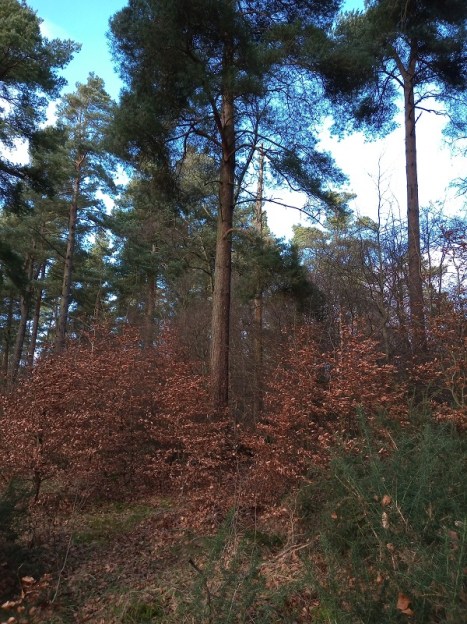
I take the rutted cycling path that skirts the woodland edge. Under the tall, fiendishly straight Scots Pines, many scattered beech saplings nestle in their winter boleros of retained leaves. Beech mast is everywhere, but I do not see the older tree from which it has fallen. Beech seedlings tend not to come up near a parent tree, but somewhere there must be a Mother.

Snow lingers crystalline along the clay-bottomed ditches where black, cold water lurks and trickles. There’s a pond under the pines which so looks like it was formed by an explosion I call it the bomb crater. No signs of frog spawn yet. Several tracks and paths meander where animals come down to drink. Duckweed covers a third of the surface; in the increasing rain thousands of ripples intersect and make diffraction patterns over the other two thirds.

bomb crater

Birds – except for a robin – are silent and glum. A flock of pigeons clatters off towards the field; freshly ploughed, it offers them nothing but the stones that lie heaped in the field corner. How many decades or centuries of cultivation have contributed to this pile? This side of the fence, someone a long time ago arranged stones round a favourite tree, where they remain, moss-covered and half-buried. Larger rocks with wavy patterns etched onto their surface erupt in groups from the forest floor, scarcely distinguishable from the stumps of felled trees. Moss, lichens, algae democratically envelop all.

blackening russula

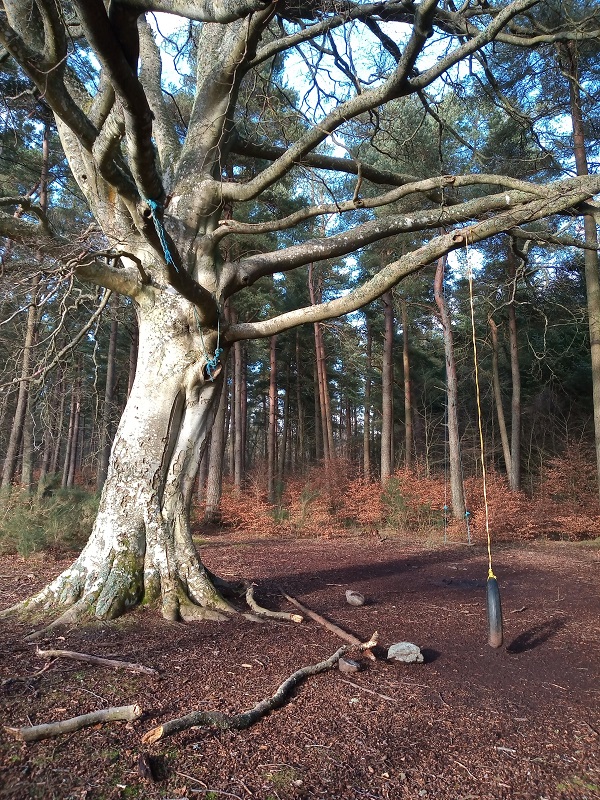
There are charred-looking remains of mushrooms by the path. I think they were Blackening Russulas, an abundance of them. I follow their orbital trail and suddenly find myself under a towering old beech tree, with many spreading branches and a hollowing trunk that makes a chimney of dead wood and fungal rots. Swings hang from two branches; insects and other invertebrates burrow into the soft core of the tree and make their homes. The woodpecker will soon come calling for her dinner, other birds will nest and shout from the canopy. I have found the Mother of Beeches, and of much else besides.

mother of beeches

Five Mile Wood and Taymount Wood are former Forestry Commission plantations just north of Perth. They have for a while been transitioning from industrial timber production to a subtle integration with the wild, and people are part of that wild change. The Commission have put them up for sale, and local people have formed West Stormont Woodlands Group. We are hoping to implement a community buy-out. You can find out more about the plans and group activities at http://www.weststormontwoodlandgroup.org.uk Over the coming year, I intend to write a monthly blog post “Words for Our Woods”about the wildness of the woods, in support of WSWG. This is the first.

Transient

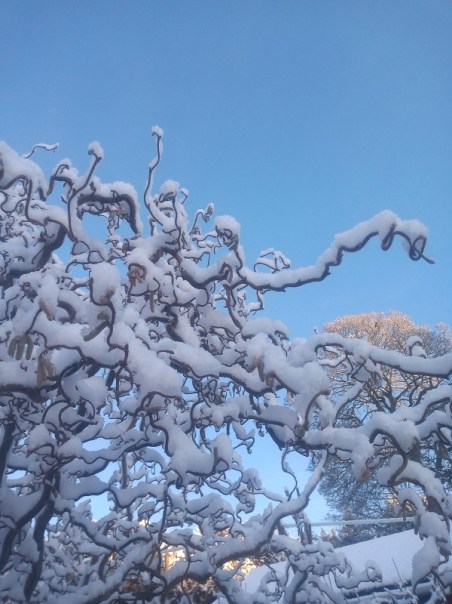
For days now, maybe weeks,
Snow has been coming and going.
Not letting go, not quite in control,
Like the viruses keeping us all on edge.
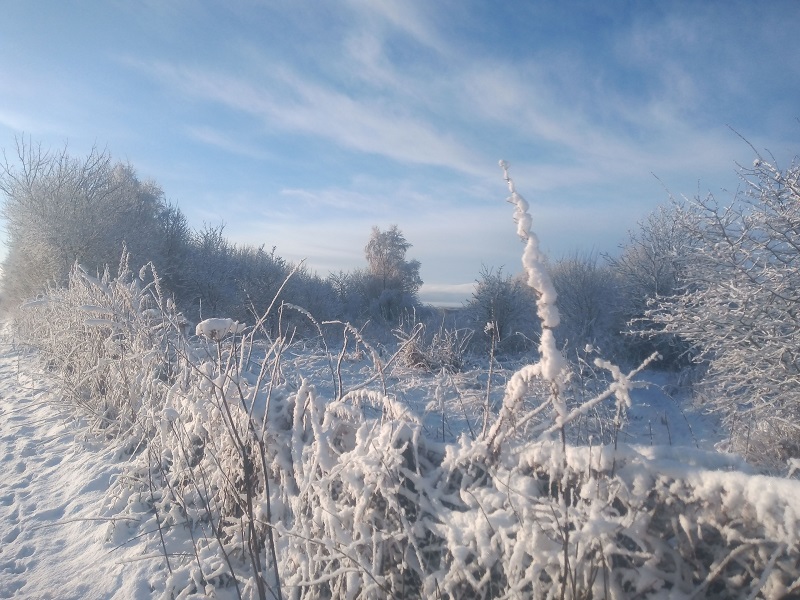
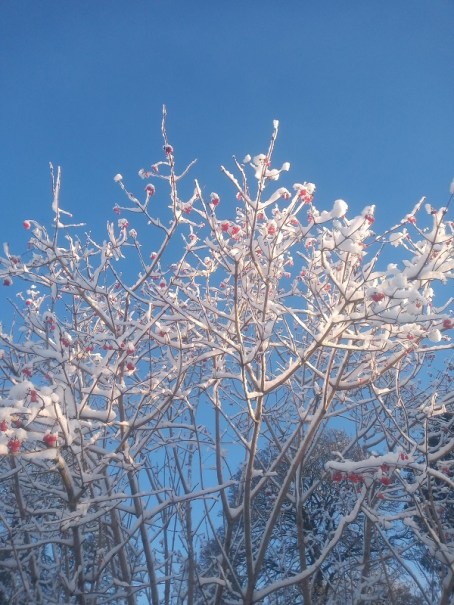
It lies poised on grasses and winter berries,
Between water and ice, catching rainbows,
Sliding off roofs, dissolving under footfall.

snow3

If this were January, we say,
We’d know what we were in for.
The snow would lie, intransigent,
Till we’re sick of it and grow bitter-eyed,
Nonchalant in our cars on frozen roads.

snowhazel

We don’t know what to expect, now,
Of weather. Of self-styled leaders, we expect the worst.
They rarely disappoint.
We, in stone houses with no ambient warmth,
Switch off the odd light,
Turn down the sinful boiler,
Shiver in extra jumpers, even though
We know we’re alone, while off they fly
In chartered jets: to gorge and gabble and guzzle,
And trade in carbon neutral bullshit.

snow guelderrose

Snow melts,
But rides in again on wild winds
To lie, and freeze, and then trickle away
In the unforgiving sun. And we
Must rise, and gather storms around us
Like blankets. Walk out, speak out
And keep on, and on, regardless.

A Dear, Green Place

qpcampsies1

I wake up under the ridiculously high ceiling of my daughter’s flat in Govanhill (honestly, you could fit a whole other floor between me and that ceiling), and it’s that not unheard-of, but always slightly surprising thing: a Fine Day. In January. In Glasgow.

So I go down to Queen’s Park under the low sun, and join all the people, taking shortcuts to Shawlands or Battlefield, grimly jogging, exercising a cacophony of canines, or gathering to hold deep discussions on the slithery paths where the morning’s frost has turned to melting ice.

I look for wildlife. There’s plenty, but until you tune in, you’d think it was all rainbow-hued, pouting pigeons intent on fornication and the many opportunist members of the crow family. Magpies bustle under municipal shrubs and into rampant ivy (arguably the park’s most significant contribution to wildlife habitat), and busy themselves with piles of beech leaves, pretending to have a purpose.

qpivytrees    qpcrows1

Crows loiter in trees with intent, fingering – or beaking – sticks and twigs, considering their suitability for Lovenest 2020.

I skirt the wildlife pond, where coots, moorhens, mallard and the remaining cygnets of the Mute Swans entertain small children. Up a green slope, and a sunken track, so deep in mud and the soggy consequences of the previous weekend’s torrential rain that had some of us dancing in puddles, it could double as a Devonshire hollow road. Fallen trees accrue fungi and insects; Queen’s Park here has shed its Paxton municipality.

qpgreenlane      qpgreenlane2

In the wilder, scarcely managed woodland, I hear birdsong – the noisy robin, the piping and sawing of blue and great tits. I know there are long-tailed tits – they visit my son’s bird feeders – but they taunt me shrilly, staying out of sight. A treecreeper works her way up a lime tree trunk. Dunnocks and wrens flit, silent and absorbed. Huddled among the trees on the Camp Hill slopes, the Queen’s Park Allotments make a city within a city, a shanty town of sheds and frames and variously glazed or translucent edifices where lush crops are started early by proper gardeners, and foxes – I can smell them -.find food and sanctuary.

qpfort camp

Higher, and I reach the Iron Age fort that crowns the hill, where grey squirrels scamper among the beech-mast, and humans have lived for centuries. The big stones in the middle of the ramparts may be what’s left of the Camp that named the Hill – during the Battle of Langside in 1568, famously lost by Mary Queen of Scots’ army and which sent her to to seek, and not find, refuge in England. But Glasgow named the park for her.

qpwassailed3

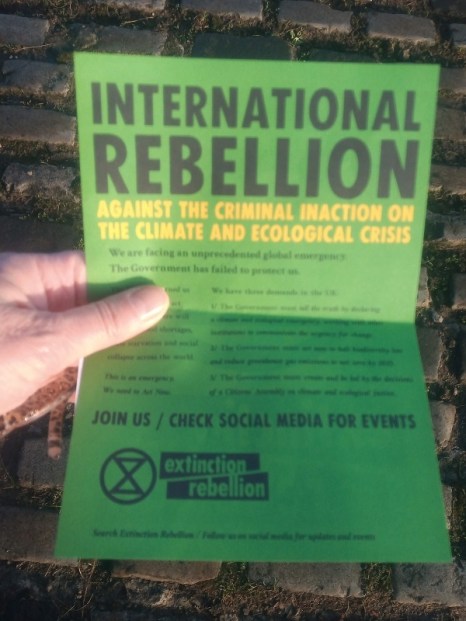
A grove of young fruit trees just below the viewpoint with its flagpole are decorated with dark tartan ribbons, the remnants of last year’s wassailing. I wonder if they will get wassailed this year. The Philosophists of the Flagpole converse earnestly, perched on the backs of the frost-wet seats. Someone hands me a leaflet. It is from Extinction Rebellion.

qpXR

The day before, Glasgow City Council had announced its intention to be carbon-neutral by 2030, despite the challenges of its transport system and heating those high-ceilinged, big-windowed tenements. That’s 15 years before the target set by the Scottish Government. Will they do it? They will give it their best shot, and count the benefits before the costs. XR will say there’s no choice.

qpchimney

We look out over this beautiful city, this dear, green place, bounded and made human-scale by its surrounding hills, dotted with parks and humming with energy that comes from its people. Smoke gushes from a single factory – I think its the brewery opposite Glasgow Green – and a motorway crashes through. They’ll need to sort that. I think, that if anywhere can do it, Glasgow will.

qp1


The Bluebell Wood in Winter

bluebell8

We’ve always felt a sense of ownership of our local bluebell wood. It’s the place we take visitors, a secret to share with loved friends and relations. Over the years, it’s become quite renowned, at least in May, when the ancient oak woodland is carpeted with bluebells. People have always flocked to it then, to capture images on camera, to bring children and grandchildren, or just to stare in amazement, breathing in the scent of bluebells that stretch far and wide.

bluebell4

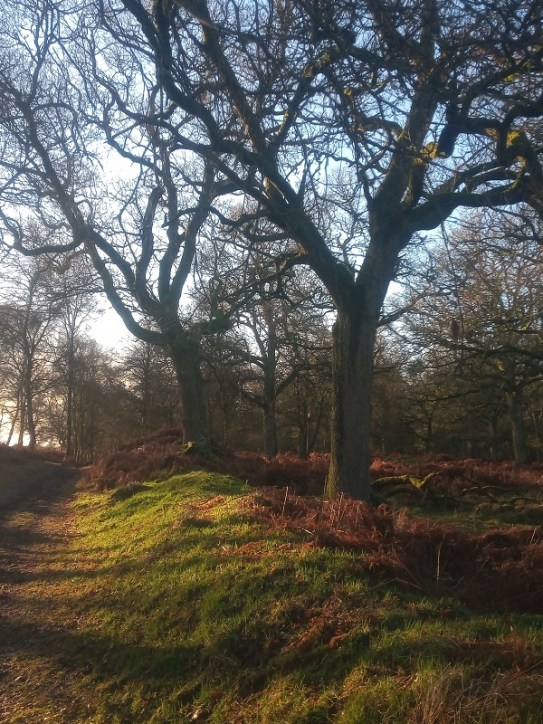
Maybe not so picturesque, but it’s equally magical in other seasons: when the bracken grows up fresh and green, or in its autumn gold, and in winter, when the silence is tangible, the bracken is tawny-brown and the shoots of bluebells lie just below the soil.

bluebell1
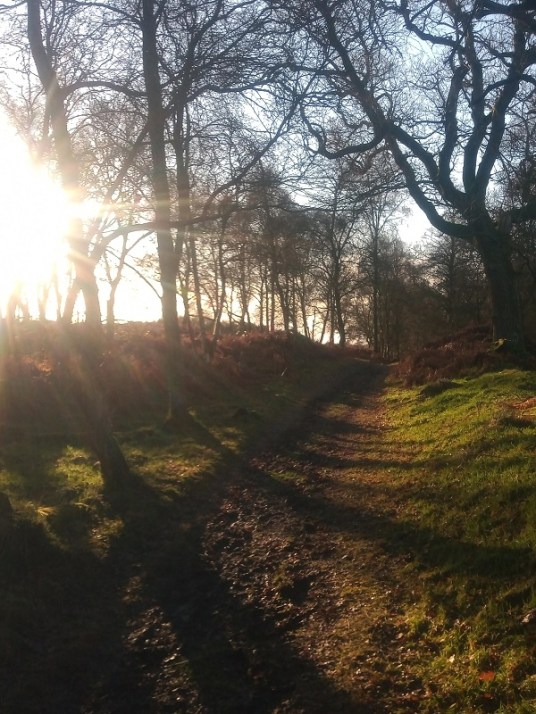
The sun is low and carries no warmth; it pierces the sweet sculpture of bare branches and paints the carpet of mosses under the fir trees with iridescent green and gold. It lights up the crumpled and disordered fern fronds as if with fire.

bluebell5

Every oak tree is adamantine and statuesque, posing in naked dignity. The scattered ancient, crumbling beeches also look invulnerable – but that’s an illusion. Every so often, one of them keels over or dumps half a split trunk. Dark, ponderous yew trees here and there are enigmatic about life and death.

bluebell6

At the top of the rise, my favourite tree is a multi-stemmed silver birch, which stands against the sky as if it were painted there. For me, this is Stephen Hawking’s tree. I was on my way up that hill in March 2018 when I heard that he’d died. I sat by the tree and digested the news, sad, but making a mental salute to a brilliant mind. I don’t have many heroes, but Professor Hawking was probably one.

bluebell7

A few years ago, the landowners put the bluebell wood up for sale. That’s when all the folk who’d felt ownership and connection came out of the woodwork. Suppose it was bought by someone who respected neither its status as ancient woodland, nor the long-established right of access? In the end, although a community buy-out would have seemed fitting,  it was bought by the Woodland Trust, thanks to a fortuitous legacy. Sighs of relief were followed by the formation of an enthusiastic volunteer group.

bluebell3

There have been changes, of course. Re-routing of paths to avoid visitors being knocked out by a falling beech branch, a hard line on invasive non-native species that threatened to engulf the bluebells themselves, the eviction of the deer from inside the deer fences to permit oak tree regeneration are just some examples. A car park – inevitable, perhaps, but no ornament… but at least it’s been surrounded by fruit trees.

And a massive planting project of new trees in the adjacent fields that formed part of the sale – thousand of trees, safely behind new deer fencing but accessible via solid gates. Work in spades for the volunteers, for years to come.

bluebell2

It’s rhododendron-bashing day tomorrow.

A Conversation with Winter

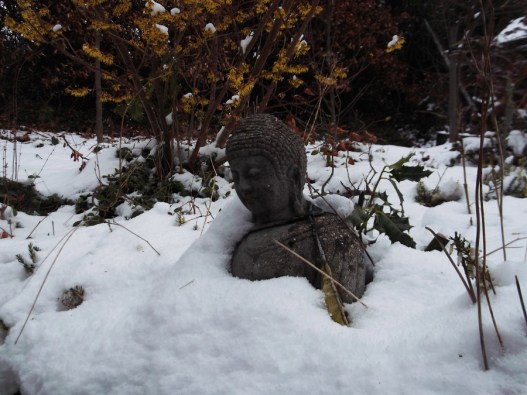
snowbuddha1

What happens now? I asked of Winter.
There is no heat in the sun’s rays. Trees are naked.
Fierce winds carry shards of ice. The voices I strain to hear
Are silent forever now. What’s the script?
What am I meant to do?

Winter, with a scarce-felt fracturing of frost,
Smiles a chill smile, whispers in the wind:
There is nothing you are meant to do. Who knows
How things will be? Be still. Wait.

But I am cold to the bone.
Silence echoes around me.
I chase cold sunbeams,
Look for gold in rainbows and find none.
How will I out-run the freezing of my heart?

I do not know, says Winter,
But I’ll be with you when
You go down to those cold corners
Where under snow and frozen soil
Quiet fermenting and slow gestation
Tick by unperceived;
Where in water beneath the ice, life softens,
Grows drowsy,
Where transformation is incremental
(Too slow to see, too distant to hear)
And seeds swell, shape-shift and shrug off
Chains of dormancy, shattered by cold,
And all is movement in stillness.

See the fire igniting in the ice?
This is not the time of dying.
It is un-reckoned with beginnings.
What happens now? I cannot tell you.
But I will warm you while we wait.

winter1


The Passing of Winter

The winter solstice bonfire wouldn’t light, at first. fire1

Days of heavy rain had soaked the pile, even though it had been cut months ago and the wood was dry enough inside. And much of it was elder, cut back from the hedge and reluctant to catch.

It smouldered, there was smoke, a few sparks, a sad crackle. More paper, more matches, noises of discontent and futility: “it’s too wet, it’s the wrong wood, there’s too much air, there’s not enough air, it’s too late, it’s too dark….”

Three fire witches emerge, with a lighter and boards of something rigid and corrugated. After a judicious dissection and re-formation of a corner of the giant smoky tepee of lank vegetation, and the application of a lighter, the fire-witches address the heap with repeated sweeping bowing gestures, wielding the boards to fan the fire.

fire2The fire catches. It spreads through the pile. Over the tracery of sycamore against the night sky, the smoke billows white and tenuous into the dank, chilly air of midwinter. Brilliant flames shoot skyward. The year, this year which promised and gave so much loss and so much gain, turns slowly, creaking out its bewildering, blistering, beguiling existence through the night, as the fire burns steadily, in spite of the wet, unsuitable fuel.

fire3It burned on through the following  day as well. I tended its last hour as dusk fell, turning in the straggling twigs and prodding the embers buried in the ash back to life. I watched the light fade, and soft rain start to fall, suppressing anxiety as I waited for children to arrive for Christmas, heart aching. And though no returning light is yet discernable in these misty, damp days and nights, for sure the year has turned.

Yule, Christmas, Solstice, New Year…….here’s wishing you all the best. May all beings be happy and at peace.

fire4