A Shadow Crossed my Window…

So today is Samhain. A Celtic festival to mark the end of summer, and the important transition between two parts of nature’s cycle. Because it is a cycle, it’s hard to know if its an ending or a beginning, both, or neither. But it’s a turning. mentally and physically, seen in the falling leaves and the settling of seed, heard in the song of the robin and the wild geese, smelt in the richness of fungal mould and felt in the night chilling of the air. We move with the season, from one place to another.

It’s also called Hallowe’en, or All Hallows Eve, and marks another transition, between the world of matter and the world of spirit. Some corners of the Earth are known as “thin” places. Some of the Hebridean islands are very thin. You go there, and time slows, the present meets past and future, you see things you’d never notice usually. You react in a different way. Hard to describe, but it’s like another world is almost tangible, separated from this by a filmy veil. Go there. You’ll get it. Well, at Samhain, that veil allegedly gets thinner everywhere, and people see things they didn’t know were there.

I’m not talking about plastic skeletons and vampire costumes and all that crap. The only vampires at Hallowe’en are the retail gluttons out to make a killing out of gullible, competitive parents intimidated by their offspring. Neither am I talking either about the demonisation and demeaning of innocent wise people (women mostly) into caricatures to hang in your window. Jamie Sixt of Scotland (James I of England) has a lot to answer for. And I’m certainly not interested in who has the biggest pumpkin! But yes, I am up for a good ghost story…..

Not, thanks very much, those overblown, ludicrous, gory “horror” stories that just make me laugh or go back to a good book. I like the kind which are incomplete, lack a dénouement, are based on real experience, and for which it’s perfectly possible to find a rational explanation…. And yet…. There was the “haunted house” in Cornwall my family rented when I was 4 years old. All I truly remember was being terrified by strange noises coming from behind the wall, and not being able to sleep. A damp, underheated holiday home is highly likely to house rats, bats or other beasties in its cavities, who moved about at night. The tapping on the bedroom window my sister heard could be explained by an overactive teenaged imagination. The footsteps approaching the back door when no-one was there may have had something to do with my mother’s penchant for telling a good story. And we’ll never know now if, that morning when we came downstairs to find all the furniture moved about, my father had been up in the night playing a never-admitted scary joke on us. And yet….

And there’s our “ghost” here at the cottage we’ve lived in for over 22 years. I used to see it a lot, but it’s been quiet the last couple of years. Avoiding Covid, no doubt. Just a figure, quickly scuttling along past the kitchen window, glimpsed out of the corner of your eye. Never does anything else, never knocks or makes any sound and never inside the house. It isn’t remotely scary. I never mentioned it to anyone for years, and then one day I started as usual as it went by and Andrew, sat in the kitchen with me, said, “Oh, was that her again?” Andrew is the most resistant and sceptical person I know who scoffs at anything remotely “supernatural” (while being secretly scared!), but he “sees” the figure as distinctly female, head covered in a shawl. “Like the Scottish Widows advert”, he says.

Easily explained! any one of a number of “tricks of the light”. I tried to pin it to our reflection in the glass when the kitchen light is on, and yet it appears in broad daylight when there’s no reflection as well. Anyway, we have missed it/her in this period of absence, though we both saw her one afternoon last week. Maybe tonight, when the veil thins, and the world turns……?
Not for Eating. Nor Collecting

There are different kinds of walks-with-mushrooms. My first, fifty years ago, were cataloguing walks, an academic exercise that became an obsession. A specimen of each would be removed and bagged (no smartphones then, and my Kodak Instamatic didn’t really cut the mustard, though I did try), taken home, pored over for hours to try to identify it, and then a spore print taken.  This was all in the cause of a college Rural Studies project that I somehow never grew out of.

When I began to differentiate the ones I could eat from the poisonous ones, foraging AND cataloguing walks happened – a basket for the ones I knew I could eat, and another for the unknowns. Many remained – and remain – unknown, something which used to really bother me. However much later when I was regularly leading foraging walks, I realised that so long as I could recognise the “edible and good” fungi and the poisonous and dodgy ones, most people were happy if we could pin the “small brown jobs” down as far as a genus.

I still take huge interest in identifying weird or remarkable specimens that I’ve never seen before, but these days I’ve discovered the pleasure of walks-with-no-purpose-with mushrooms. This walk, meandering along the River Tay from Dunkeld, had no particular object but to be captivated by the surprise and beauty of the fungal kingdom – so often misrepresented, under-valued, the importance of which is not understood by the majority of humans.

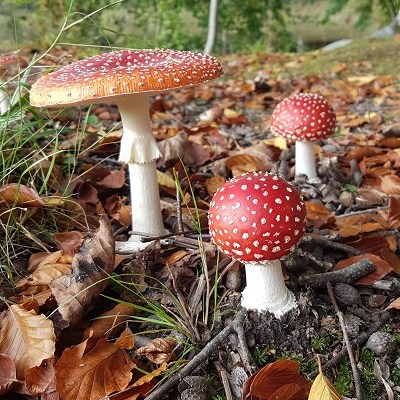
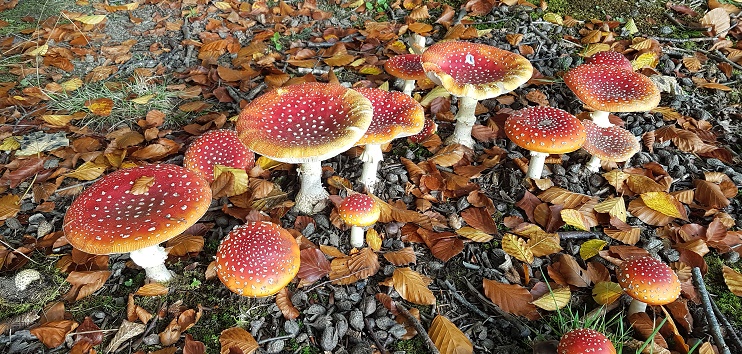
First came a phenomenal display of Fly Agarics, the mushroom of the shamans, too exquisite to pass by, shouting their wares, nestling in ground which was once birchwood. Their mycelium is always entangled with the roots of birch; from the beginnings of plants on dry land they have needed each other. They start as big white crusty buttons, the red skin of the cap breaking through the veil to leave those fairly-tale white “spots”. The cap expands, the spores fall. One was nearly as big as my head.

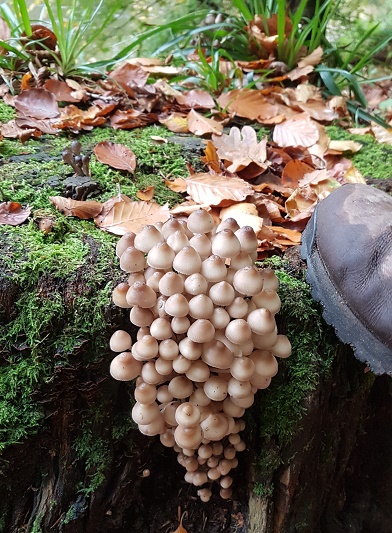
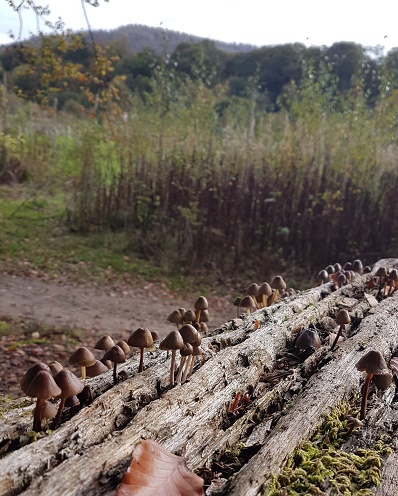
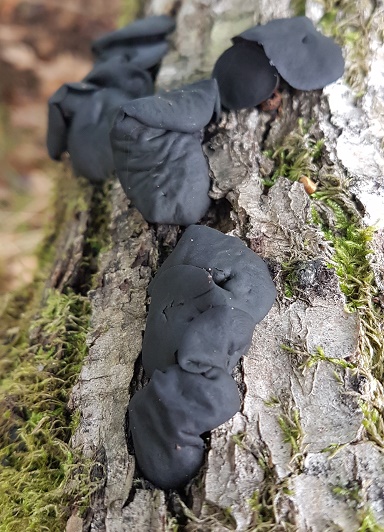
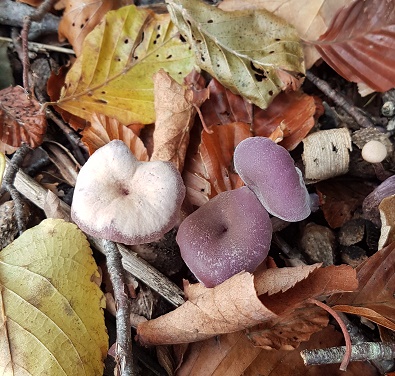
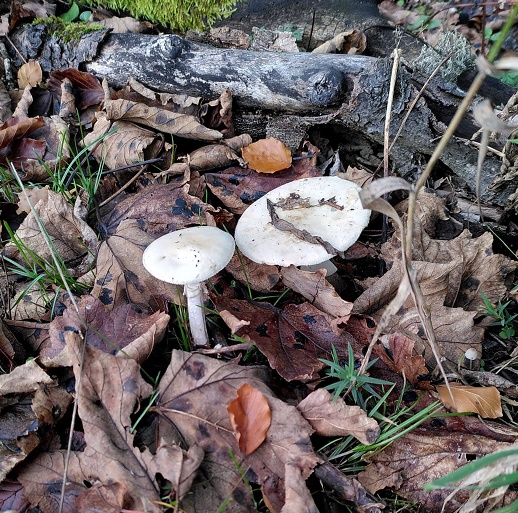
Troops of Bonnet mushrooms, various types, marched over fallen trees and gossiped in crevices of stumps, glistening in the sunlight. Shiny black excrescences of Witch’s Butter erupted from dead wood. Amethyst Deceivers – which I could have picked for eating but didn’t – showed all their colour range from vivid purple to washed-out grey. In the leaf-litter, the Destroying Angel, related to the Fly Agaric but far more deadly, glowed purest white. Such a potent name for a poisonous mushroom!

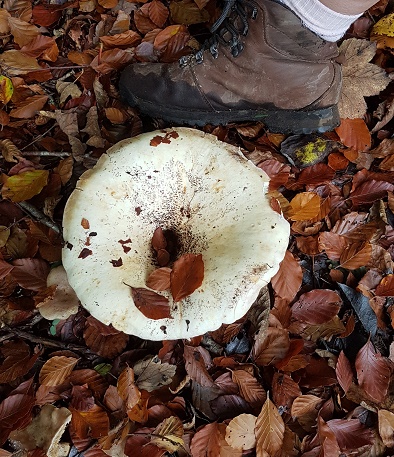
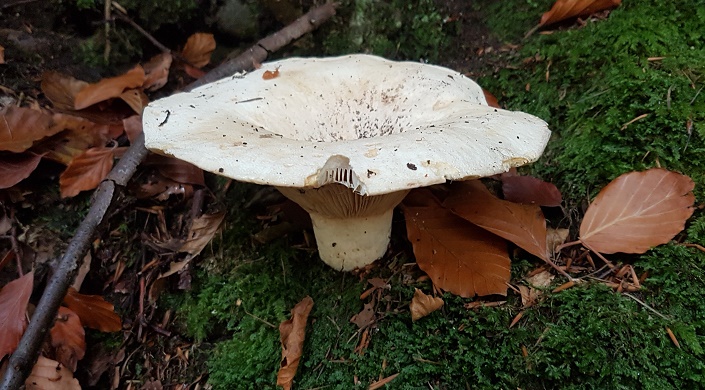
Giant Funnel Cap (Clitocybe gigantea)

Across the track lay a small segment of a huge fairy ring of an enormous mushroom commonly called the Giant Funnel Cap (check the size 8 boot in the photo for scale). This took me immediately back to those student Rural Studies Days, when I first saw this mushroom in local woods, in a ring that was actually measurable. From the fresh fruiting bodies came a strange, un-mushroomy smell. I took one home, identified it easily and, as the book said edible, fried it in slices. It tasted like its smell – like nothing I’d ever encountered. To this day, I’m still trying to work out if I actually like it! But size-wise, they are easy pickings, and it’s fun to estimate the equally astounding diameter of their fairy-rings and plough through the woods to try to find the mushrooms on the other side of it.

This walk wasn’t for foraging, for worrying about what I was looking at, and I haven’t bothered to tease apart the various fairy bonnets. Old habits die hard, but really, I don’t need to know!

When you know winter is coming…

The turn of the season is felt, not so much as a drop in temperature or the way the need for warm socks and waterproofs creeps up on you, but in the way the woods smell different. Decaying leaves, leaves still on the trees but for whom decay is imminent: the smell, for me, of being 11 years old and at a new school, where our introduction to Biology was the invitation to compile a Biology Scrapbook over the course of a year. Diligently, I collected all those leaves on the point of rotting, pressed them in encyclopedia volumes, and learned, when I next opened the books to mount them, the subtle distinction between the smell of sycamore, poplar and oak leaves in autumn.

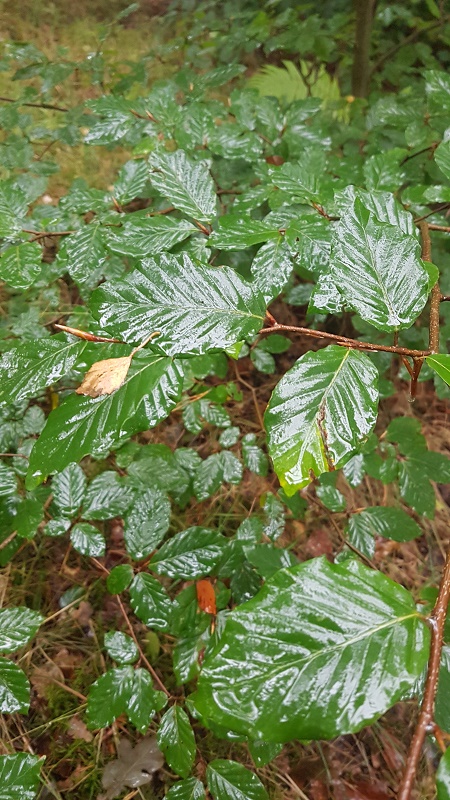
Today, a soggy Saturday in October, Five Mile Wood smells again of the Biology scrapbook. Weaving in and out of the olfactory hamper of autumn comes the odour of wet grass, heavily trodden, and the varied aromas of dozens of species of fungi, seen and unseen. It is raining, softly but insistently, the rain bringing its own subtle influence on how each smell is perceived, like a wash applied over a freshly executed painting. Beech leaves, nowhere near inclined to fall, glisten with rain. I am challenged to keep the rain from running down my neck, challenged by the chill in the air, challenged by the distraction of mushrooms, all of which breathe of magic, and the resulting lack of time that cut this walk a wee bit short.

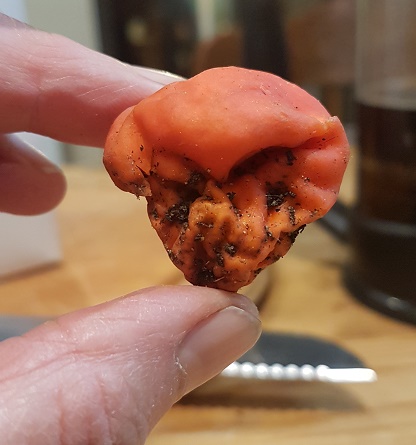
I won’t bore you with more gratuitous gloating about the basket of edible mushrooms I took home to dry or make into fungus and ale pies, nor with more photos of the ones I can identify! But today, the woods presented me with an excitingly unknown fungus, the likes of which I’d never encountered in decades of mushroom-hunting.

(Actually, the woods do that every time I go foraging, for there are many, many mushrooms I cannot differentiate. But as I know they’re not on the “edible and good” list which is tattooed into my brain, I indolently dismiss them as “small brown jobs”. Which they usually are.)

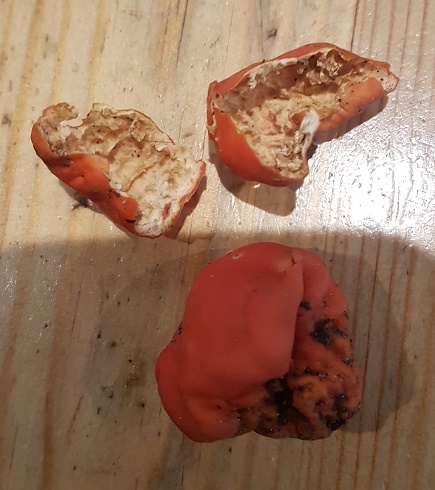
Today’s find was different, a real unknown unknown, to quote Donald Rumsfeld. Bright orange-red balls popping up through the grassy banks between the path and the ditch; I first mistook them for discarded tomatoes. But they were fungi, no question, and when I cut one open to help identify it, it was hollow, with pale coloured ribbing inside. I had never seen anything like it, but as it was so distinctive, I expected identification to be straightforward.

So far, I have not found this species in any of my books, and have drawn a blank from the social media mushroom groups from whom I begged enlightenment. Someone said they’d once seen something similar, but yellow, only got distracted by all the edible ceps nearby. Easily done! I have contacted the Tayside & Fife Fungi Group, and wait in hope. I will find out…. Perhaps someone reading this will have the name, and be laughing at my ignorance?

Inside and out….

Last Leaves Falling

A Post for West Stormont Woodland Group

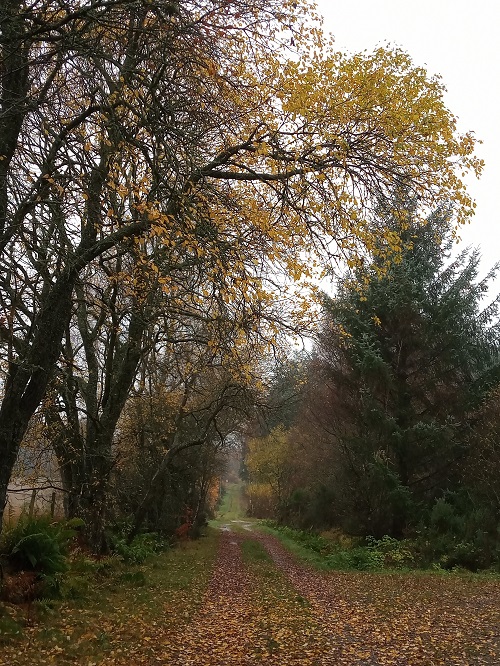
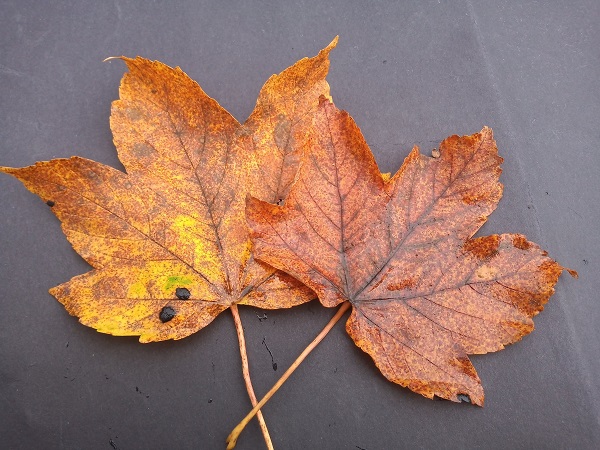
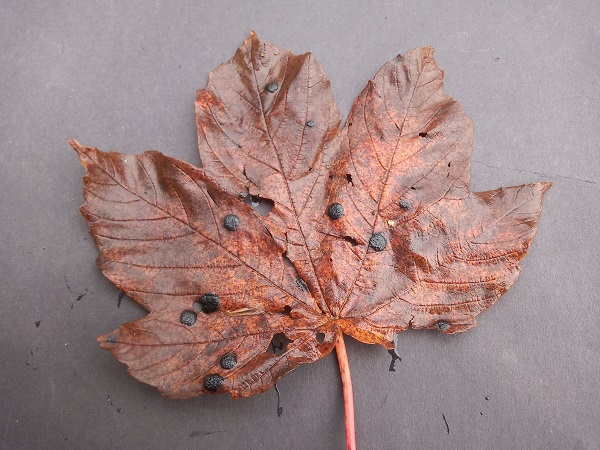
I pause on my way through the woods, quieting my breathing, keeping as still as I can. There is no sound, there is no wind. There should be no movement. Yet within the vascular systems of the broadleaved trees that bound the track, small enzyme changes are at work, invisible changes that lead to letting go, abscission, leaf-fall.

And down they come, silent, slow, like snowflakes in a still winter’s night. There is no flurry, no sound of wind through dry foliage, just the falling. Just the peace. Some trees are bare already. Birches are among the first to blaze golden and lose their leaves. Oaks keep hold of theirs till the last, but then they are usually the last to open in spring. Mature trees abscise before young ones. Young trees, and trees that have been pruned, will produce what’s known as juvenile growth, one feature of which being that the processes of leaf-fall are delayed. That’s why beech trees are so popular for hedges, the dry, crackly leaves slipping from gold to brown and staying in place till spring.

Young beeches, self-sown among the conifers at Taymount Wood’s dark heart, shine like tawny beacons.

They coat the ground, these last leaves, slick with last night’s rain and the condensing sweat of mist that loiters in motionless, tangled branches. Small sweeps of the already fallen lie around sedges and rushes, in hidden puddles and ditches. What else do they conceal?

A small brown toad lurks unmoving as the day, camouflaged among old birch leaves at the path edge. Then he moves, lopes distractedly into the grass, and is visible.

I like the emergence into visibility of the toad, and I enjoy the wood revealing its secrets as the leaves fall. The bizarre jutting side-branch of a fir tree, and the even more inexplicable branch that has fallen over it like a necktie, and somehow grown into an A shape. The filigree, waterfalling twigs of bare birch trees. The holes in trunks and large branches, the red squirrel’s aerial expressway from tree to tree. When leaves fall, I see that some trees are still richly clothed, decked in lichens and mosses so profusely you can’t see the wood, and decorated with the jewels of fruit and fungi. Food, forage and habitat here for small creatures that depend on the woods through the winter.

By the King’s Myre, the stillness of the day is magnified by the strange open vastness of this stretch of water. Reeds and trees and overhanging trees are reflected; birds are absent or silent. In the boats drawn up to the jetty, the leaves lie in rain that’s collected there, the sky bounces back, grey, metallic, motionless. There are no wafting clouds; it is all cloud, all greyness. And more leaves unhook themselves from life, drift down soberly against the small frictions of the early winter air.

On twigs and branches, wherever a leaf falls, a small tight bud, wrapped unnoticed in its winter coat, remains and waits.

Fading, Falling, Living

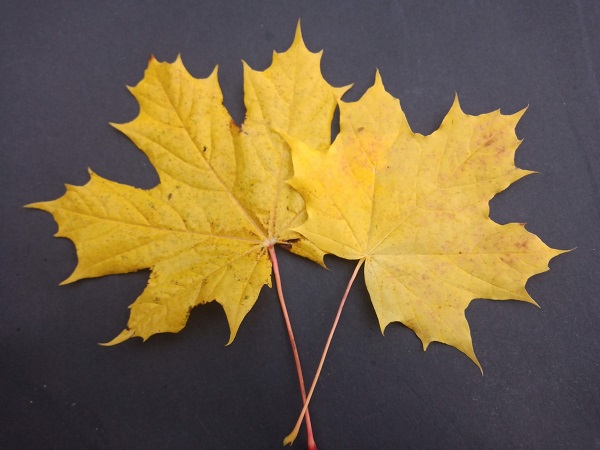
Post-abscission, clear buttercup yellow,
Glowing, brimming, laughing leaves,
Backlit by unseen candles in the soil,

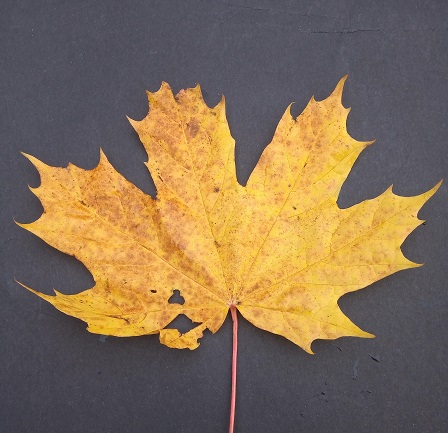
Dancing to proud chestnut speckling,
Here a tear, there a ragged edge,
Tawny shadows cluster.

Form altered, yet perfect,
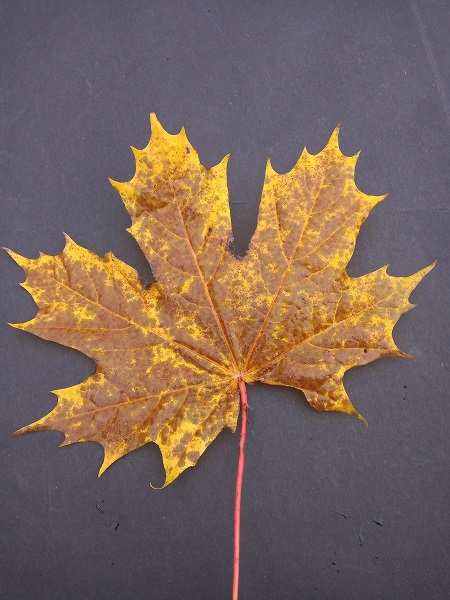
Loveliness of mottling, deep riven veins,
Clarity of soft, yellow margins.

No stage of this fading
Worth more or less than the last,
Or the next.

Burnished by rain, age spots darken,
Host to unimagined organisms.
Veins grow thin, but flow golden yet,

And when this encompassing brown darkens and crumbles,
Becomes indivisible with soil,
When nettles push back through the earth
And the chrysalis breaks apart

This, too, is living,

When Leaves Fall

leaffall3

New pictures are drawn on hillside and in hedgerow; the leaves
now start to drop away.

Trees emerge naked
– shy, hesitant, proud, unafraid, with dignity –
sculpt riots against steely skies.

Finely etched tracery of birch; yellow clouds of leaves
flutter, discarded, on winds grown icy.

leaffall1

Brown-cloaked oaks, stubbornly clinging to summer
angular knees and elbows showing through threadbare fabric.

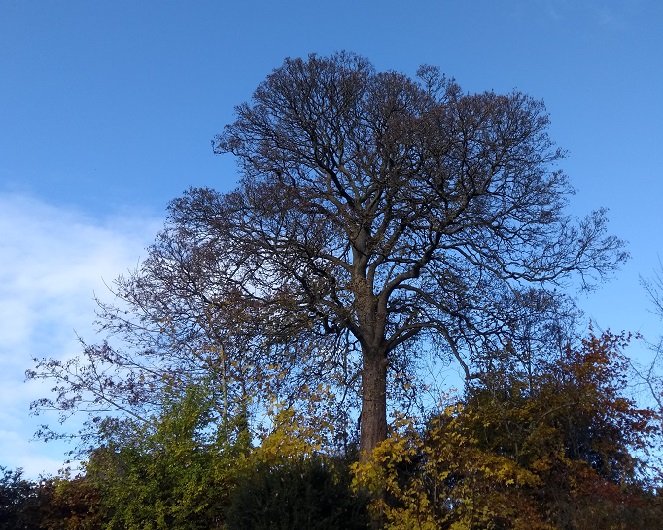
Sombre sycamores statuesque on the skyline,
Leaves already shed, yet fuzzy with progeny:
Seeds in clusters wait the November storms.

leaffall2

Needles of larch whisper away on water
Lie silent and still on forest paths.

When leaves fall
Tiny buds of spring curl dormant in leaf axils, and wait.

Winter Geese

geese

Breathing in, the air is clean and cold, that sharp tang
That preludes winter, edging around frost and ice
But not there yet.
Horizon endless, sky that translucent pale blue – a trail of smoke
Distant, wavering,
Moves towards the watcher in the field.

Earthbound, crows prod lugubriously at the stubble,
Clumsy pigeons clatter from tree to tree, voracious,
After each other. High above, the smoke separates,
Cries out exultant, forms streamers and ribbons,
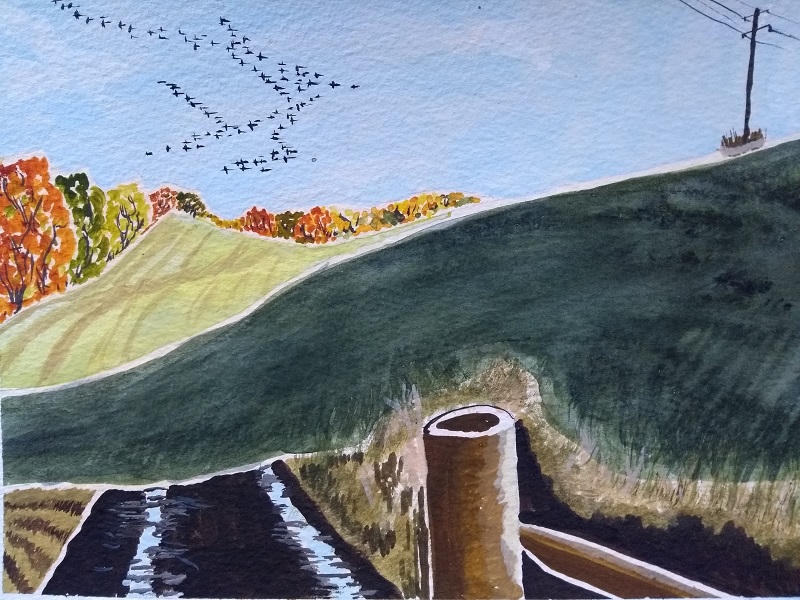
Waves in and out of formation, as the winter geese pass.

In the marshes and seawalls of Essex, long ago,
I watched through binoculars the arrival of the little Brent geese,
Who stayed with us all winter, sweeping up and down the estuaries,
Squabbling and crying for joy in multitudes in reclaimed fields.
Here, Greylags and Pink-foots (I can never tell which) mark the season:
The harvest-home, the burning leaves, the smell of turned soil.

Once a Pink-foot landed, exhausted in my garden, left behind,
Confused maybe by the demands of Goose and Gander for their breakfast.
We fed and watered her, marveled
how small she was
Against our farmyard geese. The next day she was gone,
As the morning skeins’ urgent calls measured her pace and purpose.

Solid yet ephemeral; never to be held;
An instant of joy in an ever-changing and darkening sky;
Winter geese, this moment, here and now.

The Gorse Tenement Spiders of Perthshire

“When gorse is out of flowers, kissing’s out of season,” so the saying goes.

That’s one use for this for this furiously jaggy native shrub, also known as whin, or furze. Since flowers can be found on a gorse bush in every month of the year, it’s a license for affection. A light tea from the deliciously coconut-scented flowers is another purpose; the same flowers are an ingredient in natural dyes. Sounds highly unlikely, given that horses have sensitive mouths, but allegedly the dry branches of gorse, thorns and all, are a nutritious feed for these beasts. The plant’s tendency to seed, spread and steam all over any unsuspecting tract of slightly open ground might be off-putting to the gardener, but there’s little doubt it makes a good deterrent for invaders and intruders.

Do we reckon the value of a plant only in terms of its uses to humans? Too often! A hillside bright with gorse will not only gladden the human eye, but it will provide pollen and nectar for a range of bees and other insects. A gorse bush is an ecosystem owing nothing to our interference.gorsespiders2

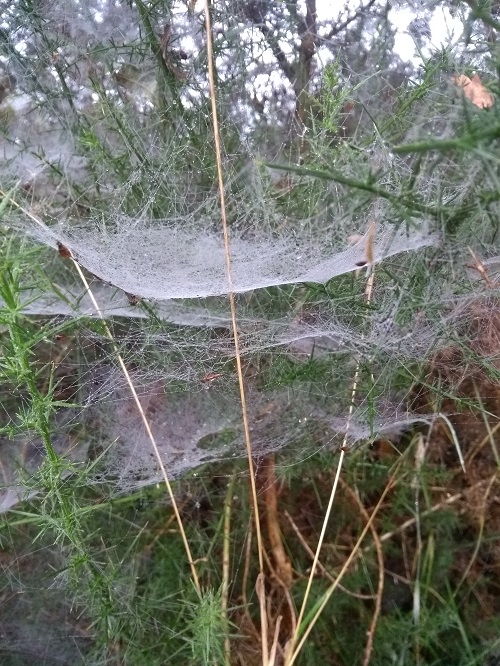
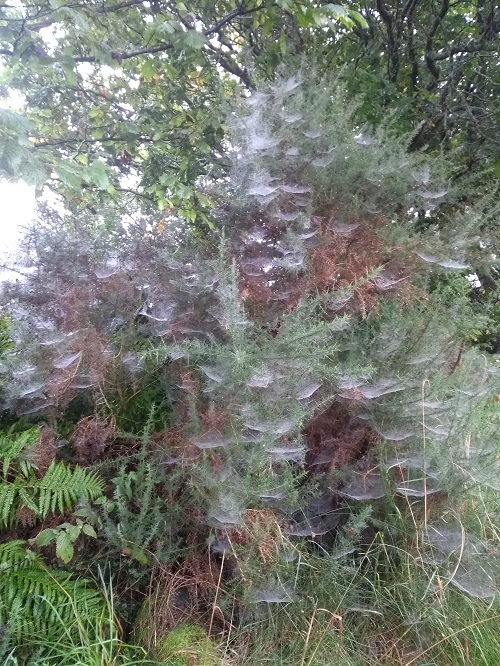
One autumn morning – the kind where damp mists hang low and the sun is watery and out of sight, I came upon the Spider Tenements. I did not see a single arachnid – nor yet a gorse flower! – but the fog condensing on the gossamer revealed each web on these gorse bushes in elaborate detail. It also revealed the happiness of spiders to rub shoulders (knees?) with one another in close proximity. If one web equals one spider, there must be hundreds on every bush. They don’t mind the jagginess; obviously it gives them lots of points for attachment of their superficially haphazard cobwebs!

gorsespiders1


I wonder how many small insects were caught on this bush today. How many webs do you think there are?

And does anyone know what kind of spider my gorse-loving, tenement-dwelling pals might be?


Midstream

river trees

In the past ten days, two friends have died. Not unexpectedly, no shocks. A couple of weeks ago, when they were both still alive, everyone and everything around me seemed painfully mortal, and this poem is what I wrote then.

I cross the bridge, but
Midstream, I stop.
So much water, passing under.
I cannot hold it back.

Midstream – upstream – a dipper,
Mischievous, concealed among stones and ripples,
Bobs, and waits.
Midstream – downstream – a fisherman
Casts and retrieves, over and over,
Silent, focused, amid swirling water.

I, too, have cast,
Over and over.
But now my line diffuses and is lost in movement
And what, now, is left to retrieve?

fiddle treeBy this great river I sit
Beneath the fiddle-tree,
A gnarled and feathered oak, gashed
By storm, decay and distant ghosts of song.
Riverbank trees, like frozen statues, arch and crane,
Their token reflections broken
Like dreams in the midstream of sleep.

On dark ripples, tiny sounds of water on water,
Midstream, the undercurrent
Chases the rain from highland to lowland
Into deeper water yet.

Midstream, unseen fish bestir
And battle homeward. But I
Am snagged, log-jammed, midstream
Watching lives flow on and vanish into river,
Slippery, elusive as salmon, impossible to hold,
Passing, on unfathomed journeys, beyond my sight

While I stand helpless and wait
Midstream.

The Morning After

unicorn mushrooms

The morning after the march I went mushrooming again. There were no mushrooms of any kind left in the fridge. I nearly didn’t bother, because I was dog tired, and, after all, I would pass at least three supermarkets in the afternoon.

But something about the air that morning was irresistible. Cool, zinging with the promise of sunshine; light, ethereal and just a little autumnal; dust motes and electrons dancing a jig. The dam and the woods and clearings energised and soothed simultaneously – an antidote to the adrenaline that had kept me up and awake till gone 2am, head birling with ideas and reflections and hope no anxiety could dampen.

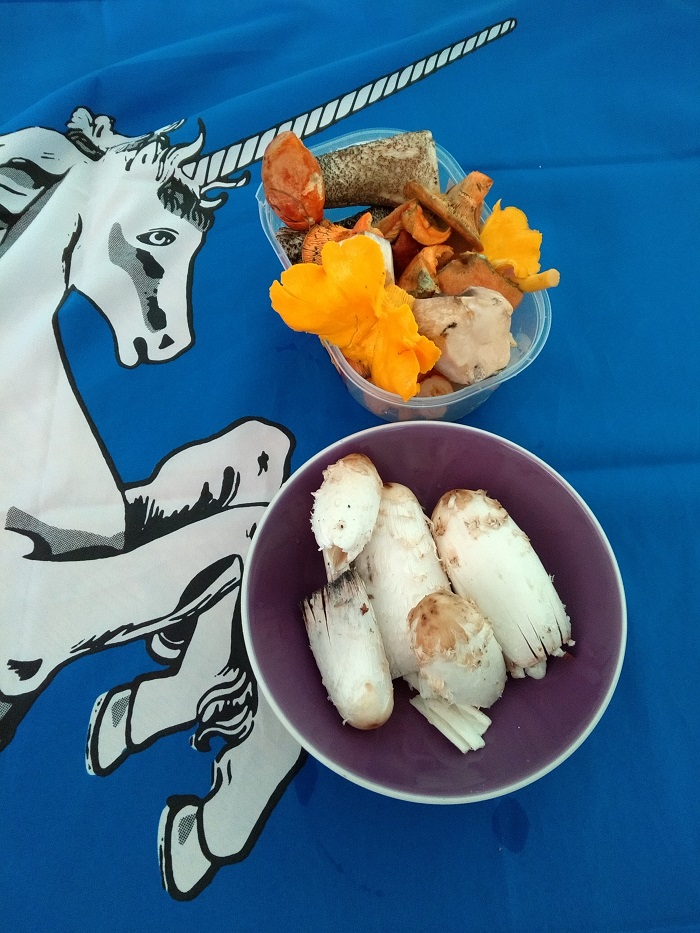
Every secret hollow, bank and bog in my regular itinerary yielded something edible. Shaggy Inkcaps standing like soldiers, Hedgehog Mushrooms like tiny undercooked loaves, spiny as urchins beneath, chunky Orange Birch Boletes that go alarmingly black when you cut the flesh but taste divine. And a few late Saffron Milk Caps, only slightly infested.

jed Rohallion

The sunny gold of Chanterelles glistened like the yolk of a happy hen’s egg. Deer came skipping coquettishly out from the wood and crossed in front of me, one of them practically pirouetting in her glee – anticipating perhaps, the rutting season nearly upon us.

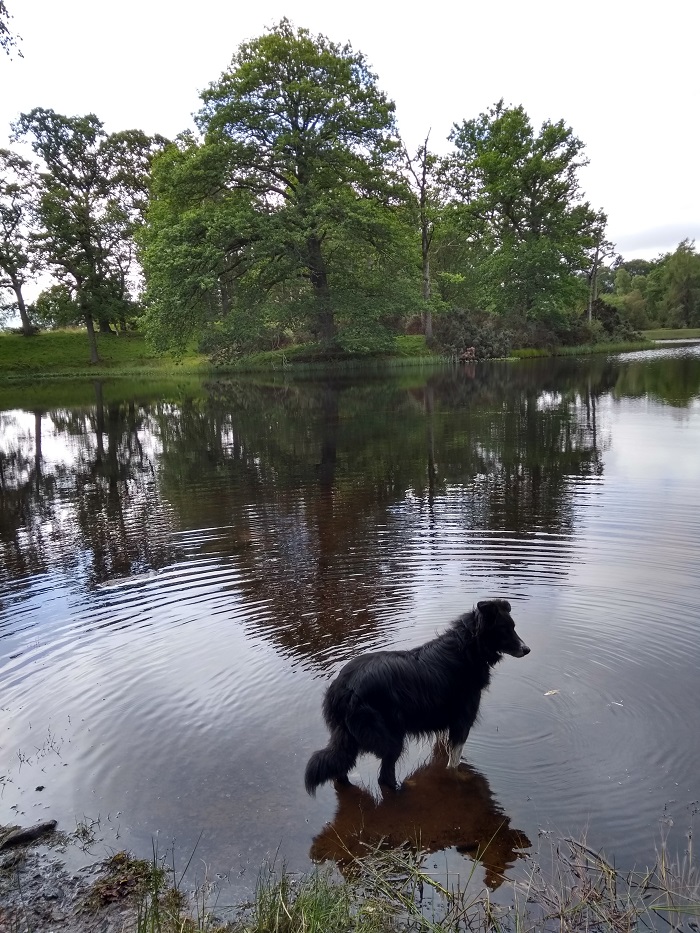
From my dog gazing lovingly at his stick floating away on the loch to the shafts of sudden sun on the ripples he makes, from the happy brown collie and his owner to the mute swans and their big grey babies – the morning after, all of Scotland seems to be smiling at me.