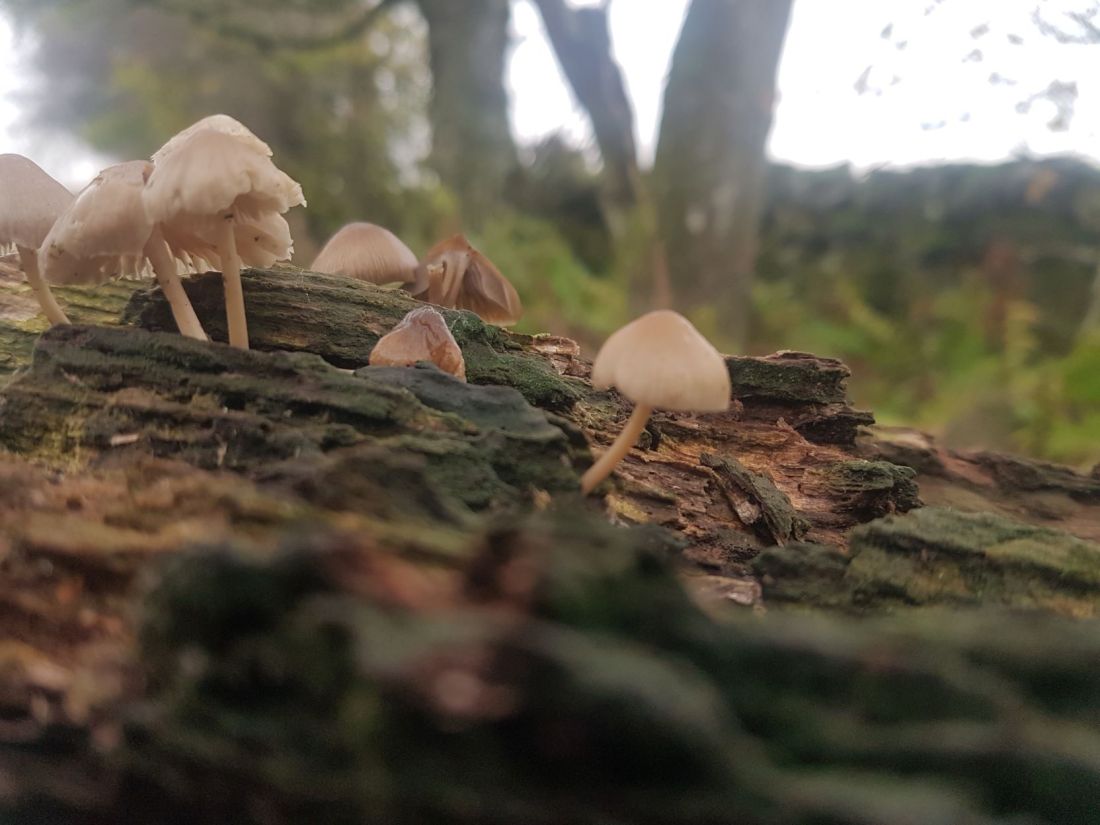
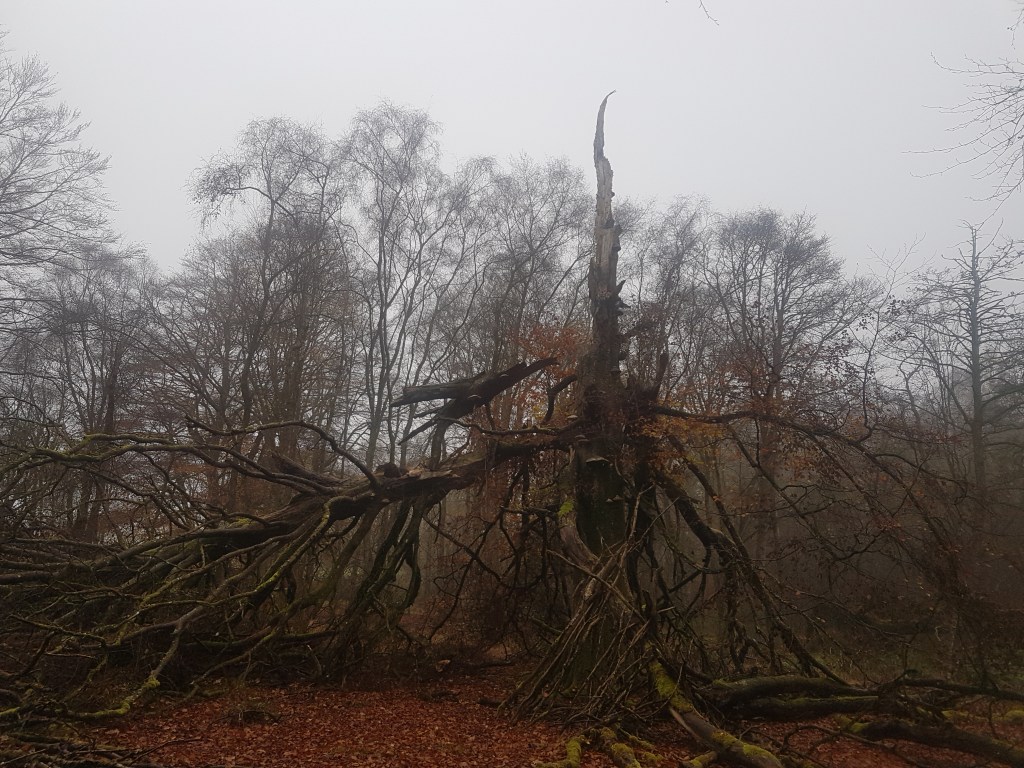
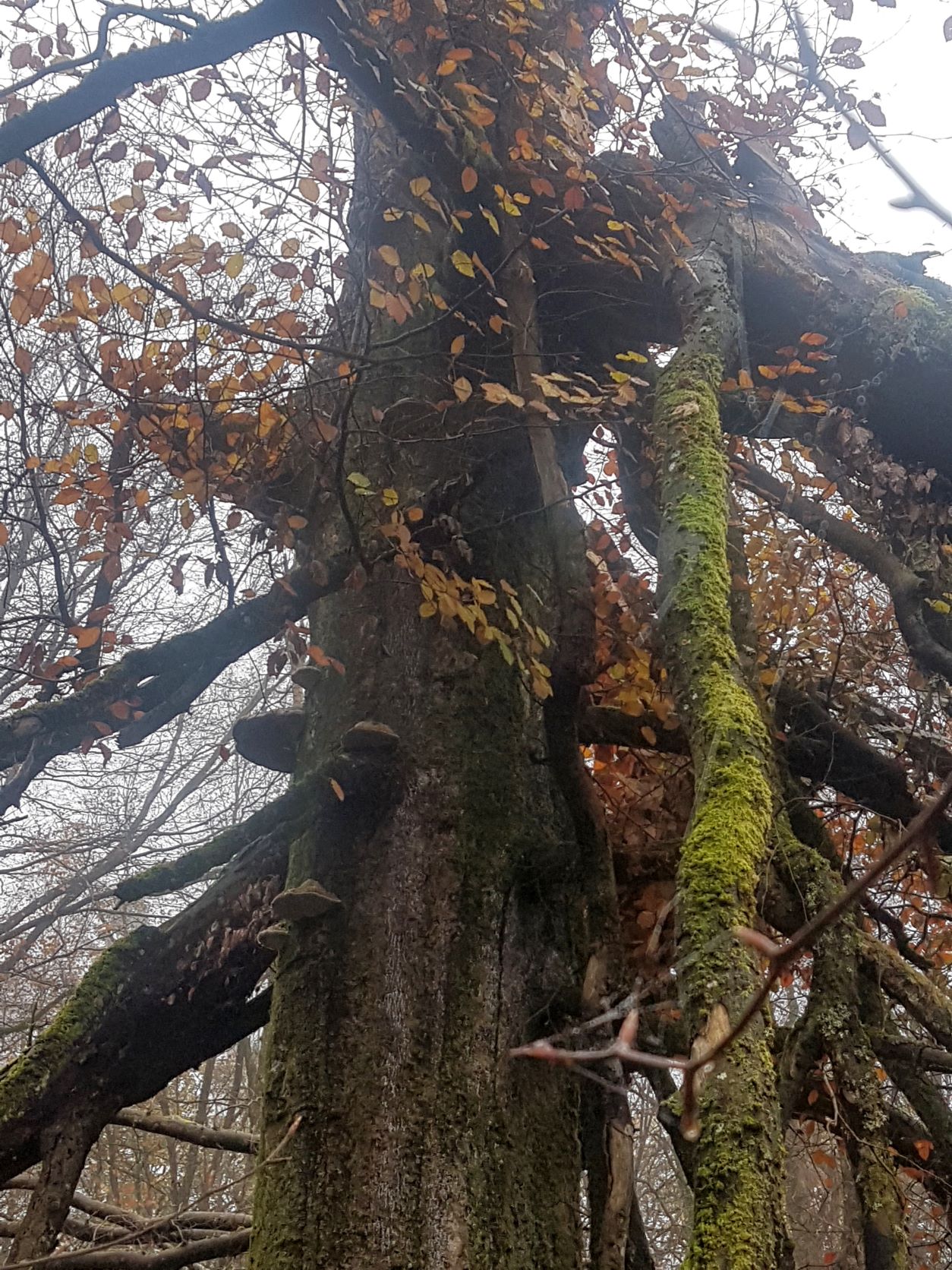
It began by shedding branches in every storm, this multi-stemmed beech tree. Being a beech, whose toxic leaf-litter successfully manages to put off any tree or shrub (even its own offspring) from growing under its canopy, there is plenty of space for the branches to lie. For a few years, it was my go-to place to harvest the beech-specific, edible, incredibly slippery Porcelain Mushroom in late autumn. This year, the fungus appears to have exploited all the suitable fallen branches and moved elsewhere.
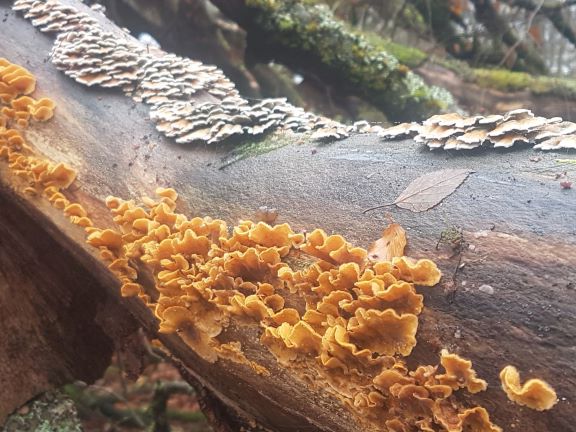
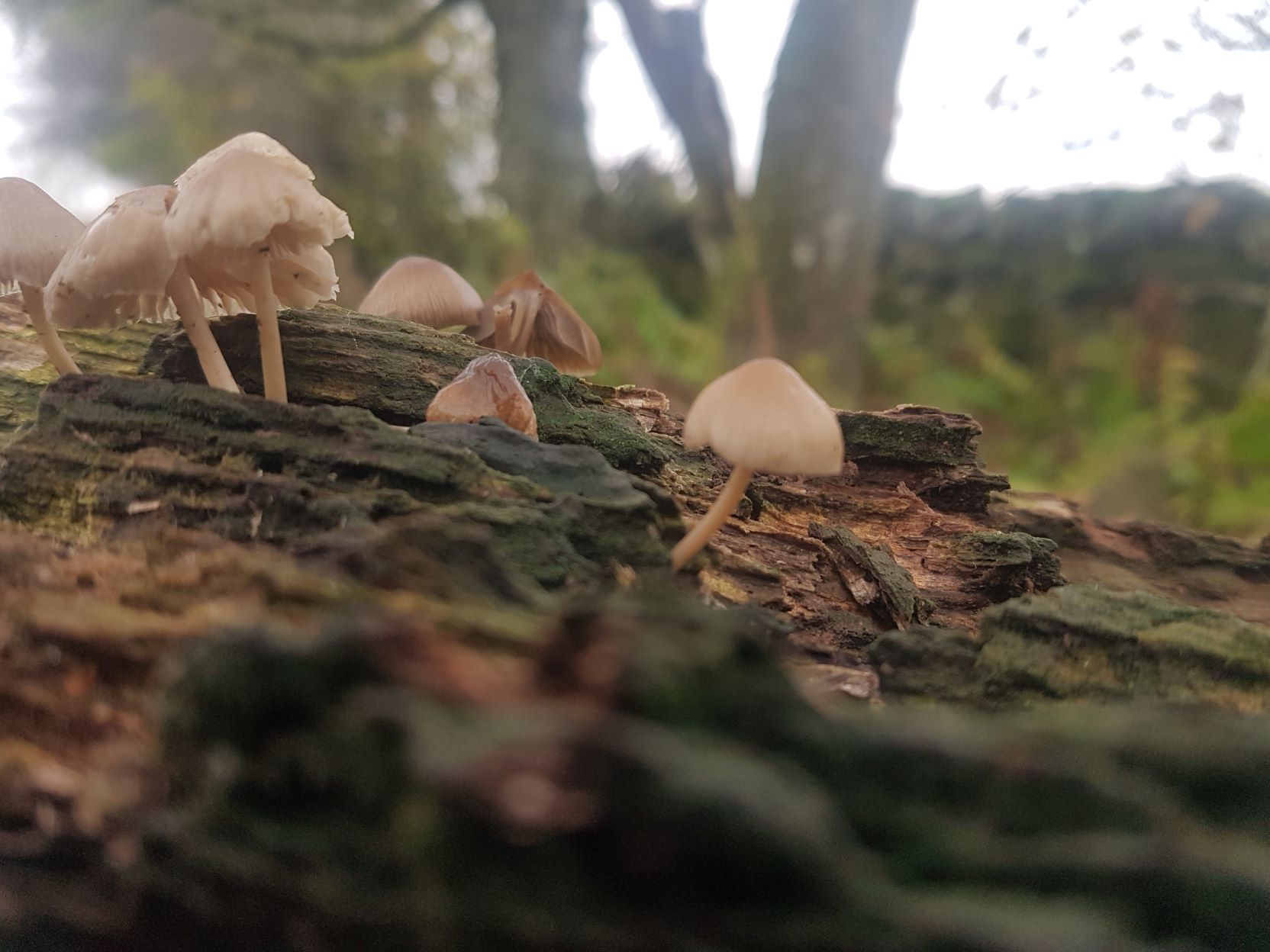
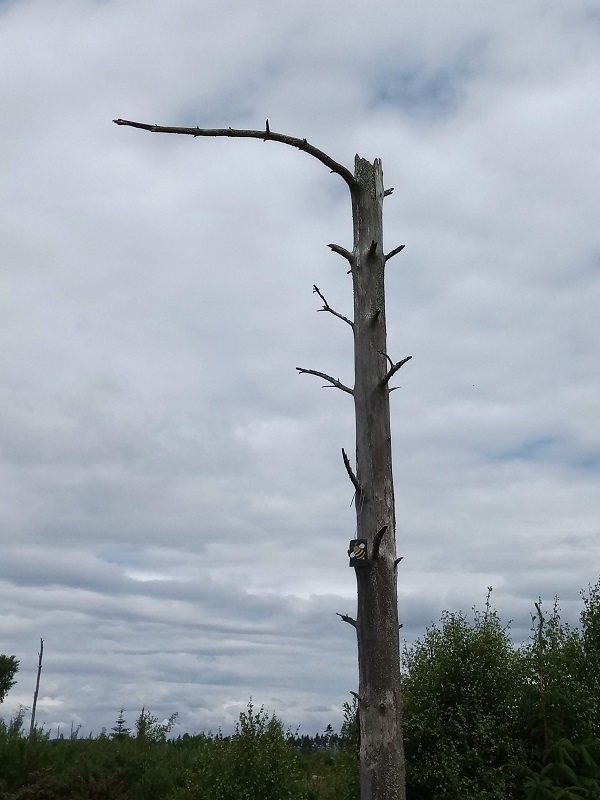
No shortage, though, or other fungi. They peer from behind the remnants of bark, congregate on dead wood, splash colour over the domain of the doomed beech tree. Now, whole trunks are falling, large brackets appear near the snaggy top of the one remaining trunk, piles of branches and fallen debris cover the ground. Meanwhile, leafy twigs still emerge from parts of the tree – it’s not dead yet!
Is a tree ever dead? Though branches crash down, timber decomposes, bark is shed, these are all the signs of a massive construction programme. The mushrooms and bacteria are building soil. The mosses, lichens, ferns and flowering plants are taking hold and creating gardens. Invertebrates in their thousands are moving in, chip-chipping away, getting in, getting under, uprooting, making a tree metropolis. Birds and small mammals home in on the seething busy-ness as if to an urban food-market, finding homes in the piled deadwood and tree-openings. Human foragers like me, and other large animals such as roe deer, visit for breakfast mushrooms. In spring, chickweed wintergreen and wood sorrel will cautiously return to woodland lighter and less toxic.
As the tree slowly, and apparently, dies, it shouts louder and louder with life,
Although I was born and grew up in a London suburb, awareness of nature was hammered into me, partly by my family, partly by primary school, where the “nature table” was obligatory in every classroom and was always piled high with artefacts, and partly by the nature books that lay around the house. It was while poring over these behind the sofa that I began to learn my flowers.
My favourite was entitled “Spring Flowers of the Woods”. To start, I relished the beautiful hand-painted illustrations, and, later, when I read that the woods were full of flowers in spring BECAUSE leaves were off the trees thus allowing light for the flowers to open and the pollinators to amble in, it was my first glimmer of ecology, and the entangled ways of nature. I came to recognise and seek those exquisite, archetypal spring flowers such as primrose, wood anemone, wood sorrel, mercury and violet.
Wood Sorrel and Violets
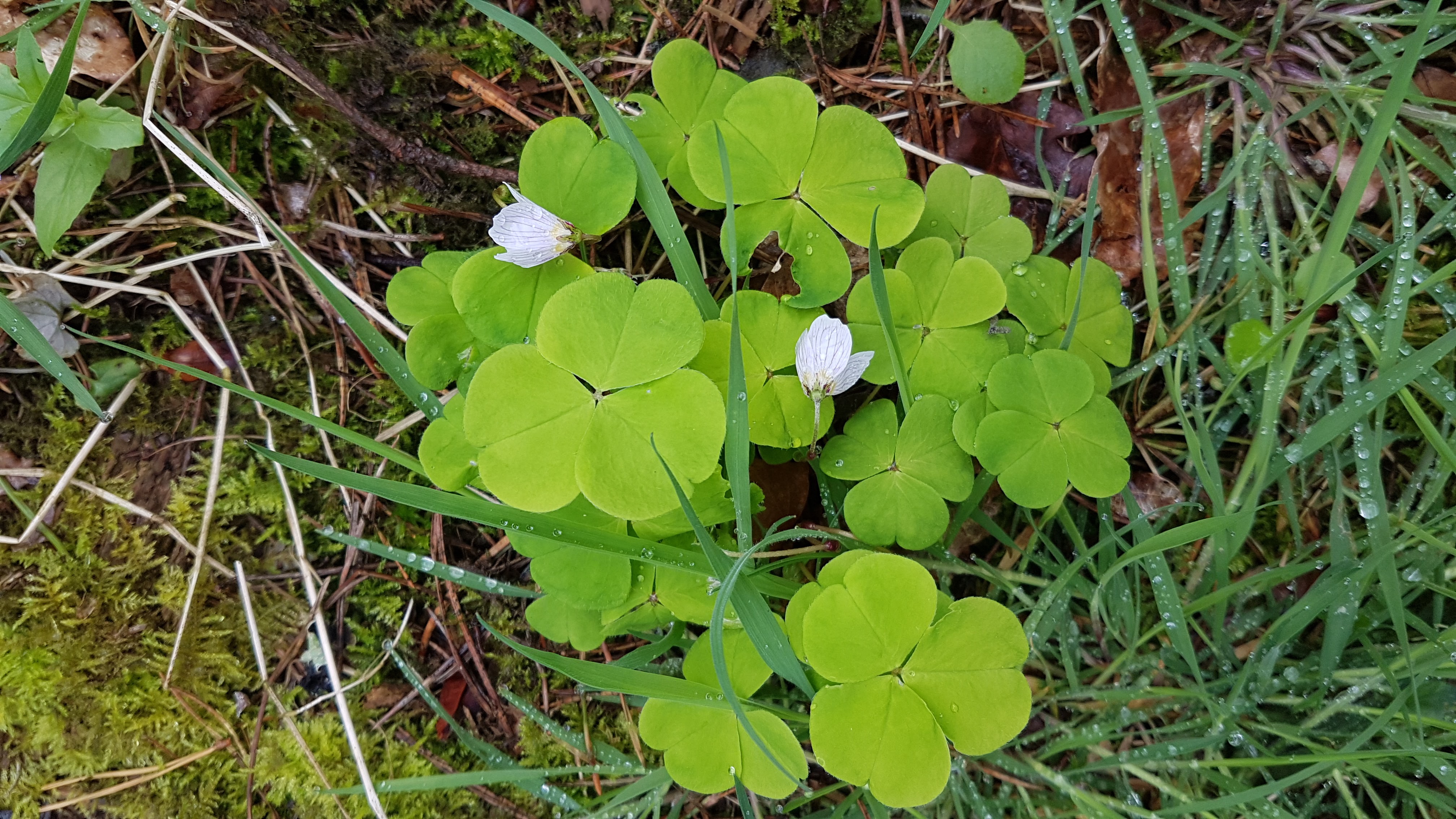
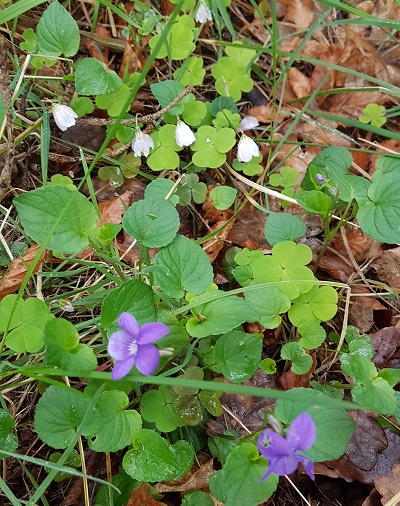
Today in Five Mile Wood, on a damp and overcast day, I greeted some of them. In the broad strip of mixed broadleaved and conifer woodland to the south, violets a-plenty sprinkled themselves over the dead leaves of birch and beech, growing on old stumps and under windthrown trunks. Sometimes they congregate with Wood Sorrel, whose edible, trifoliate leaves draped from spindly stems, and finely-veined, nodding white flowers are one of the (many) most beautiful things on earth. Wood Sorrel grows here only in scattered communities. I have the impression these colonies are networking towards each other, perhaps via the hidden telegraph of soil-fungal communication.
I have not yet found Wood Anemone here, which is surprising, but intriguingly, there is the merest germ of a bluebell wood, if you know where to look, and they are beginning to flower. (photos were horribly blurry, and I shan’t burden you with them. Everyone knows what bluebells look like.) Bluebells are said to be a sign of ancient woodland (which Five Mile probably isn’t) or at least a settled woodland ecology. I do not wish to unsettle them!
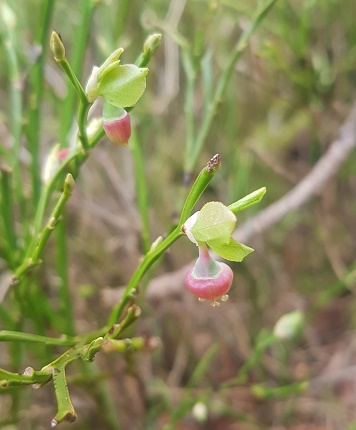
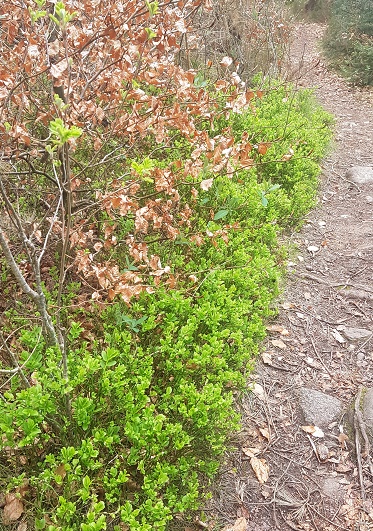
As the ground rises, that ecology morphs into something more akin to acid heath (there are certainly signs that at least part of the central area once held deep peat, signifying raised bog, perhaps). Two flowers in this habitat – not stars of “Spring Flowers of the Woods” – gave me great pleasure. One was the blaeberries that line the paths and snuggle up to trees here. They are now in hard-to-spot flower. Tiny, beautiful dull reddish bellflowers (look closely!) which will turn into the fruit of this our native blueberry and provide good walking snacks in the summer. It’s a treat to see this wild harvest crop doing so well; it was somewhat decimated by the last clear-fell. (Do we understand well enough the changes we force on a landscape by our actions? Do we care enough?)
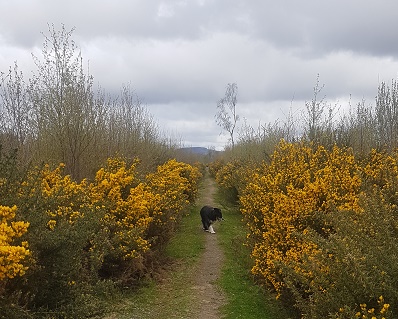
The other is gorse. I have a very soft spot for this riotous, prickly native shrub. So many plus points does it have: nitrogen fixing, baby tree protecting, wild tea providing and a redoubtable habitat for spiders (see here) among others. What’s in a few scratches? A week ago, cycling round the wood at speed (to be honest, anything over 6mph is “at speed” for me even on an electric bike), I did incur a few scratches….. but it was like moving through a mist of warm coconut, the delicious gorse flower smell made powerful by the bright sunshine and muggy air. Today, it was fainter – but thanks to the slightly unnerving vigor with which gorse is spreading across the path, I could still catch it. Divine!
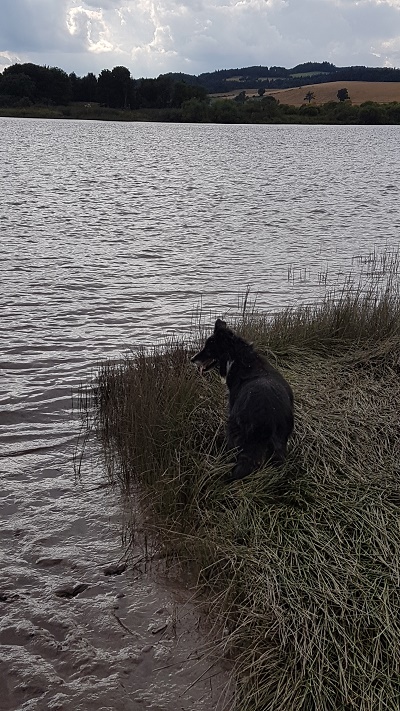
Gorse-intoxicated Border Collie
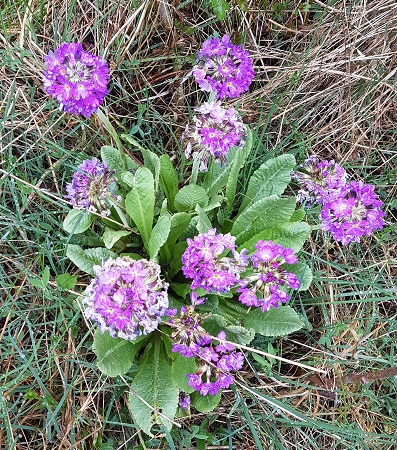
Primroses seem to be absent, as well as the wood anemones, but there was this unexpected relative – Primula denticulata, the Drumstick Primrose or, locally in Angus, the Kirrie Dumpling. Native to Himalaya, this has not, I suspect, got here on its own! If I were a hard-line ecologist, I’d uproot it (and find a home for it in a garden). I’m not, but there might be a good argument for collecting the seed before it spreads itself about. Or not?
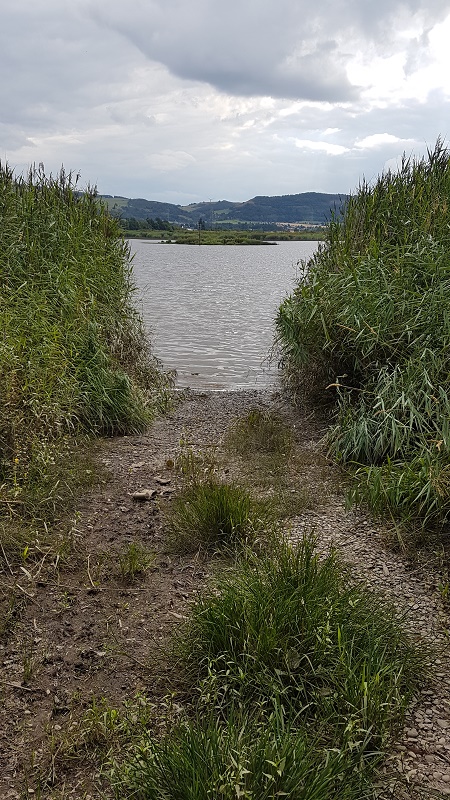
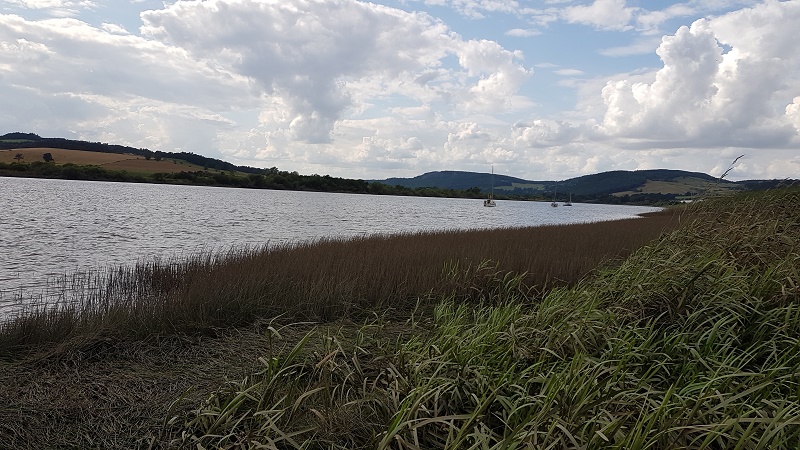
I wanted to walk from Cairnie Pier near St. Madoes west to Inchyra on the Tay estuary. My old map (old being the operative word) said there was a path, but it says that about a lot of stretches of the Tay along the Carse of Gowrie that it would be nice to walk, and it’s often mistaken. Google Maps hinted that if you got really, really close to the ground, there might even be two paths, but it wasn’t committing itself. At Cairnie, the existence of a small car park looked promising, and I found the great river hiding among its own reedbeds as usual, lapping quietly at a little inlet whose stones oozed mud. Fishermen’s paths trailed off in both directions.
Cairnie Pier
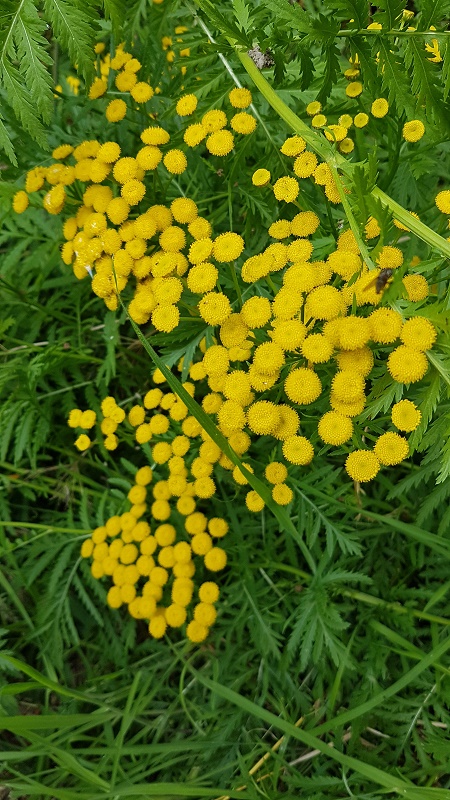
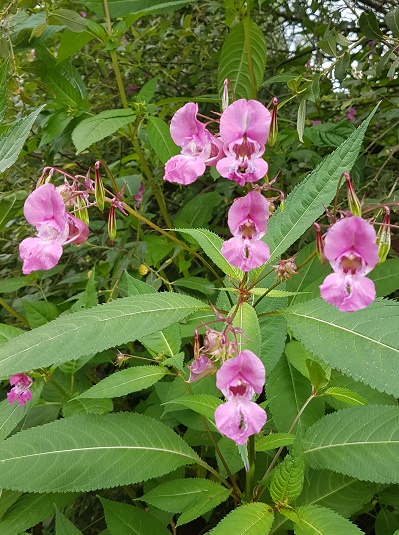
It was drowsy-hot, an afternoon of hoverflies and docile wasps, intent on the many flowers that lined the path. The river is a conduit for all kinds of unexpected vegetation, which thrive in the tidal mud and lovely untidy, unsanitised, hedgebanks and verges. The yellow buttons of Tansy pop up everywhere along the Tay, together with the silvery Mugwort, a long-ago Roman introduction, allegedly a cure for sore feet. Warm and spicy, the scent of Himalayan Balsam over-rode the scents of native flowers, and its spectacular flowers trumpeted a welcome to pollinating insects. This “alien invader” has been around a good while, anywhere near to water, and it’s a Marmite plant. Speak to any beekeeper and she will wax lyrical about the “ghost bees” who return somnolent and satisfied to the hive, covered in its dense white pollen. Speak to most mainstream ecologists and they will say it’s invasive, outcompetes “our” native flora and has no place in “our” countryside. I love its other name – Policemen’s Helmets – does anyone remember when policemen wore helmets? The top and bottom lips of the flower are encased in a helmet-like fusion of the other petals. I’ve happily pulled it out of ancient oak bluebell woodland, but I can’t say it bothers me too much today. I munch a couple of the peppery-pea tasting unripe seedheads, out of duty.
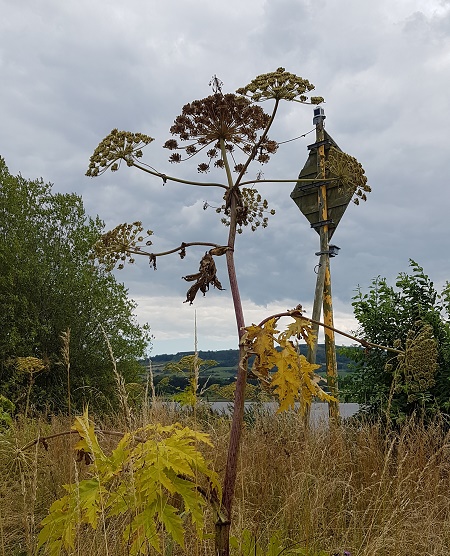
But then arise the forbidding, towering structures of a harder-to-love alien. Giant Hogweed, introduced by gullible and novelty-obsessed Victorians to adorn their fancy gardens. Apart from its spectacular, H.G. Wellsian-Martian structure (still being extolled by lecturers when I learned garden design), it is low on redeeming features. It is truly rampant, flowers and seeds everywhere and delivers serious burns to anyone brushing against it in sunny weather. It’s a property called phytotoxicity, and today the sun was shining and I passed gingerly.
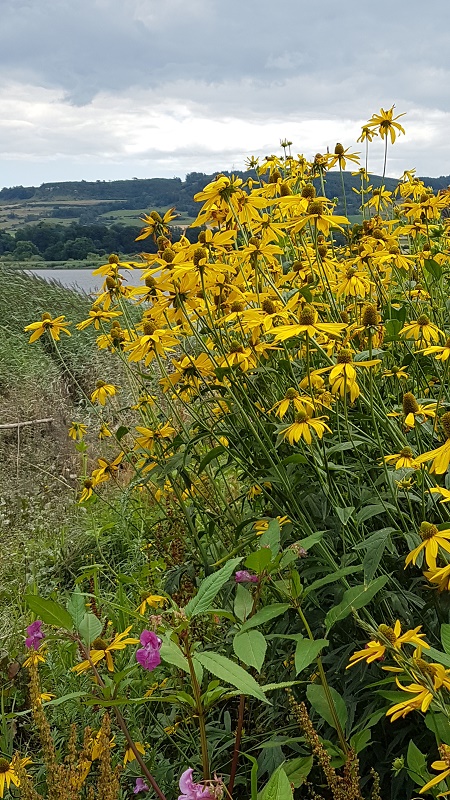
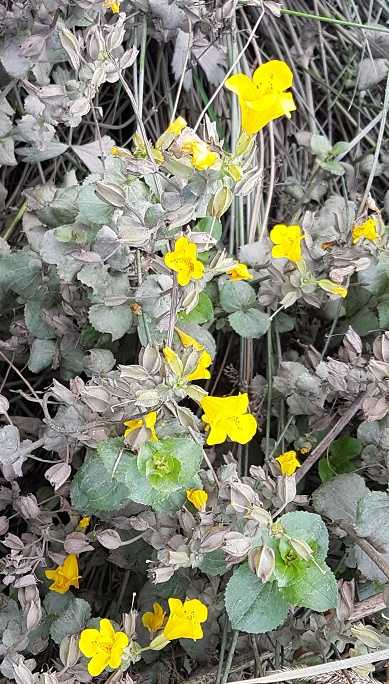
Far more attractive, and indeed glorious were the bright yellow, sunny Monkey Flowers, coated in tidal mud, and the clumps of tall Rudbeckia, both garden escapes, that sway gently in the breeze up the river. They are dotted all along this stretch of the Tay. I remembered another sunny day talking with David Clark of Seggieden – a great botanist and a man who so loved this river – about whether they “should” be there and what exactly was native anyway, since both of us could be labelled aliens ourselves. We agreed that neither of us were fanatical about racial purity in plants or anything else, but weren’t fond of Giant Hogweed, nor the next invasive alien to show its face on my walk, the Japanese Knotweed. This monster would out-compete the miles and miles of Norfolk Reeds themselves…..oh wait, did I say Norfolk Reed?
Yes that’s right, the incredible Tay Reedbeds, home to rare marshland bird species and a complex, life-affirming ecology, are the result themselves of the introduction of a “non-native”.
My fishermen’s path had petered out, and an attempt to reach Inchyra along the edge of a field also met with failure, so I drove back towards St. Madoes and took a side road left. Thus I reached Inchyra, a beautiful little village of low houses, pretty gardens and derelict farm buildings looking, as they always do, as if a quick afternoon’s work would put them back into service. From this hamlet, crouching among tidal lands as if in terror of sea-level rise, I found a wild garden overlooking the estuary and across to Rhynd, and small moored sailing boats bobbing in the rising tide.
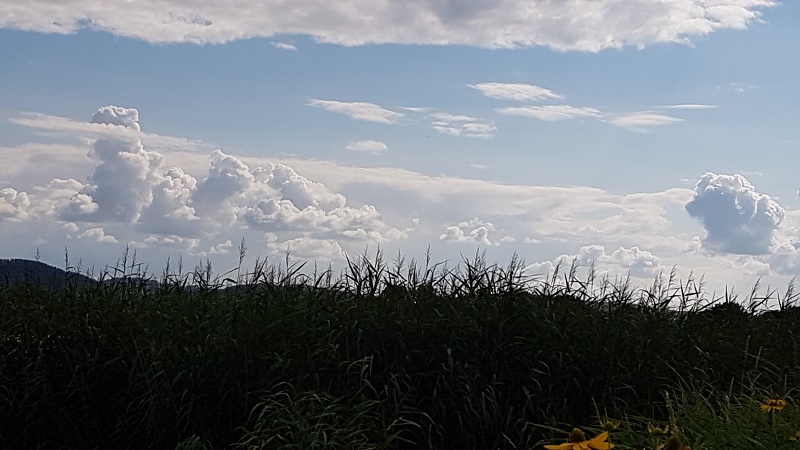
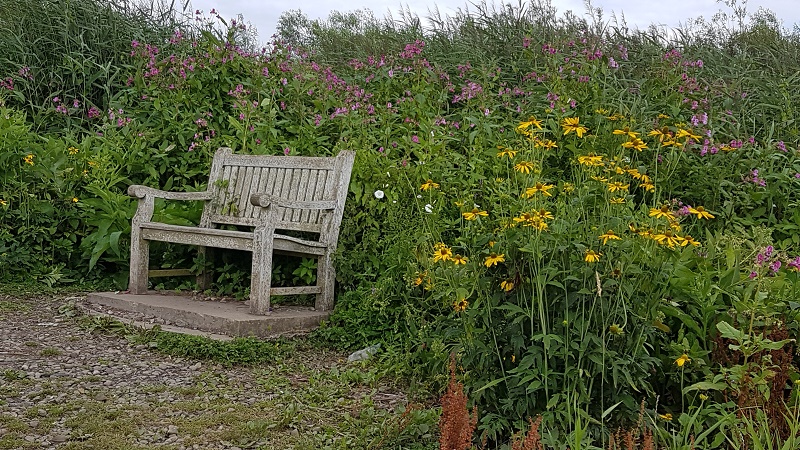
Here was a seat, to the memory of a daughter of a local family, and I sat in complete peace among the reeds, with flowers – native, non-native and all the gradations in between – blessing the air with scent and colour. Even the busy tractor across the water hummed to itself. Rain was forecast; I watched silver-lined thunderclouds pile up on themselves, shift and mutate, and then dissolve again into the blue sky. It was so good to be here.
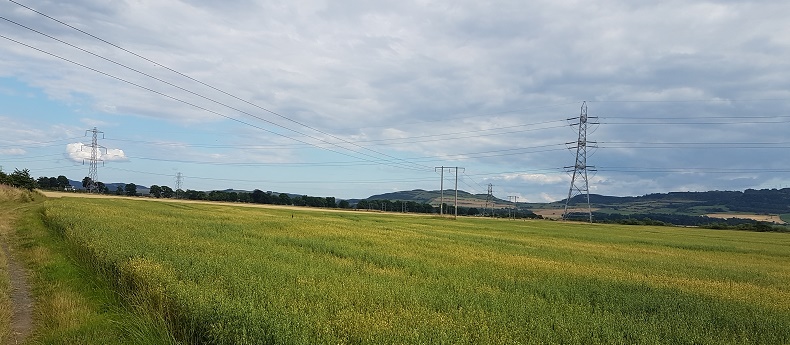
When it seemed the clouds were getting serious, I found a path that ran beside Cairnie Pow, giving me a good circular walk back to the village. The pow is a local name for a drainage channel, often of ancient origin, that was created to free the fertile soils of the Carse of Gowrie from being marshland. They litter the Carse, and give a sense of being neither quite on dry land nor in water. This one tracked parallel to the path I didn’t find earlier from Cairnie Pier, and then swung left at the point I’d almost got to, where a host of overhead power lines had got together for a gathering. They sky darkened, and the air, hot and still full of the damp scents of flowers, smothered the senses. Young trees, planted by the nearby farm, gave welcome shade. A big, old house rose out of the marsh with no obvious gateway or entrance. It looked dark, empty, full of tales and secrets. I wondered, made up stories in my head, began hearing things and holding imaginary conversations with people who did not exist. Perhaps it was as well that heavy, ponderous raindrops deterred me from more exploration that day.
In Anna Tsing’s book The Mushroom at the End of the World*, she tells the story of landscapes ruined – or seemingly ruined – by the greed of human activity. In particular, forests. In one unpromising forest in Oregon USA, where commercial forestry had stripped out all the trees of value and left an empty terrain of broken ground and scrubby volunteer pines, she met some mushroom hunters, refugees from Laos. They were gathering Matsutake, one of the most prized and valuable edible mushrooms in Japan and – allegedly – the first living organisms to appear from the wreckage of Hiroshima after the Bomb.
Matsutake mushrooms, like many fungi, only appear when they can be entangled with the roots of a suitable host tree in a mycorrhizal relationship. They got on very well with those scrubby pines. Tsing tells how the accidental introduction of the Pine Wilt Nematode on a shipment of American Pine into Japan had devastated the Matsutake’s natural host there, hence its rarity. It is not a serious pest of American Pine.
Incidentally, Scots Pine is a good host for Matsutake, too….
Abandoned remnants of the commercial forest
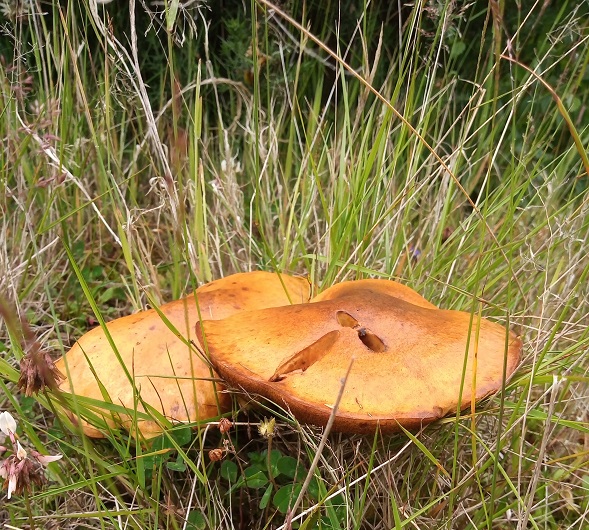
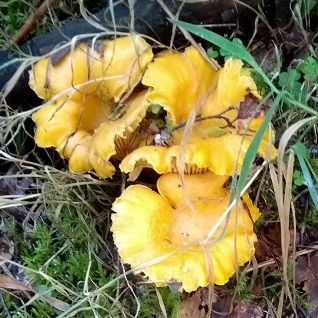
Mushrooms disappearing when a forest changes is familiar to me. All forests and woods are in the process of change, but our two ex-commercial forests, Five Mile and Taymount Woods, are forests in abrupt transition. Before the Commission took out the last valuable trees and wind-throw did for many more, Five Mile Wood was my happy mushroom-hunting ground, the place I’d take people to for foraging walks. I knew exactly where to find the biggest chanterelles, the white Angels’ Wings, the logs where real oyster mushrooms could often break out. The ditches beside the path were home to many fascinating species, including several edible Boletus including the Cep and the maggot-free Bay Bolete – and, of course plenty of highly poisonous examples too. Some years, the tantalisingly similar but inedible False Chanterelle outnumbered the real one – which is exactly what you need when teaching people not to harm themselves by misidentification. One damp corner was an emporium for the delicious Slippery Jack, which turned up in troops like clockwork, every year in late summer and autumn. I used to dry the ones we didn’t fry up right away, and store them in jars.
The biggest chanterelles
The fragile associations which had built up over the decades were shattered by felling. The self-sown birches that are colonising parts of both the woods now will eventually reel in their own, interconnected fungal friends, and the chanterelles will surely re-emerge one day, because birch is their main host tree. But from my experience, it takes at least a decade before mushrooms start to appear in a new wood, and the first arrivals are never the ones you want to eat! The precarity of a habitat for specific mushrooms is alarming – involving water tables, shade, parasitic plants, weather patterns, nematodes, beetles, animals – including mushroom pickers. Tsing’s book includes chapters on the equally precarious lives of the pickers – refugees, indigenous peoples, itinerants. Humans aren’t in control of what the mushrooms will do, because there are so many variables in play. Humans are just part of the landscape, and the landscape is changing because of and despite them.
Another remnant….
So, I can only observe and enjoy the new but mushroom-free habitats in parts of our woods, note the changes, watch new worlds forming out of devastation and realise we are not in charge, not that clever, and maybe, not that important either. I scoured the ditches in Five Mile Wood for boletes recently, and right at the end, I did find a couple of lingering and determined specimens. I left them there.
But who knows what will be the mushroom at the end of the wood? And where is the end of the wood?
*Tsing, Anna Lowenhaupt: The Mushroom at the End of the World – On the Possibility of Life in Capitalist Ruins (Princetown University Press 2015)
We are in strange times. Things are changing. People don’t like change. Many people will be yearning for everything to “go back to normal”. The media incessantly bleat that expression “back to normal”, interspersed cleverly with “business as usual.” People listening assume that’s what they – and everyone else – want to see. People won’t raise an eyebrow at this assumption, because people like to feel they are in the majority and agree with everyone else. They think there’s safety in numbers, even when the numbers are imaginary or made up.
Some of us – many of us – don’t. We want things to change. Some politicians even want change – or at least can see that it’s inevitable. But they sugar the pill by calling it a “new normal”. What do we want to change?
People to stop over-consuming the planet’s resources
The widening gap between rich and poor
Greed and Injustice – social and environmental
Air pollution, plastic, environmental degradation
Wars, bombs, threats, dictatorships
Governments that chip away at democracy
People thinking biodiversity loss is inevitable “progress”
What Tennyson called “the faithless coldness of the times”
….and so much more
We want, well, everything to change. It’s too much to ask. Where do we start?
We are in a pandemic, caused, not by China, Johnson or even Trump, but by a virus. Viruses are funny things. Are they even a life-form? They have no life and no power to reproduce on their own. They can only do that by hijacking the DNA or RNA (the genetic element of a cell) of another species. Plant or animal, whatever the virus finds suits their need. Did you know that stripy tulips only got that way because of viruses? A virus made them worth a fortune in the 17th century.
Viruses are very small, smaller than bacteria. Indeed, they can even infect bacteria. Some of them – including the coronaviruses – are incredibly beautiful structures. We have learned, in recent decades, to applaud our “friendly” bacteria which protect our digestive system or power our sourdough fermentations. Bacteria aren’t being friendly or unfriendly, though, they’re just getting on with their lives, and we happen to benefit sometimes. Other times we don’t and we go all antibacterial and kill off the useful bacteria as well as the harmful ones, leaving ourselves open to more infection.
But no-one ever applauds a virus. Even though within the lining of the animal (including human) gut, live viruses called bacteriophages. Guess what, they eat up “unfriendly” bacteria. Other viruses help develop and support the human immune system. Just like the bacteria, they’re not doing it out of the goodness of their hearts, which of course they don’t have. They’re just being viruses. Viruses, bacteria, slime moulds, fungi, algae, tardigrades, invertebrates, mosses, insects, molluscs, fish, flowers, trees, amphibians, birds, reptiles, mammals (including people), and all the groups I’ve missed out – they’re all just organisms in a complex web, getting on with it as best they can.
Sometimes – but not very often – an organism will get above itself. It will be clever, but hellish stupid. It will decide that it’s superior to all the other entangled organisms and it will start acting in a way that’s detrimental to all of life on earth. Destructive, actually, and stupid enough to believe – no, to CHOOSE TO BELIEVE – that destruction won’t include them.
It might take something as small as a virus to bring them down with a bump.
If the sound of arrogance crashing around us is louder than the soothing noises of those with vested interests in “business as usual”, more people will start thinking everything must change. And here’s where to start: drop the conceit that you are apart from the rest of the natural world. You are as entangled and connected to every other living organism – and many which may not be living – as the Covid 19 virus. You are no better and no worse. You are part of nature. You will never, ever, be above it.
Come back down to Earth, and then together we might really hope to change everything.
These are free-range pine trees, the Scots Pine, Pinus sylvatica. Not the heavy, lowering plantation evergreens erroneously referred to as pine forest, but which are more likely to be spruce, fir or sometimes the non-native black pine, Pinus nigra nigra. Recognise the Scots Pine by the gingery red of the bark on the upper trunk. Black pines stay grey.
These pines do not grow in battery-cage rows. They give themselves space to expand, to stretch out to unseen horizons; they live with dignity and grandeur; they are splendid and heroic in their dying. The Caledonian Pine Forest is multi-aged, thanks to decades of careful management to reduce deer predation and facilitate natural regeneration – seed from local trees giving rise to progeny that fits the landscape that made it like a glove. Because of age diversity in the trees, there’s also diversity in height, spread, form and density. That means greater biodiversity. And beauty.
The forests made by the spreading Caledonian pine are light and airy. The ground is soft with layers of needles, kind to the dog’s arthritic paws, so he bounces puppy like full-tilt along meandering paths and up and down banks and ridges, grinning like a mad thing to encourage his slow, plodding humans.
Look up.
The overground network of branches, which look too heavy for the boles to support, whispers with the quicksilver flow of red squirrels. Titmice flicker from bough to bough – coaltits in pairs, long-tailed ones in squeaky flocks. There may be crested tits in pursuit of pine nuts, for the Caledonian pinewoods are home to species rarely seen elsewhere. Shy and secretive, many of them, like the Pine Marten; or striking like the Scottish Crossbill -possibly the closest we have to a native parrot. Or the Horse of the Woods, the iconic, pied Capercaillie, whose shyness vanishes embarrassingly during the mating season, when you really, really don’t want to bump into a male bird.
Look down.
Roots lie just below the surface; barely visible but easy to trip over. Mosses cover them; the translucent yellows, greens and pinks of sphagnum are almost luminous in the wetter areas. The smell of peaty soil mingles with the soft fragrance of resin and bark. Fringing the shallow bogs are ling and heaths, the former still in flower, blaeberries and ferns. Throughout, fallen twigs and branches, last year’s needles and crackling debris of fern make a thousand homes for maybe a thousand life forms; plant, animal, invertebrate, bird, fungus and bacterium.
Onto these worlds within worlds, light rain emerges; rain so light, so like to air the raindrops are quantum particles which move and spin, randomly, beyond the realms of gravity. This is light-rain, on a world shrunk to infinitesimally small or seen from afar, from where the Scots pine woods become mere fractal patterns on the margins of time.
Once the Caledonian Pine Forest was the dominant vegetation type of much of Highland Scotland. It lightly brushed the sides of tall mountains; it thrived on islands in linear lochs, it swept through the glens. Farmers and crofters cleared some of it, but also made homes among the trees, for shelter and because it was a lovely land. Then came the changes, borne of greed, fear and hatred, that nearly pushed the Caledonian Forest and all it nurtured to extinction. Both sheep and the deer on the “sporting” estates which displaced poor or powerless people ate the succulent young trees, preventing regeneration – the story’s well known. Then there was the snatching of the big trees for the war effort. They were cut down to make boxes to store ammunition. Doubtless someone made a lot of money from that.
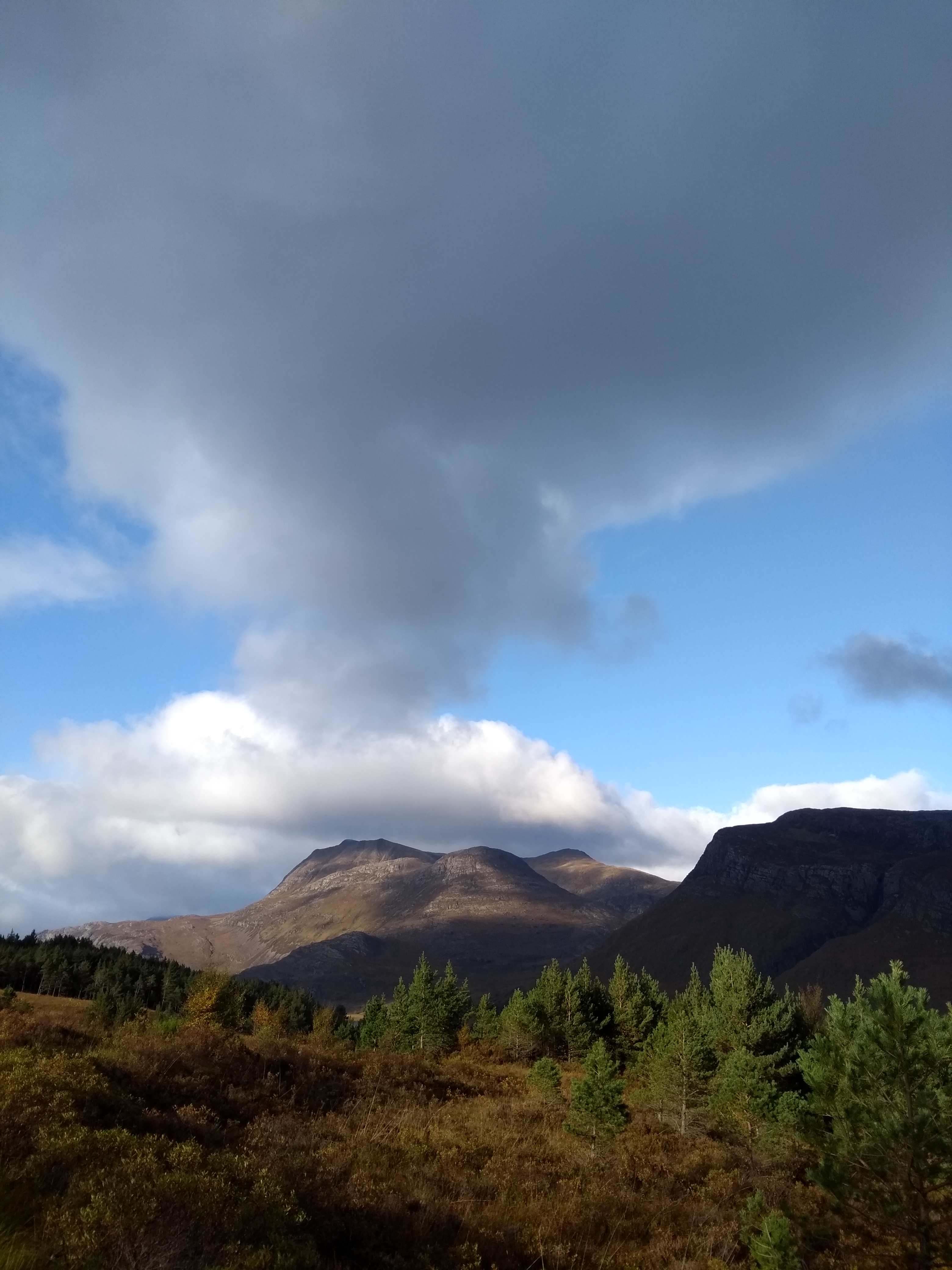
Now, thanks to hard work, vision and the dedication of many unsung heroes and heroines, the all-embracing arms of old Caledonian Pines are spread wide, young trees erupt vertically, baby trees get underfoot and choose odd places to grow. The trees are back on the mountainsides. Long may they flourish and grow.
“When gorse is out of flowers, kissing’s out of season,” so the saying goes.
That’s one use for this for this furiously jaggy native shrub, also known as whin, or furze. Since flowers can be found on a gorse bush in every month of the year, it’s a license for affection. A light tea from the deliciously coconut-scented flowers is another purpose; the same flowers are an ingredient in natural dyes. Sounds highly unlikely, given that horses have sensitive mouths, but allegedly the dry branches of gorse, thorns and all, are a nutritious feed for these beasts. The plant’s tendency to seed, spread and steam all over any unsuspecting tract of slightly open ground might be off-putting to the gardener, but there’s little doubt it makes a good deterrent for invaders and intruders.
Do we reckon the value of a plant only in terms of its uses to humans? Too often! A hillside bright with gorse will not only gladden the human eye, but it will provide pollen and nectar for a range of bees and other insects. A gorse bush is an ecosystem owing nothing to our interference.
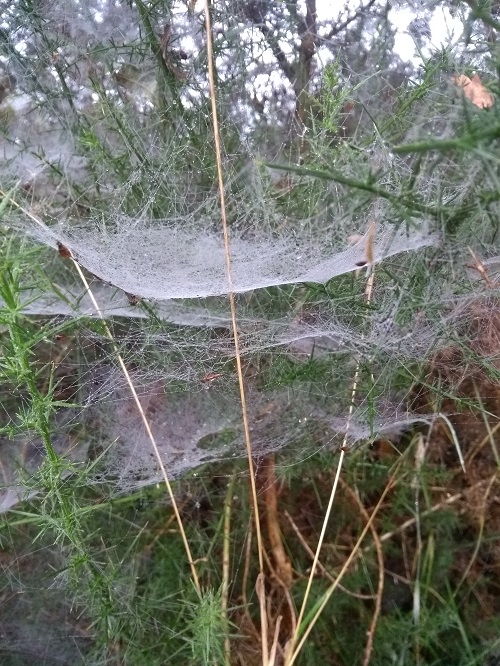
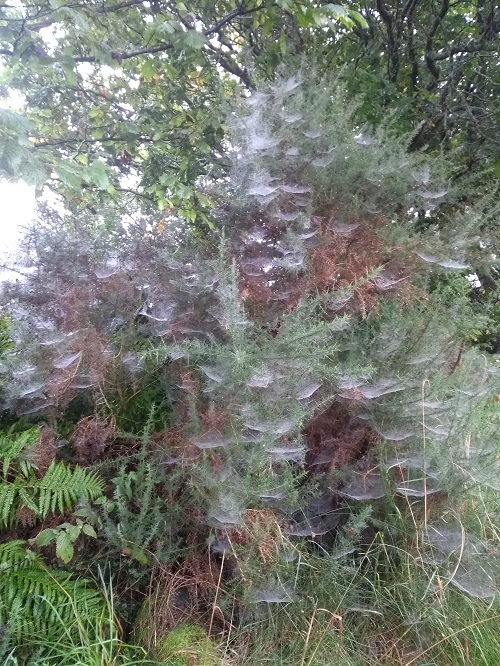
Oneautumn morning – the kind where damp mists hang low and the sun is watery and out of sight, I came upon the Spider Tenements. I did not see a single arachnid – nor yet a gorse flower! – but the fog condensing on the gossamer revealed each web on these gorse bushes in elaborate detail. It also revealed the happiness of spiders to rub shoulders (knees?) with one another in close proximity. If one web equals one spider, there must be hundreds on every bush. They don’t mind the jagginess; obviously it gives them lots of points for attachment of their superficially haphazard cobwebs!
I wonder how many small insects were caught on this bush today. How many webs do you think there are?
And does anyone know what kind of spider my gorse-loving, tenement-dwelling pals might be?
My favourite book age 9 was a slim volume called “Folk Tales of Devon”. Innumerable accounts peppered its pages of spirits, human and fey, being sucked into the bogs on a trackless Dartmoor. This, coupled with “The Hound of the Baskervilles” a couple of years later, and walking treks in Sutherland with my sister, left me with a deep certainty that if water ever gets over the top of my boots, it won’t stop till I am submerged forever.
Therefore, though I adore them on an intellectual level, and thrill to the spookiness and mystery of moss, bog or myre, it takes me ages – and I mean AGES – to get from one side of an expanse of rush or bog cotton to the other. During which time, I suffer feelings of vulnerability and exposure no normal walker would recognize, and fantasize about nice hard stone paths and causeways.
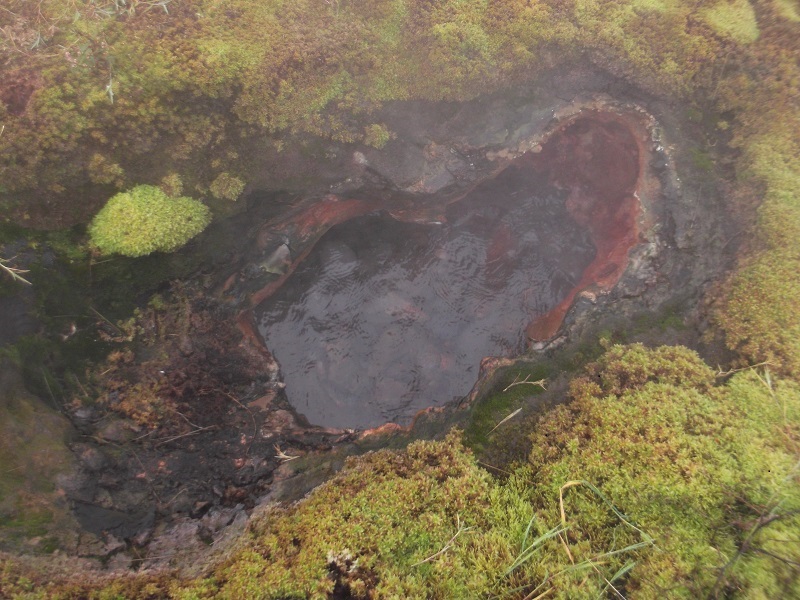
Everyone should leave their comfort zone behind from time to time, though, and if you venture into The Moss there are rewards. It’s called “moss”, because in most cases that’s what makes it – sphagnum mosses of breathtaking colour and beauty, slowly expanding and dying away to leave peat. Mosses are primitive plants dependent on water for reproduction, and you can be sure the brightest patches will be the wettest. Sphagnum holds an incredible quantity of water. Its uses range from wound dressings (it is naturally antiseptic) and hanging baskets to impromptu disposable nappies when walking with babies! Rushes, too, are useful – think matting, cattle bedding and rushlights – and if you can balance on the clumps as stepping stones, they will see you across a wet patch of moor.
In the poor, acid soils of bog lands, you will find pretty, semi-parasitic flowers such as milkwort, lousewort and butterwort, and carnivores such as the tiny sundew, all striving to supplement the mineral content of the soil from other sources. Many orchids have their habitat here. Where you find blaeberries (aka bilberries) growing, it is safe to cross – this plant with its delicious fruits prefers drier slopes. Related species, cranberry and cowberry, will appear on higher moors and myres. Bog myrtle, although happy in the wet, will draw a lot of moisture up, so is also an indicator of safer ground. This is a very useful plant – its aromatic oils are a deterrent to insects – including midgies, allegedly. It’s also called sweet gale – and can be used to flavour Gale Beer. It has a lovely, spicy smell, worth risking wet feet for.
Finally, there is the alluring bog cotton-grass – a guarantee of treacherous wetland just waiting to suck you down – but such an unusual flower and how beautiful waving massed in a moorland wind – white woolly standards raised to announce a weird, wonderful and ominously wet world of plants!
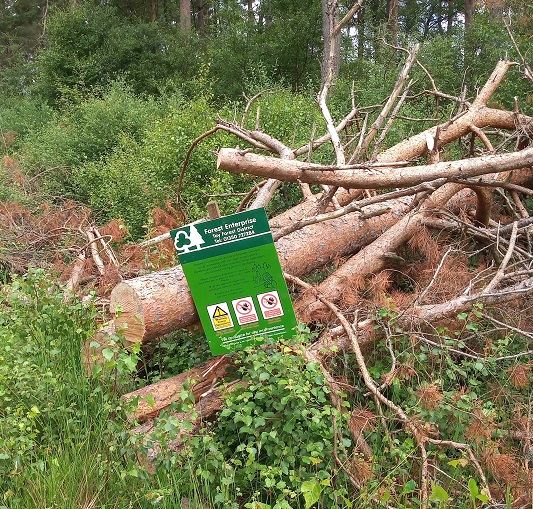
In the misty dampness of a cool May morning, the tangled and decaying woodland holds its breath. Falling trees prop up shattered branches and each other, precariously leaning, hanging on by brittle twigs to some semblance of the vertical. Elsewhere, the long archaeology of those that have already succumbed to gravity make the woodland floor uneven, precarious, unpredictable. Some are half-sunken: indistinct mounds of mosses and soft, cushion-like wood, sprouting ferns and small plants – wood sorrel, purslane, chickweed wintergreen – from every crevice. Others, newly crashed in last week’s gale, still carry their leaves, shrivelling, poignant. Between the two extremes, lie trees and logs in every stage of decomposition.
The walker in this wood must learn these stages, and recognise which logs will still make good rafts to lay across the boggy places and ditches she would cross, and which will just crumble when stepped on. She must be aware of what lies overhead and if it would be wiser to go around, rather than under, the hung-up branches. Familiar paths are blocked every month and must be re-routed. New ground is created, explored, and lost again.
Out of the decomposition, new worlds are also born. What is decomposition if not the beginning of opportunity? Spiders re-align their webs in the remaining dead branches of a leaning tree. The breakdown of bark releases nutrients; tree becomes soil, soil claims tree. Single-celled organisms work their way through a sea of bacteria, laying the foundation for others to thrive.
Opportunities are made for beetles that feast on the rot in wood and bark, and the birds and small mammals that home in on the beetles. Shelter, food source, songpost, tunnel, bridge – the creatures of the wood utilise the fallen and falling trees in many ways. On their bodies they bring more soil, seeds, and the elements of fertility to this garden of decay.
And oh, how the garden grows.
It is not death that the walker witnesses, but birth and life. Is this decomposition, or composition? Is it both? Is this the end of the wood, or the beginning of a new landscape? No human cares much for this wood. Children sometimes come and make fires, camp or build twiggy shelters, but you never see them. There is an old tyre swing, hanging neglected. Someone – no-one knew who – used to make sculptures out of stones in the heart of the wood, but not anymore. Dogs are walked, but usually led straight past the wood now that access is trickier. No-one “manages” it. Change, then, seems rapid. Whole trees crash down, leaving soggy craters and towering cliffs of root-ball, but transformation in nature is incremental, and constant. Each year, the populations dwelling on those bare root-cliffs are slightly different. Ground living fungi give way to aerial brackets, rabbits exploit entrances to potential burrows, liverworts, lichens and ferns take hold.
And underground, fungal mycelia move like whispers within subtle, shape-shifting parameters. Today, a downpour of the night is percolating under the moss-covered banks and logs. Soft spring rain, scarcely visible except when the smirr catches a shard of sunshine, seeps into the soil cauldron, fermenting, bringing new elements, new conditions.
Things move unseen.
Everything waits.
The walker in the woods has seen no mushrooms yet. But even a human animal can smell the contents of the cauldron, the warm, damp changes happening unseen below the wreckage of an unmarked wood. When all the boxes have been ticked, the harvest will be rich and golden.




 Everyone should leave their comfort zone behind from time to time, though, and if you venture into The Moss there are rewards. It’s called “moss”, because in most cases that’s what makes it – sphagnum mosses of breathtaking colour and beauty, slowly expanding and dying away to leave peat. Mosses are primitive plants dependent on water for reproduction, and you can be sure the brightest patches will be the wettest. Sphagnum holds an incredible quantity of water. Its uses range from wound dressings (it is naturally antiseptic) and hanging baskets to impromptu disposable nappies when walking with babies! Rushes, too, are useful – think matting, cattle bedding and rushlights – and if you can balance on the clumps as stepping stones, they will see you across a wet patch of moor.
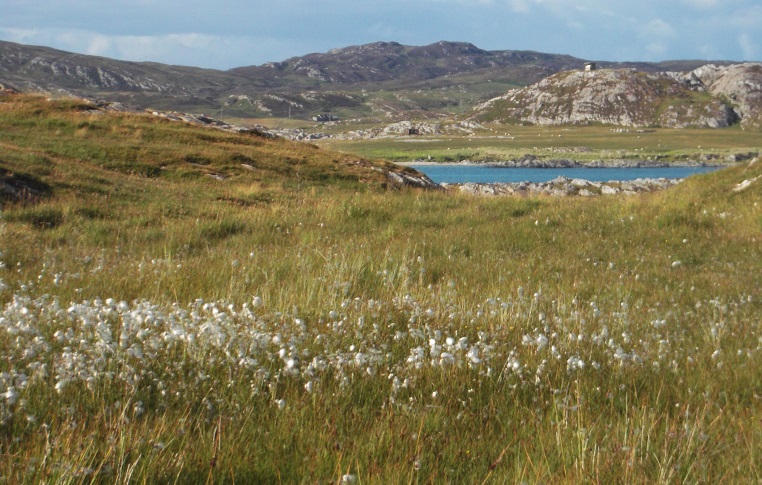 Finally, there is the alluring bog cotton-grass – a guarantee of treacherous wetland just waiting to suck you down – but such an unusual flower and how beautiful waving massed in a moorland wind – white woolly standards raised to announce a weird, wonderful and ominously wet world of plants!
 Comments on The Nature of the Universe