The Long Way Round to Taymount Wood

The Pathfinder

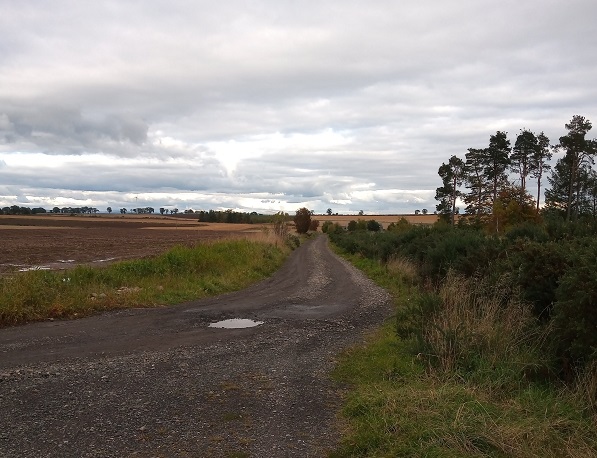
We met up at the Taymount Wood car park, Linda and I, put on our boots and turned away, not into the gate. This was to be the long road to the woods, a circular walk via the disused railway line which once ran as a ponderous branch from Stanley across the River Tay to Coupar Angus. The embankment is reached from the Taymount Mains farm track, and you then head towards Kinclaven and Ballathie, across open country, under disused bridges and past a little railwaymen’s shed made of sleepers with a brick chimney still in place. Although today’s challenge for us was to find and walk the narrow path through the northern finger of the wood, the line itself offered a few challenges – a chilly wind and stretches of water where the rains of March hadn’t percolated the poorly-drained soil.

You turn north-west away from the line before you get to the grounds of Ballathie Hotel, crossing the road and continuing north up a rough track beside the Old Smiddy. The track goes past several houses and in the past, we’d stuck to it, until it vanishes at a farmhouse. Then we’d scrambled witlessly through fields and fences and bits of scrub till we arrived, somehow, on a track in Taymount Wood. This time, we were determined to find the “proper” path. So, we left the comfy track when it turned the bend and continued up to the edge of the wood. People had been this way, but not many, and it wasn’t clear how far in we should go before we turned left. Google satellite was remarkably unhelpful.

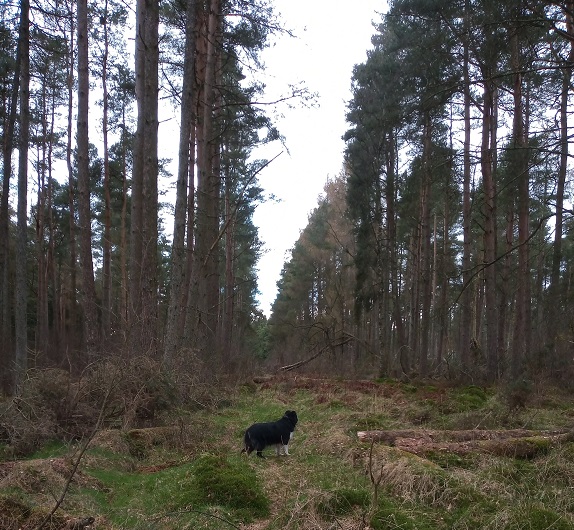
Dogs have many uses. Everyone thinks of companionship, protection and exercise machine, but an intelligent dog is a wonder at Finding the Path. While we stood wondering and wafting around, Jed set off into the unruly herbage with a look of collie dog purpose, nose to the ground. Sure enough, when we followed, there were the vestiges of a footpath. It doesn’t take many human footprints – and barely one canine print – to inform Jed this is The Way to Go. We continued, scrambling after him, and he didn’t lead us into any blind alleys. At times, we were on the point of losing faith, but then the path would reappear, on the other side of a boggy stretch or a tangle of bramble and brushwood.
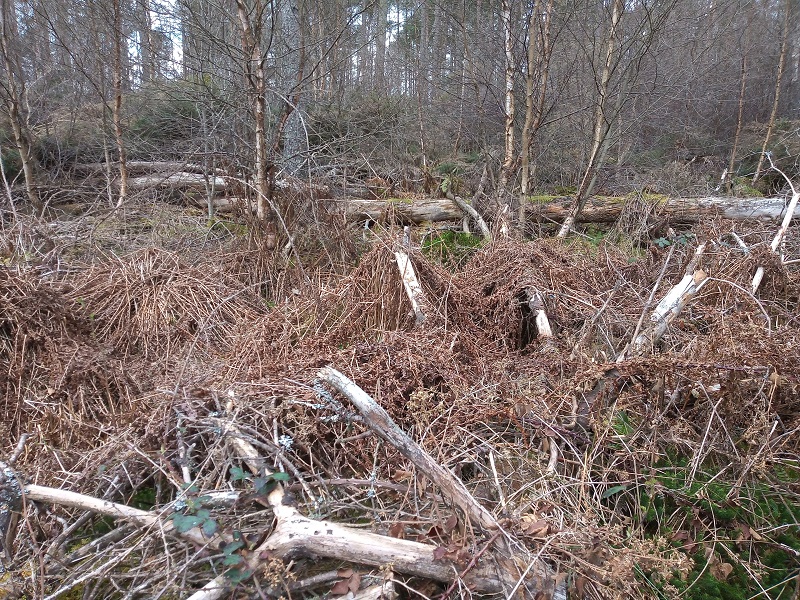
There is a path here somewhere….

Wind-throw had put up many of the barriers that challenged us. I discovered I’m at an age where I’m a bit stiff for limbo-dancing under fallen trees, and my sense of balance (never my strong point) for climbing over them was precarious to say the least. There were points when we even doubted the dog, but then to our great surprise we encountered someone going the other way – an ecologist doing a survey of small mammals for West Stormont Woodland Group no less – who assured us that a. we were on the path and b. it was passable, if a tad wet in places. Well, we certainly found the wet places and finally stumbled out onto the hard forestry track that would eventually take us through the main wood and back to the car park. The challenge wasn’t quite over – several metres of scratchy, mean-minded gorse had colonised the track to meet in the middle, and we suffered quite a few scratches and tears before we were through it – noting jealously how impervious the coat of a collie dog is just about anything.
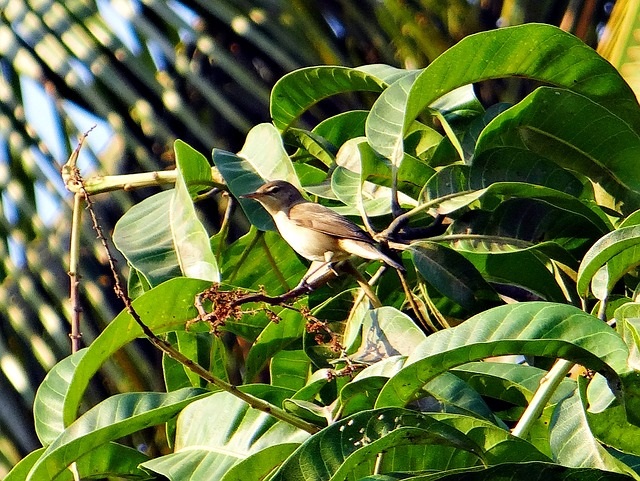
Common Chiffchaff (photo Bishnu Sarangi, Pixabay)

And the gift from today’s walk? There were lots – newly unfurling larch leaves, frogspawn in a drowning bit of track, skeletons of last year’s ferns, the beautiful vertical grandeur of the trees that hadn’t blown down, some chestnut brown bracket fungi left from the autumn. But as soon as we entered the wood on our optimistically rediscovered path, we heard the chiff-chaff call nearby. The earliest of our summer warblers to arrive, this is a small brown job of a bird, indistinguishable from willow and wood warblers unless it keeps still and stays a metre away from you. This one didn’t – they never do – but the call, exactly like the bird’s name, sets it apart. We never saw our little warbler, but the mocking “chiff-chaff-chiff-chiff-chaff” was never far away. It was, I am sure, laughing its little head off, but we chose to find it encouraging. When we found ourselves safely “out of the woods” and into the wood, it went off to scoff at something else. It made us appreciate all over again the wide range of habitats the woods provide for many bird species, residents and summer or winter visitors. I look forward to more birdsong in Taymount Woods this spring.

Find out more about WSWG and out hopes for community ownership of the woods at weststormontwoodlandgroup.scot
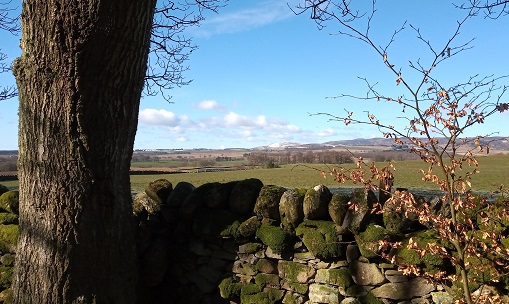
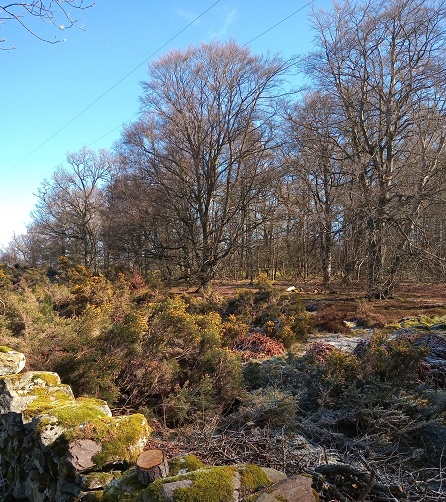
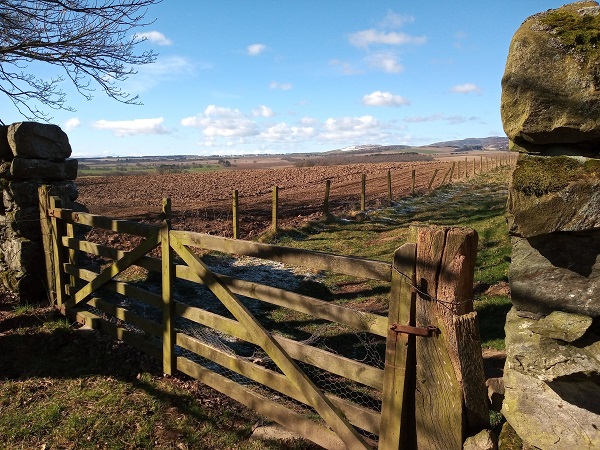
Circular Walk, Spring Morning

A night of light snow, followed by clear-sky freezing has left
The ground hard and white.
Rapidly the sun, heroic, overcoming all, climbing high,
Melts snow to iridescence at every margin, every edge.

On a single hill, snow is held in thrall. Like a crumpled Mount Fuji, but
No blossom, no art,
The hill holds its ghost-clothes, despite the sun’s triumphal progress.
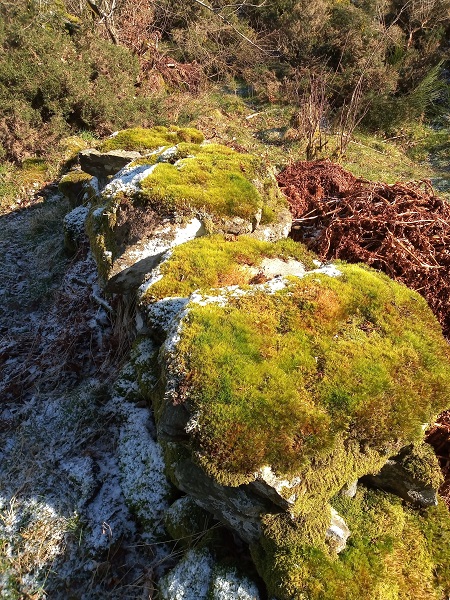
Magisterial old beeches sun themselves among old walls and
Moss-covered stones, dripping, wet, full of temptation.

Birds call, fluting, piping, chameleon-coloured, slipping away like lizards.

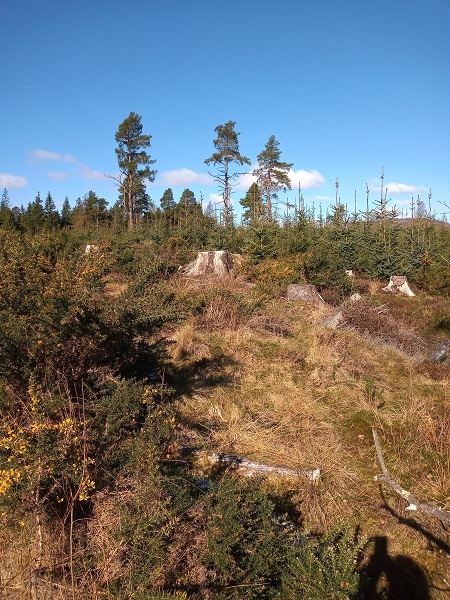
I’ve never understood the detritus of forestry. The wind cuts and dives
In and out of the shambles of stumps and trenches, where startled pines left behind
Look half-naked and vulnerable, hesitantly beginning to stretch arms to the sky,
To each other, united in the icy wind.

I follow the wind. I leave the wreckage, the small shelter
Of self-seeded spruce erupting from glossy gorse and broom. Ahead
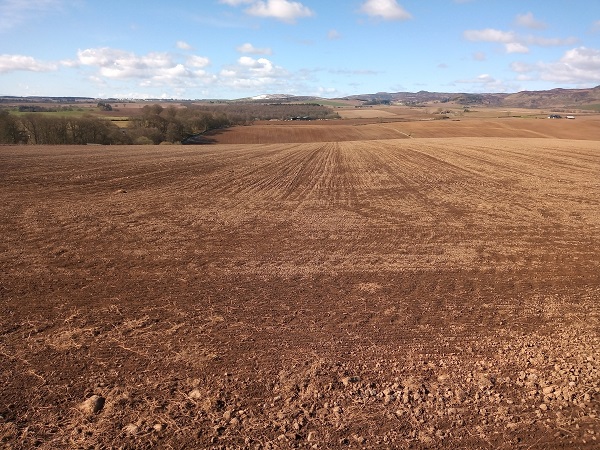
A vast and dreary vista of huge, brown and empty fields,
Unpunctuated by tree or hedge-bank, meticulously ploughed and harrowed.
The dust rises, faintly reeking still of the abattoir, that small, derisory recompense
For decades of soil inevitably lost and life precluded.

Back by road, the first wood anemones
In the deep and shady gulf where children once played canyons,
And a rising stir of sound comes up from behind. Suddenly
A thousand geese are shifting and snaking in the blue, blue sky,
Withering the last frost with their joy.

Exits, Entrances and Crossroads

A post for West Stormont Woodland Group

Is there an artist in the wood?

There is, really, only one easy way into and out of Five Mile Wood – at least in October. That’s from the south end on the Stanley to New Mill cottages road – currently a bit of a no man’s land thanks to the dualling of the A9. Here the track is clear, broad, made for forestry vehicles – and you can even park! At the north end, there is also the old straight track I’ve written about before, from South Barns and beyond that, with a diversion to Bankfoot. Follow the line of this track and it will take you to Dunkeld, once a mighty ecclesiastical seat. I learned last week that from Dunkeld to the wood it’s five miles – hence the name.

I wonder what happened to One, Two, Three and Four Mile Woods?

But once through the gate at the end of the straight track, the going is tricky. At this time of year, wellies are essential, thanks to the legacy of ditches, boggy ground and waterlogging that followed the felling of the trees here. When did it become the norm for forestry practice to leave such a mess? However, with care, agility and thanks to the enterprising actions of previous walkers using felled timber to ford the worst ditches, you can get to the main path that circles the wood.

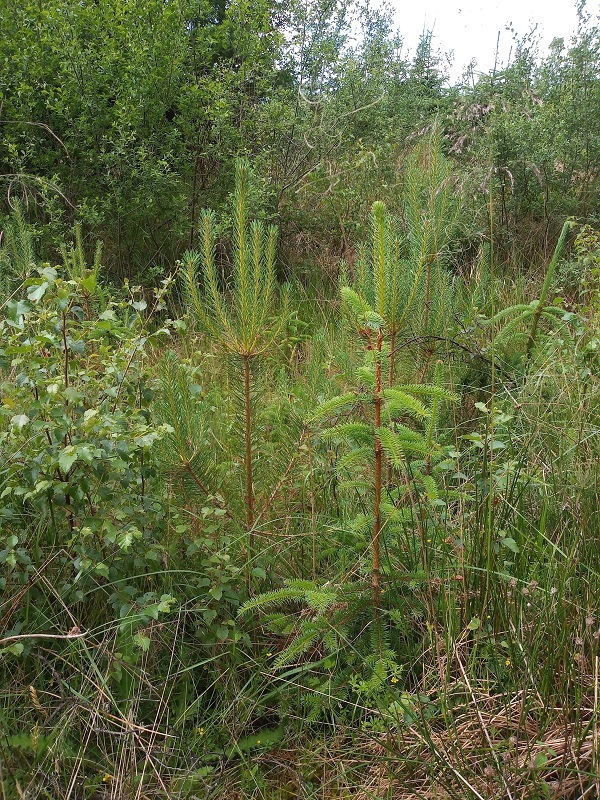
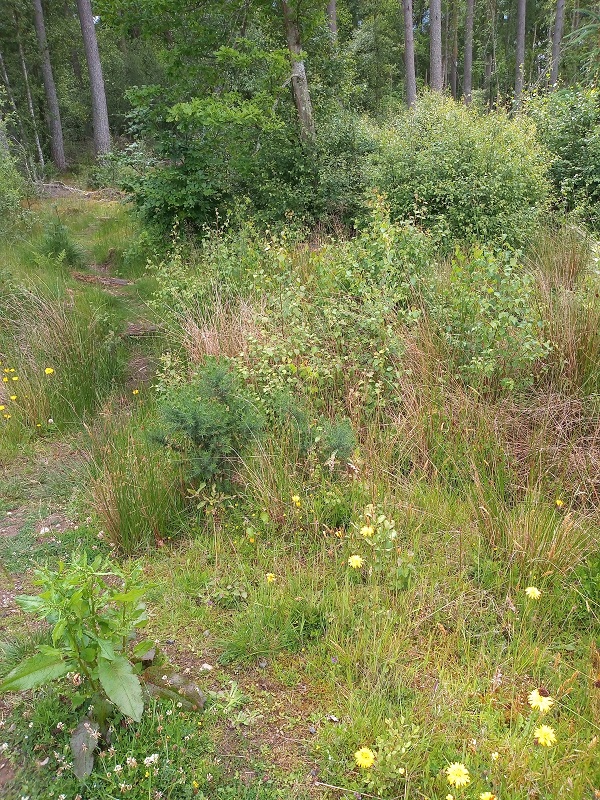
Deer, birds and other animals have their own paths off into the undergrowth, but for humans, the area where trees were felled before the Commission ceased to work are becoming impenetrable, Gorse crowds thickly on either side of the track, requiring constant maintenance to keep it from meeting in the middle. Self-seeded birch, larch, Scots pine and willow are all growing well, but there are no paths between them in this baby wood. Then there are the trackside deep ditches, another legacy of forest drainage operations, not impossible to cross but very off-putting.

So walkers, joggers and cyclists stick to the circular path and leave the wood by the way they came. Someone on Trip Advisor found the wood disappointing, and the circular track through felled forest boring. But I wonder. We undervalue landscapes that aren’t “finished” – such as newly planted gardens and self-seeded woods at the start of succession. The prettiest part of Five Mile Wood may be the winding bike-track under mature trees which shoots off from the main path near the south entrance, but the burgeoning growth of pioneer vegetation in the centre – the “gap site” as some call it – is vibrant with hidden life, resounding with the flickering flight of small birds and bubbling with amphibians and aquatic life in the ponds and ditches created for drainage. Even the nuisance gorse is a rich nectar source for pollinators and home, each bush, to thousands of spiders and other invertebrates. It’s not what we are schooled to believe beautiful, but in terms of ecology and resilience, it is every bit as valid as ancient oak climax woodland. Not all landscapes can be measured in human terms – though the amount of carbon sequestered by rapidly-growing trees and shrubs will be enormous and far greater than that in a carefully-planned, gardenesque setting. And humans need carbon sinks as much as every other life form.

People like to have choices, though. Choices about where to enter the wood – entrance points close to all the settlements that lie within walking distance. New tracks to follow, new routes to explore, the chance to come out into the sunshine at a different point from where you went in. Paths that cross, diversions, sidetracks, viewpoints. I don’t think they should be the main focus of the wood, or dominate the richness of undisturbed wildlife in the centre. There must be places that are no-go areas for humans, where nature can get on with it, and prove, as ever, that she will make a better job of it than we can.

And then, let our tracks meet and link wood to wood, as we learn to walk more, and be more in nature and less apart from it. Then we will lose our expectations of park furniture and entertainment, and realise the woods aren’t, in the end, all about us.

The Difference a Drop of Rain Makes

A Post for West Stormont Woodland Group

https://www.weststormontwoodlandgroup.org.uk/

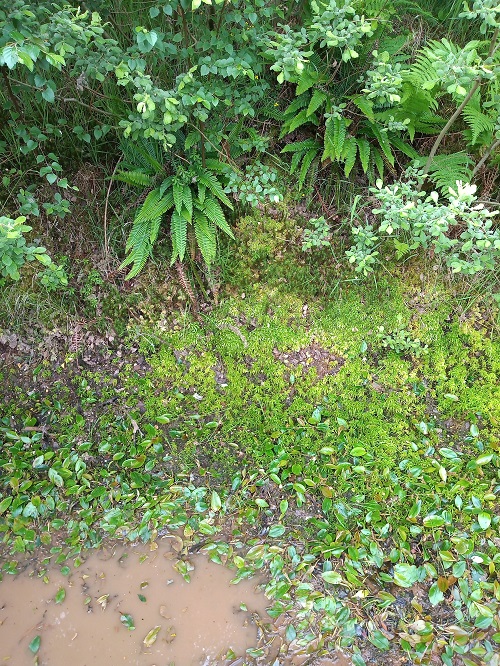
Five Mile Wood today is a wood part-forest, part scrub and heath. When the Forestry Commission took out the last tree crop, they left a fragile fringe, largely of Scots Pine, around the north-east side of the circular path that now forms almost the only access to the bulk of the wood. The Benchil burn trickles through and under the path here, on its way to the Tay, and water from the high water table of the central area percolates into a series of pathside ditches and curious water-holes made by a forestry digger. This is the wet side of the wood. While the trees must take up a lot of water, their canopy also prevents evaporation, and after recent heavy rain, the glades and ditches are alive with summer flowers and butterflies.

Sphagnum, Lesser Spearwort, ladder ferns and willows congregarte in wet ditches.

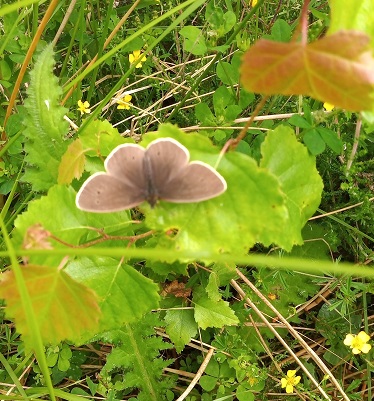
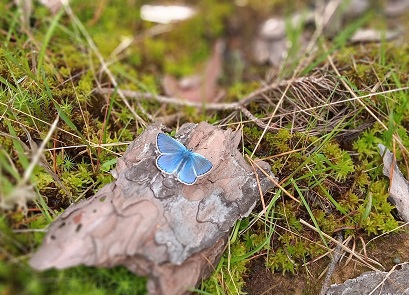
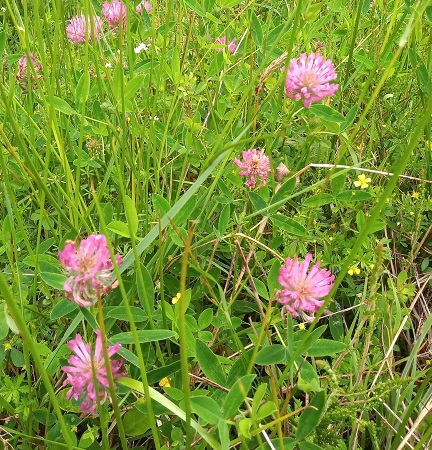
Heath Bedstraw and Tormentil are strewn along the path edges like yellow and white confetti, and red clover flourishes heroically on the banks. Meadow Vetchling and Bird’s Foot Trefoil are visited by brown ringlet, wood white, common blue, and pearl-bordered fritillary butterflies, who pause and spread themselves out infrequently on warm stones and bark shreds on the path.

Ringlet Butterfly

Common Blue Butterfly

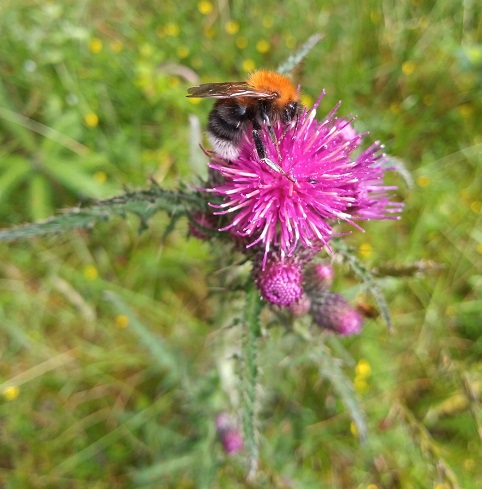
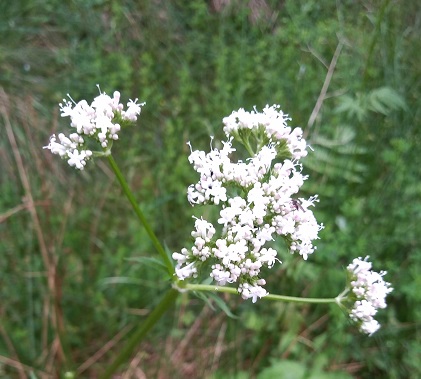
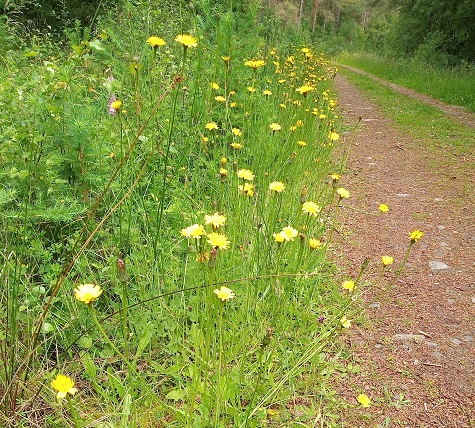
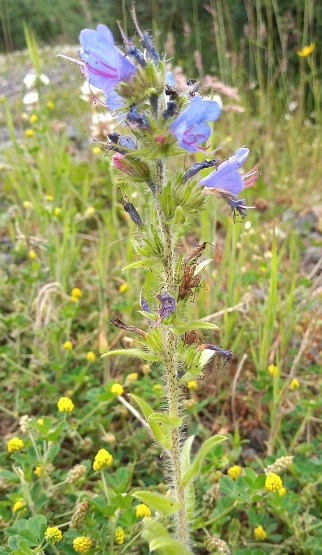
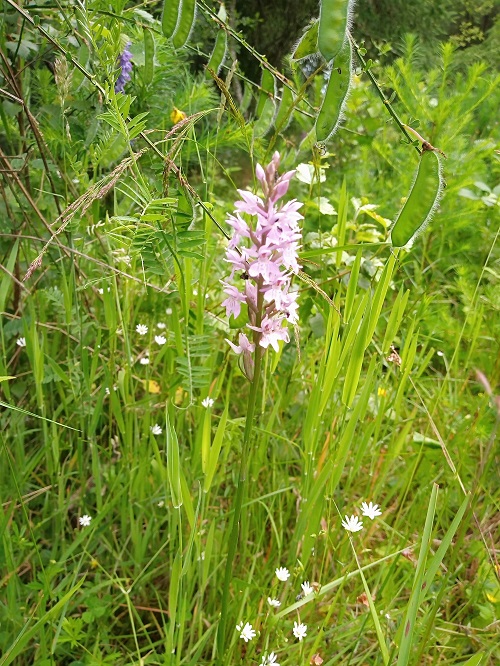
Bright Hawkweeds grow tall and enthusiastic, stretching for the dappled sun that today is scorching whenever the clouds part. In the cooler shade, sweet-scented Valerian grows. It prefers a damp habitat, and its white to pinkish flowers are nectar-rich, a magnet for more butterflies. This plant is widely used in herbal medicine, its roots being a soporific. Common Orchids and Viper’s Bugloss unusually share a habitat. Here and there are thistles, always a good bee-flower, and today a relevant newcomer to central Scotland, the Tree Bumble Bee (Bombus hypnorum) is engrossed with nectar collection.

Tree Bumblebee (Bombus hypnorum)

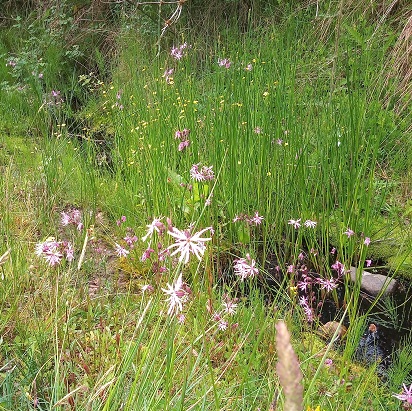
The true nature of this tract of land gives itself away in the damp bases of ditches and where vague deer tracks can be followed a short way into the springy sphagnum. It is part of a network of raised bog, myre or moss that probably once were joined. King’s Myre in Taymount Wood is another remnant. Damselflies hover over the multicoloured water forget-me-nots in conjoined pairs. The Lesser Spearwort dazzles from many a watery ditch and aptly-named Ragged Robin, dances its frilly pink skirts by the burn. Acid-loving and ubiquitous tormentil abounds, and bell heather is in flower already – another treat for insects.

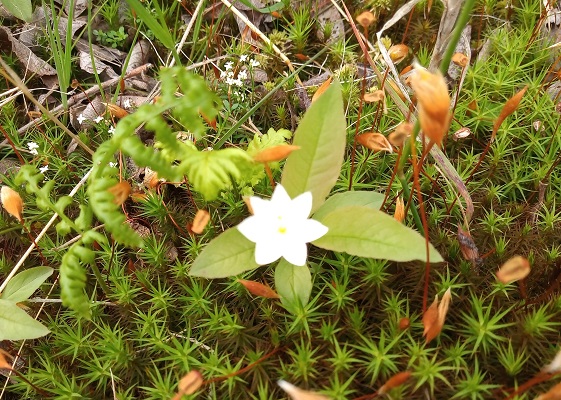
Chickweed Wintergreen peeks out from ferns and sphagnum mosses

We humans are such visual creatures, and it’s the flowers that draw us and grab our attention. But flowers are the tip of the ecological iceberg of the wet side of the wood. Ferns, grasses,  unidentified rushes and reeds are the matrix of this habitat, while unnoticed and unobtrusive, the sphagnum mosses proiliferate, and go on with their work of creating peat, holding onto water – and capturing carbon.

How the woods work to heal us.

Clockwise from top left: Red Clover, Valerian, Viper’s Bugloss, Ragged Robin, Common Spotted Orchid

Last Flight

pexels-photo-210172.jpeg
Photo by Pixabay on Pexels.com

I said I chose not to fly again , except in an emergency. This race to see and speak seems to be emergency enough. I look for the quickest way south. I choose to fly. As the little propellor-plane taxis along, I suppress thoughts of Indiana Jones films and think, this may be my last flight.

It turns out to be a flight like none I’ve had before, a child’s magical birds-eye flight, skimming over a clear, unusually cloud-free landscape at a height where details can readily be identified, and anything not visible is imaginable. I note the snow on the Stirlingshire hills as they retreat behind me. Snow puffs and scrapes across the highest hills of Galloway, and streaks the mountains of England’s lakeland.

I watch the strange, human patterns of fields and settlements. It all looks so much older from the air, like something that has grown organically; haphazard, unplanned. It is the random cracked glaze made by fire on an ancient cauldron, imprinted on glacial landscapes by millenia of human occupation.

I see how nearly bare native trees and unplanned woods snake along river valleys, and cluster beside routes that connect only in a roundabout way; wandering paths and roads that go round things. By contrast, the dark plantation forests of Sitka spruce are bald and angular and the reparations of modern forestry design have done little to alleviate their awkwardness. They still do not fit.

When I next look out, we are passing over Wales. Snowdon and its consort peaks are proud, triumphal, dazzling white and icy, but dark hills lie all around. An extinct Welsh volcano, crimped with snow, broods over a green plain of farms and fields. Its crater hides a cache of snow from all bar those who fly over it. On the Black Mountains, the snow seems to trace the contour lines. It’s like looking at a giant 3D map or one of these models you find in landscape interpretation centres.

Here is an Iron Age landscape, a Celtic domain. Hillforts rise above farmland, the timeless strongholds of Arthur, Merlyn, Caractacus and those who went before. This one has six ditches and ramparts, etched in snow. Its neighbour has only three. And there, quarries and open-cast mines with their working terraces create an optical illusion of hillforts turned inside out.

How green are the valleys, with their wandering rivers and the streams of towns and villages that run along them, made silver by the sun shining on roofs and streets, their buildings,  estates and conurbations making swirling patterns of dots and squares. Way off, Swansea nestles in hard among its cockles and laverbread and all its lovely words, and below lies the black, coal-rippled sand of the South Wales coast.

Crossing the Severn Estuary, the bird’s-eye landscape fades. Features become shadows, obscured, hazy. Cloud lies over Devon and Somerset, a ponderous, doubtful fog. But beyond the unknown, to the west, another landscape beckons. I cannot tell if it is sea or sky, dark streams of cloud or a distant land; lost Lyonesse or the islands of the blest.

aircraft airplane aviation dawn
Photo by Christine Renard on Pexels.com

(I didn’t take any photos on the flight. Even if I had, they’d not be of any use, since I’ve left my phone on a bus!)


Mushroom-hunting, between Lowlands and Highlands

mushrooms1A full evening, two nights and two days of rain. Humidity hangs in the air, the soil beneath my feet pulses damply, the mosses are full and green. Raindrops still coat every flower of grass and frond of bracken, but the sun is shining. The timing is right.
I go for mushrooms in the place where the Highlands meet the Lowlands, where the land is rent by fault-lines and rainbow-coloured slate out-crops and erupts. I pass the court hill where outlaws were tried and hung from the oak trees of Birnam Wood, three hundred years after Macbeth was king of this nation. I stalk through the devastation where the larches were, before they got phytophthera and were felled. There is nothing there now. But in the crowded wood beside the path, one big larch has been missed, and the sun shines in tawny patches upon last year’s fallen needles. It catches on a small group of Larch Boletes, glistening and tawny themselves in their cosy cohabitation with the tree. I take one. A deadly Panther Cap smirks nearby and I ignore it.

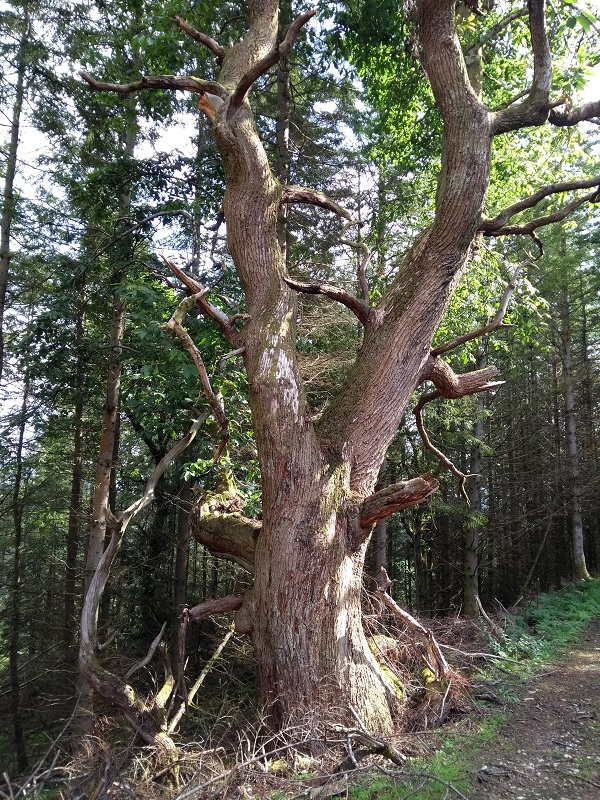
Broken and battered, an old sweet chestnut tree ismushrooms3 surviving the metallic blundering of the foresters’ vehicles, harvesters and forwarders, along the track. How did it get here? Not a native tree, so planted a long time ago, when this haphazard forest was occupied in a different way. Who planted it? Did they hope for chestnuts to roast on autumn fires?
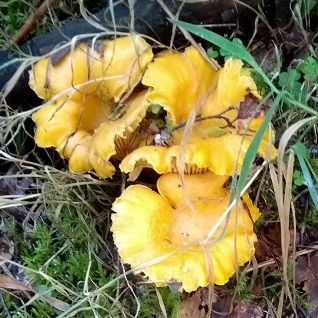
I follow the hint of a track down a slope towards the thicket where rhododendron is making its usual bid for world domination. No more than a wisp of trodden grass and bent fern, my path diverges and peters out at a crop of the biggest chanterelles I’ve mushrooms2ever seen, tucked into the side of a rugged bank that oozes water. Was this path made by a human who knew where to look, or by another animal? Someone told me yesterday that the best chanterelles are on banks and slopes because the deer can’t graze them there.
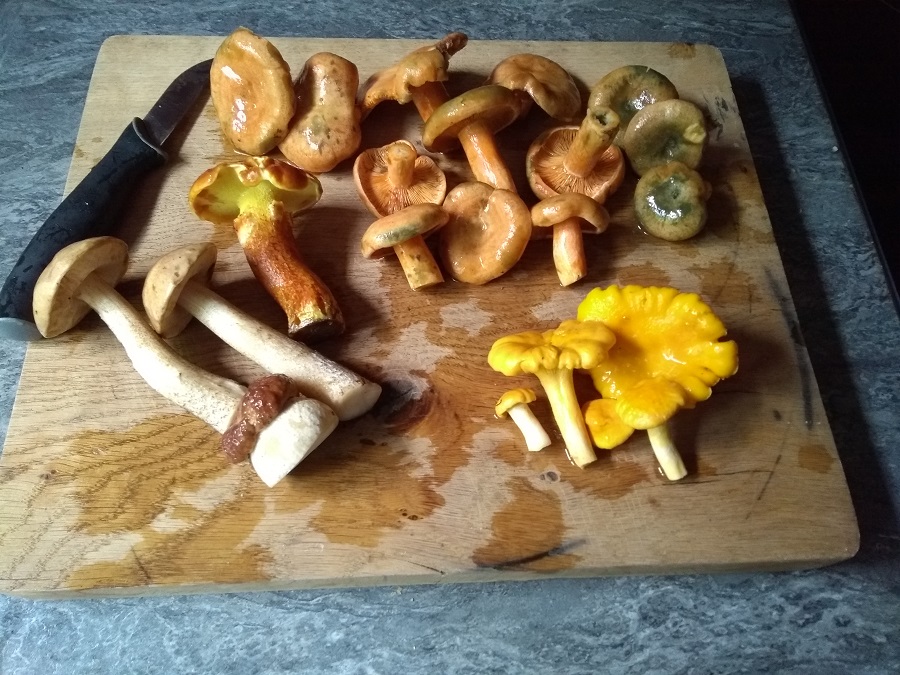
I’m always competing with other animals for my dinner. But I’ve had lots of chanterelles this summer and there is still a dish at home in the fridge. I take a couple. I have rules when I’m foraging. Never take more than I need, only take a percentage of whatever I find, leave old mushrooms to sporulate, leave young ones for tomorrow, for the next predator or none, for others just to see and love.

Under birch, I acquire some young Brown Birch Boletes and a single Cep. Ploughing through forest, I note the tiny horsehair mushrooms are up and about, trooping on twigs and the needles of conifers. I ignore, too, the many “wee brown jobs” of mushrooms that once I diligently took home as single specimens to try to identify with hand lens and spore print. Some I succeeded in pinning down, too, only to forget them altogether until I came across them again in another wood, another year. Life’s too short now, I am focused on my prey.mushrooms4

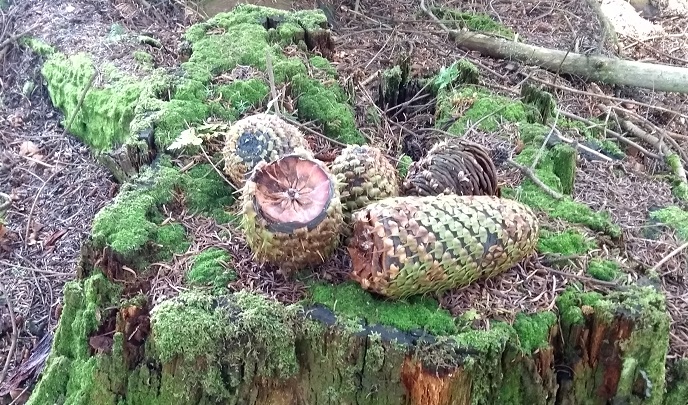
Huge shaggy mushrooms shout out to me as I pass another grove of conifers and I am lured in. But they are the uneaten halves of massive fir cones – red squirrels have eaten the succulent tops from every one, and laugh at me from the tree tops.

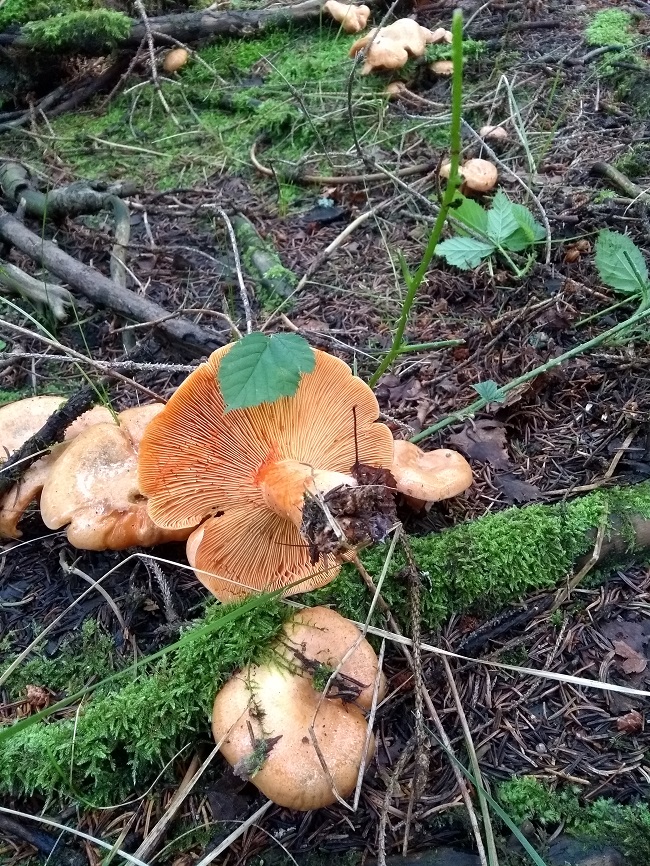
They cluster in the fallen forest by the dam, the new flush of Saffron Milk Caps, just where I thought they’d be, and just at the right stage before the fungus gnats lay their eggs. They are sound, and plentiful and could make a wonderful painting, with their improbable colours of orange, cream and khaki-green. But they won’t, for I take my portion and weave them into a spell of dinner.

mushrooms 5