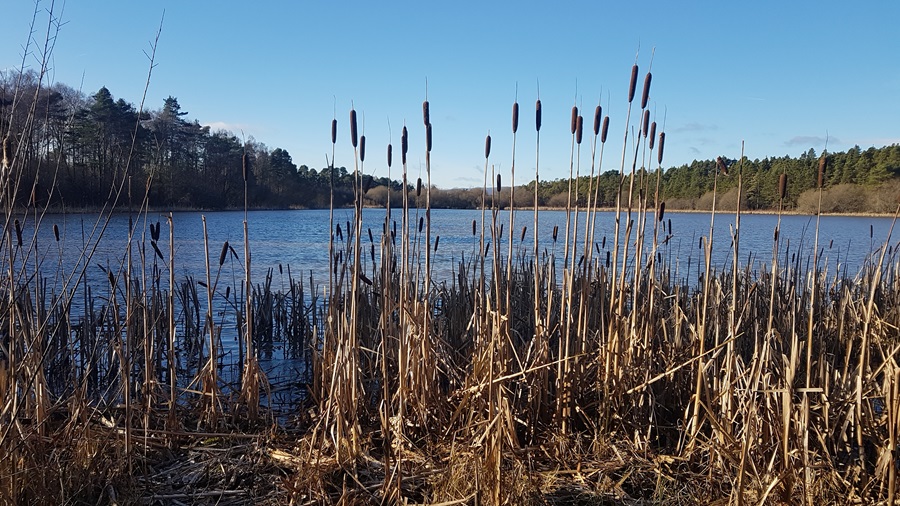
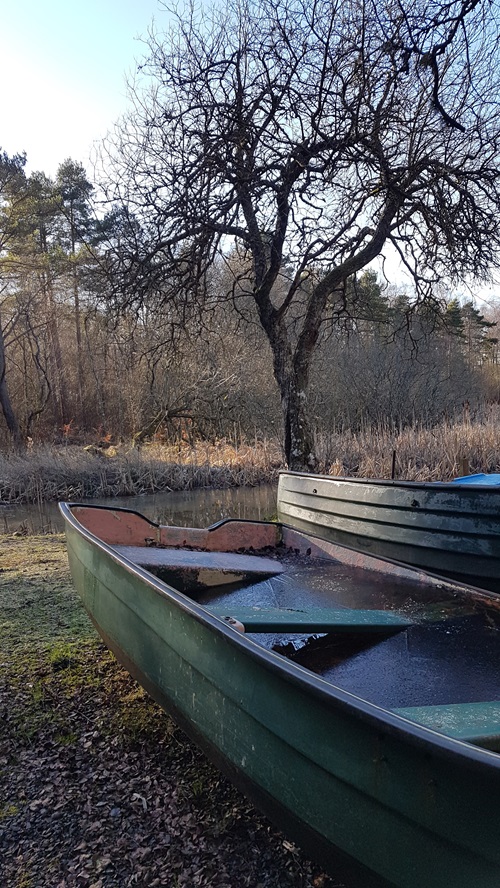
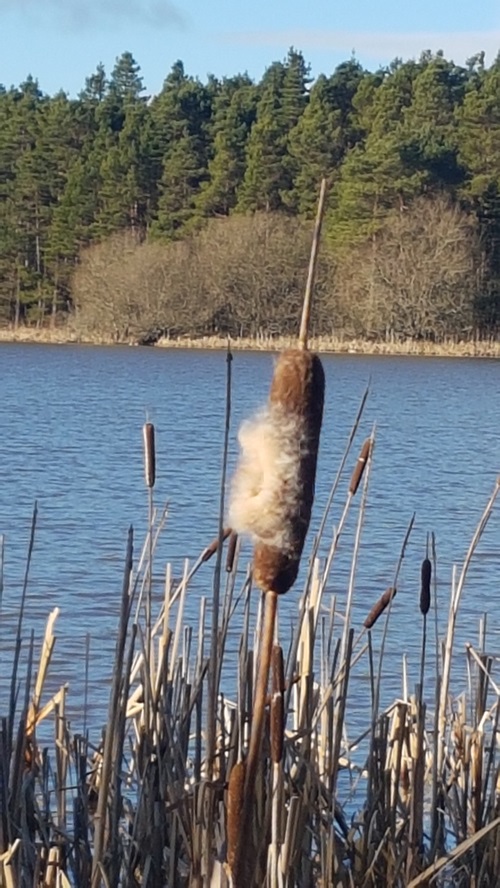
On a quiet day of winter sun and muted activity from woodland birds, I arrive at King’s Myre again. Reed Mace flowerheads from last year cluster around the watery margin, clogging the channel by the little jetty where the boats wait and fill with rain. We used to call them “bulrushes” where I grew up, and it wasn’t till Mr. Illesley, in Rural Studies, enlightened us all about the differences between reeds, rushes, sedges and grasses that I ever learned their proper name– or that Reed Mace is related, but none of these anyway!
It is the same plant known as cattails in America, and valued throughout its distribution for its edibility. The rhizomes – root like underground stems, or underwater ones in the case of this plant – are starchy and filling when baked. They can also be dried and ground into flour, though I never have. The pollen from the male flowers can be used as flour too, or to thicken sauces and soups. It has many medicinal uses. But the best part is the emerging shoot – which will be appearing above water level any time now. Cut, cleaned, steamed, baked, sauteed – it is a lovely spring vegetable to rivals asparagus or bamboo shoots for flavour and versatility. You can keep eating the shoots until the flower spikes start to emerge, you don’t need waders to forage it, and, as Reed Mace is actually quite an invasive plant, it’s pretty sustainable to nibble bits off the clump! Last year’s flowers are starting to burst apart now, revealing the dense, cottony-fluffy seedheads inside.
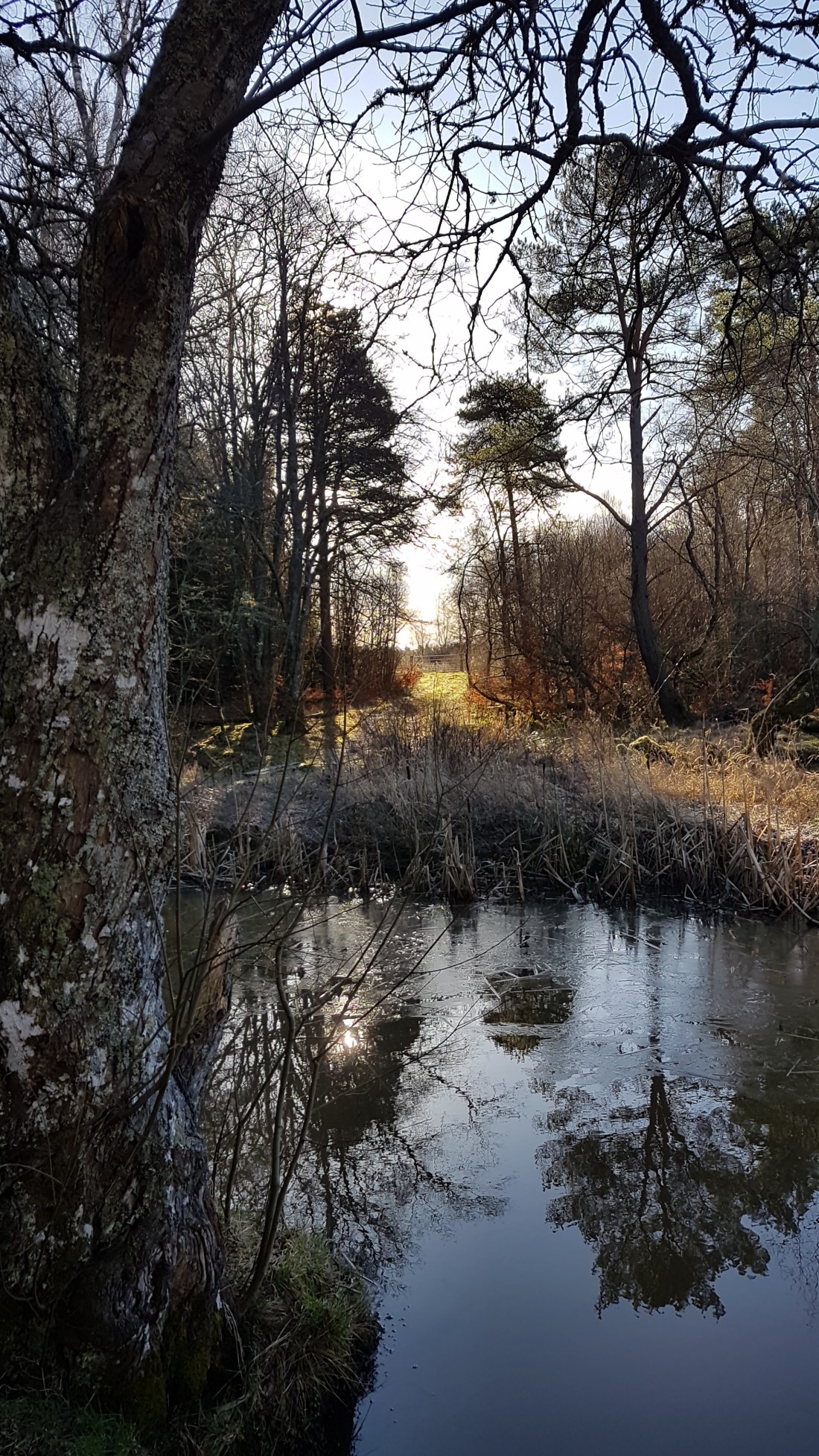
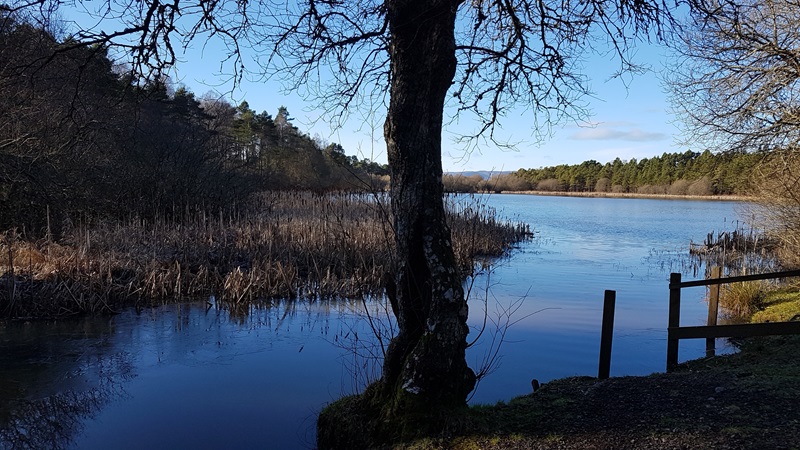
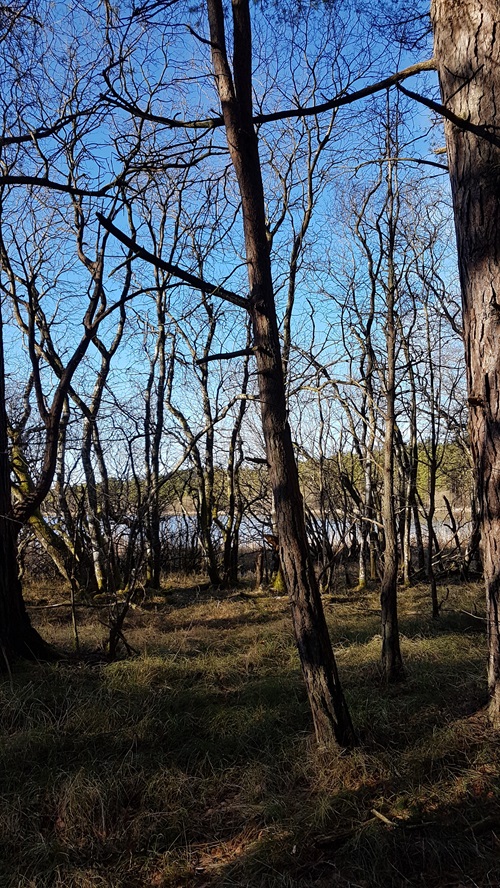
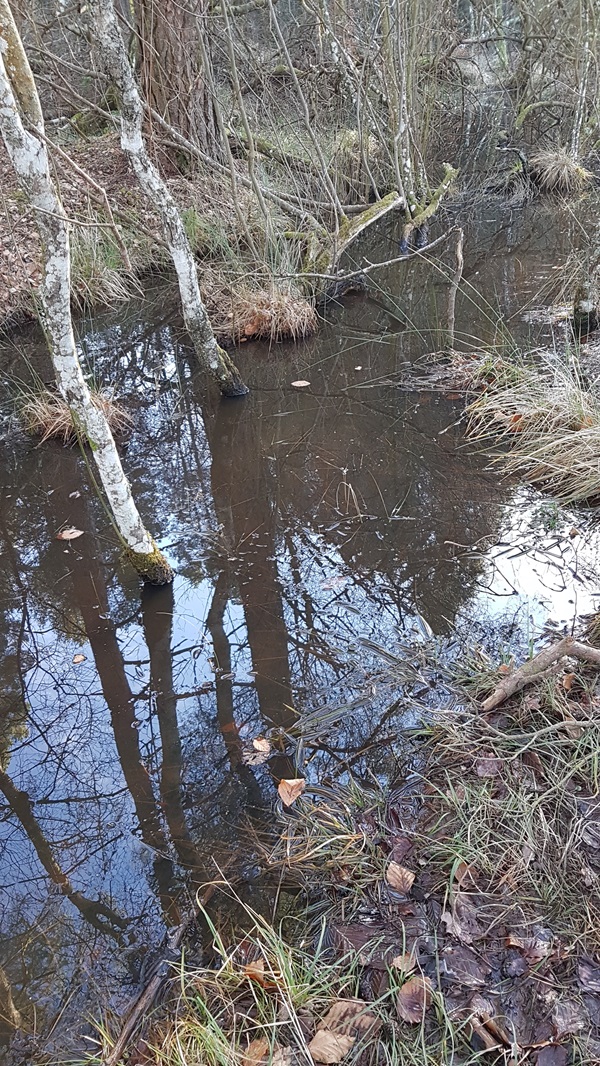
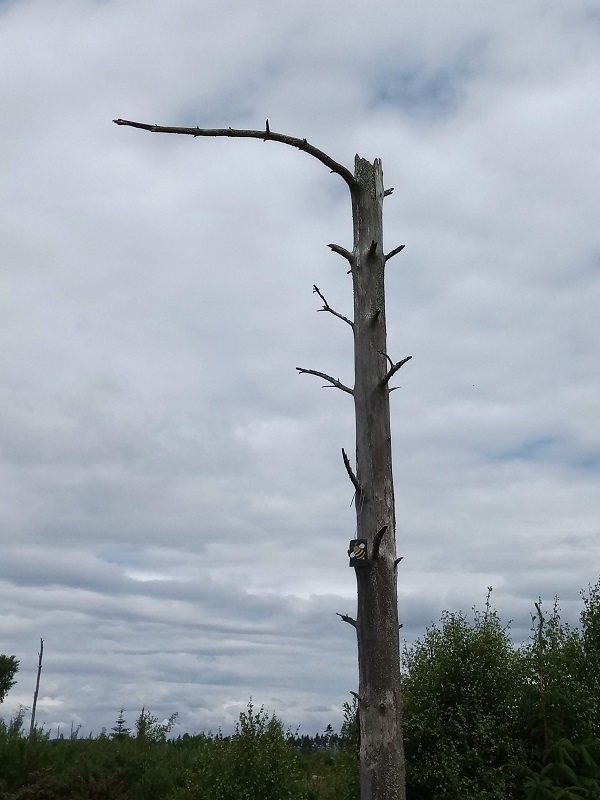
I creep through the spongy, saturated margins of the little loch at the heart of the King’s Myre, to peer through the cattails to see what wintering birds are on it today. Goldeneye, a few gadwall, mallards, a coot, typically swimming against the tide of the rest, intent on his own adventure. No sign of the swans, too early for the osprey to be home yet. In the damp woodland, waterlogged alcoves and scrapes, from which spiky, angular trees grow erratically, wait for frogs and toads to arrive for spawning. Between bare branches, multiple trunks and stems and a storm of tiny twigs, the blue sky seeps as if caught in a vast, arboreal net, reflected in patches of water.
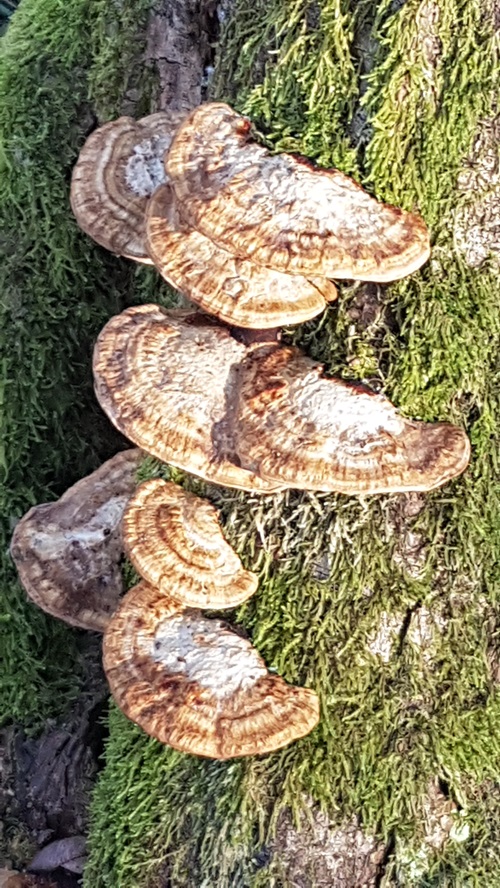
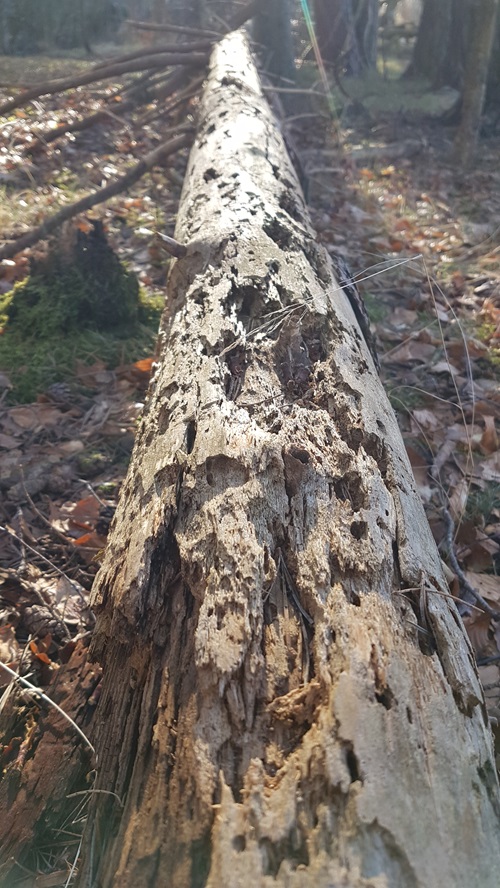
Bracket fungi show off their smug Cornish-pasty smiles of concentric bands, on wood they share with moss and lichen, and a thousand invertebrates. Spread across the leaf-carpeted floor, long-dead logs, un-barked, silvery, yielding, are home to thousands and thousands more, riddled with holes and channels and hidden tunnels in the fungus-softened wood. On cue, somewhere in a dead tree, a woodpecker begins his first tentative drumming and drilling.
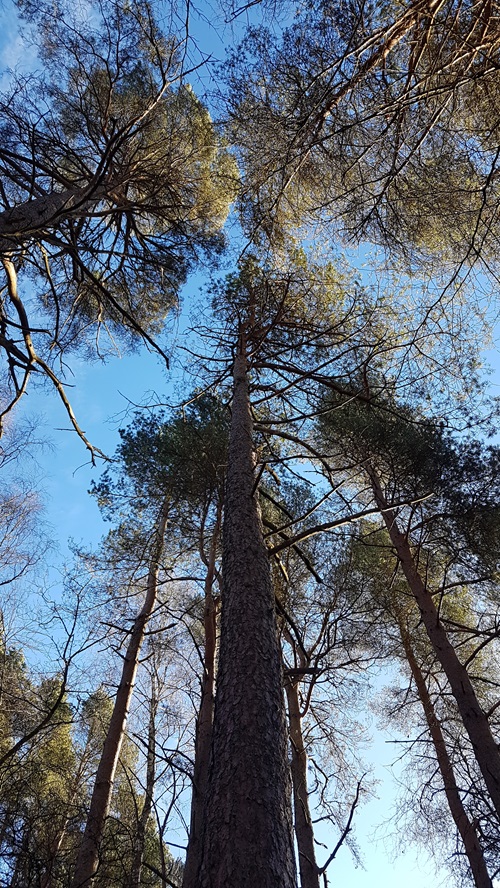
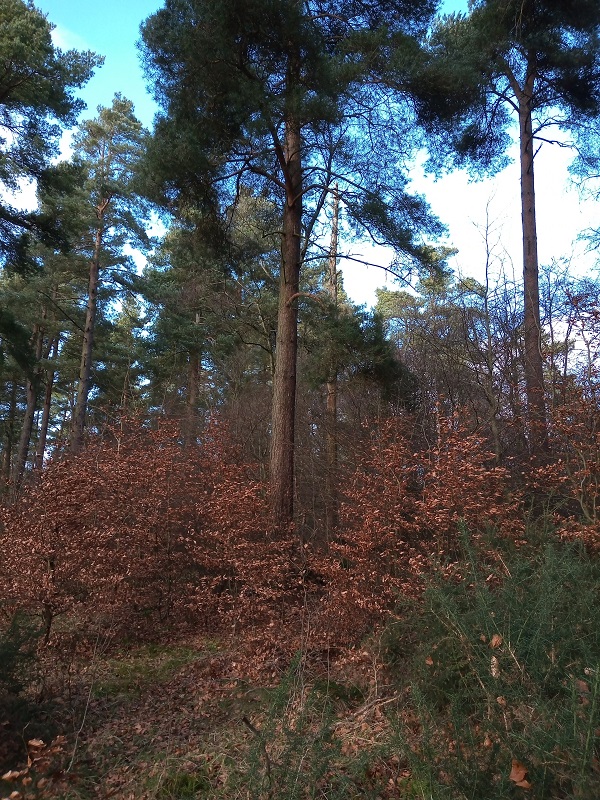
I look up into the Scots Pines, their narrow crowns dancing around each other like polite or nervous teenagers, and see the shapes of jagged sashes of sky, so clear, so blue….
Look up, look through, look between – there is much to see. Or is there only sky?
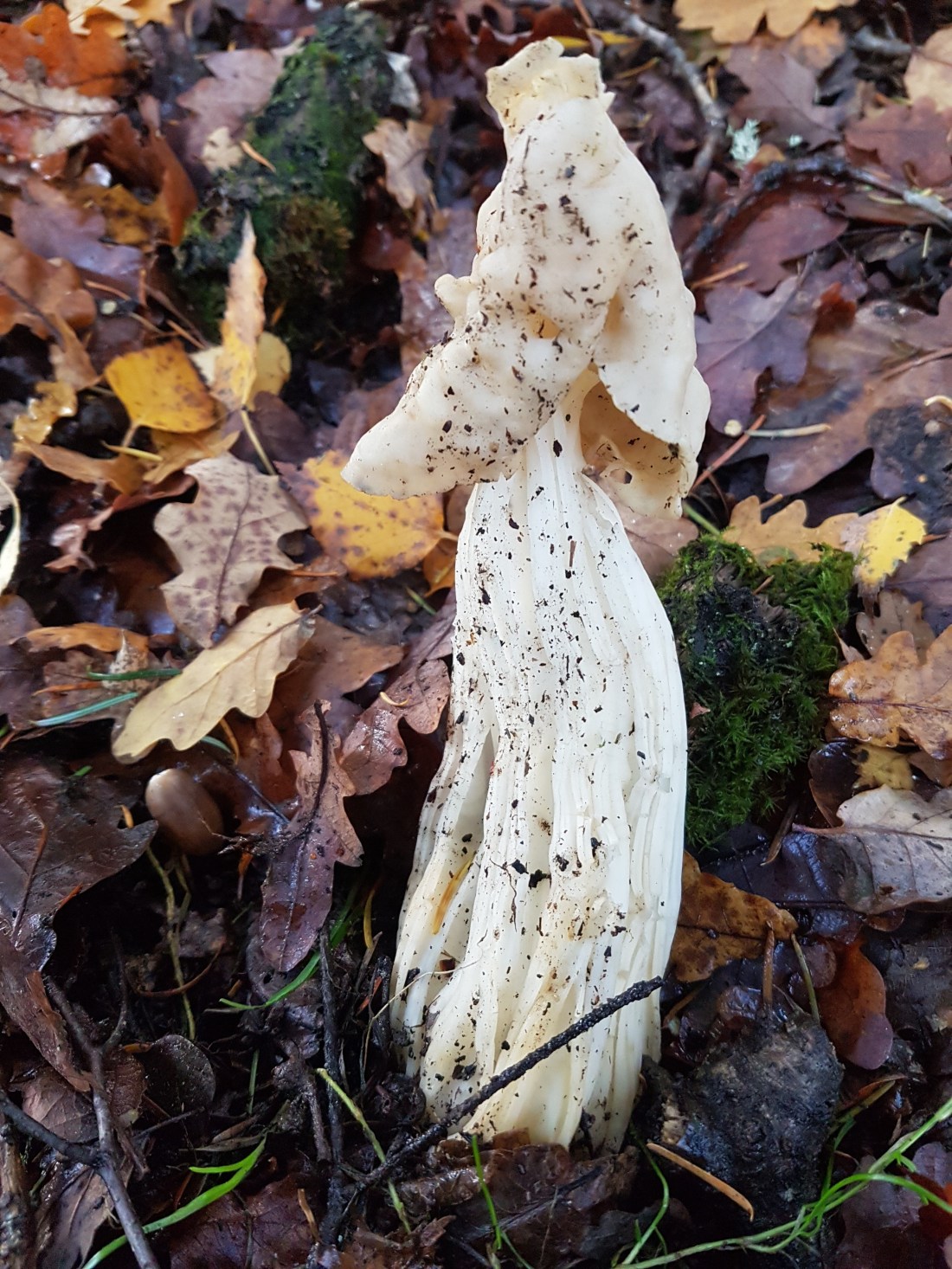
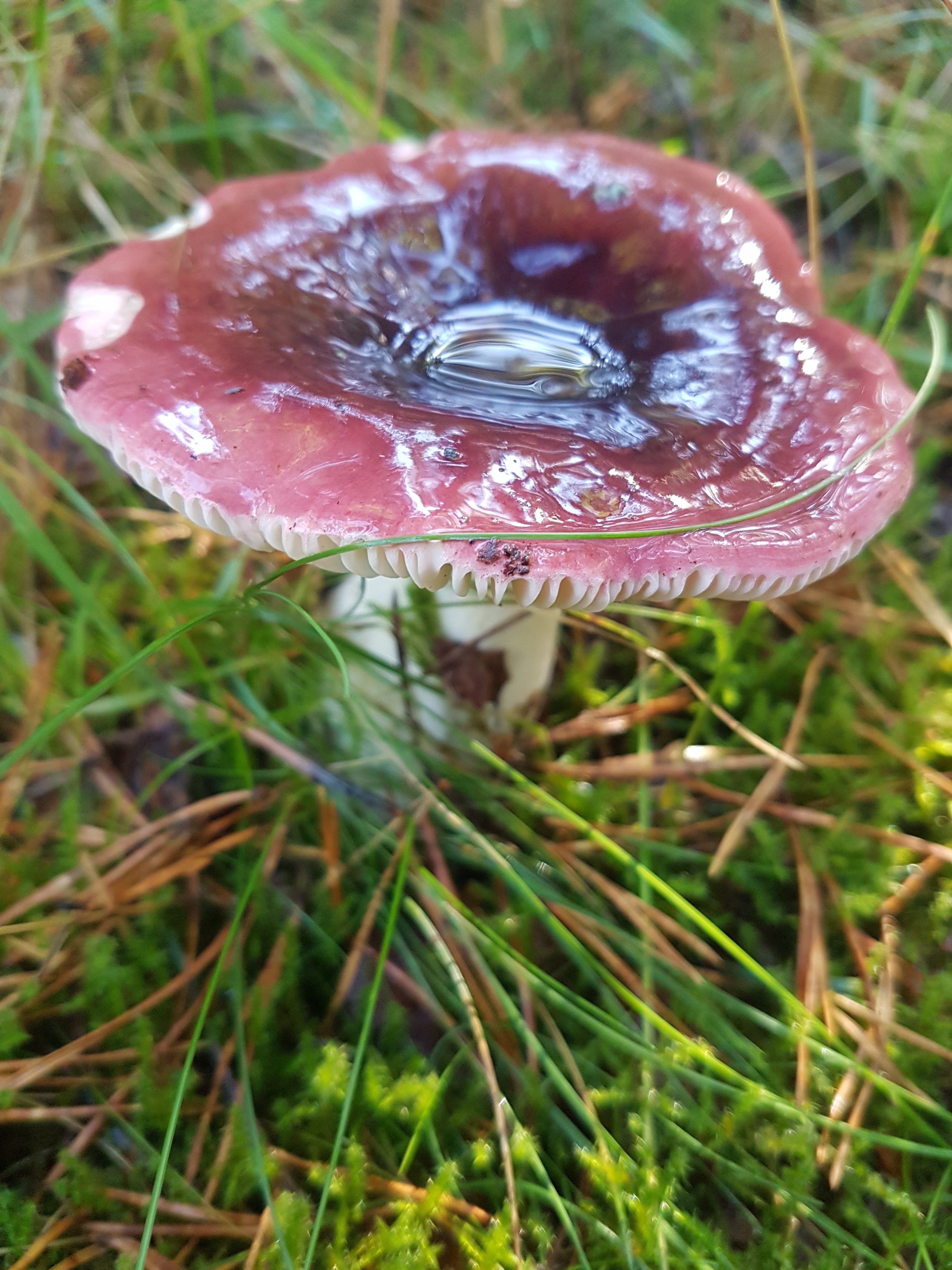
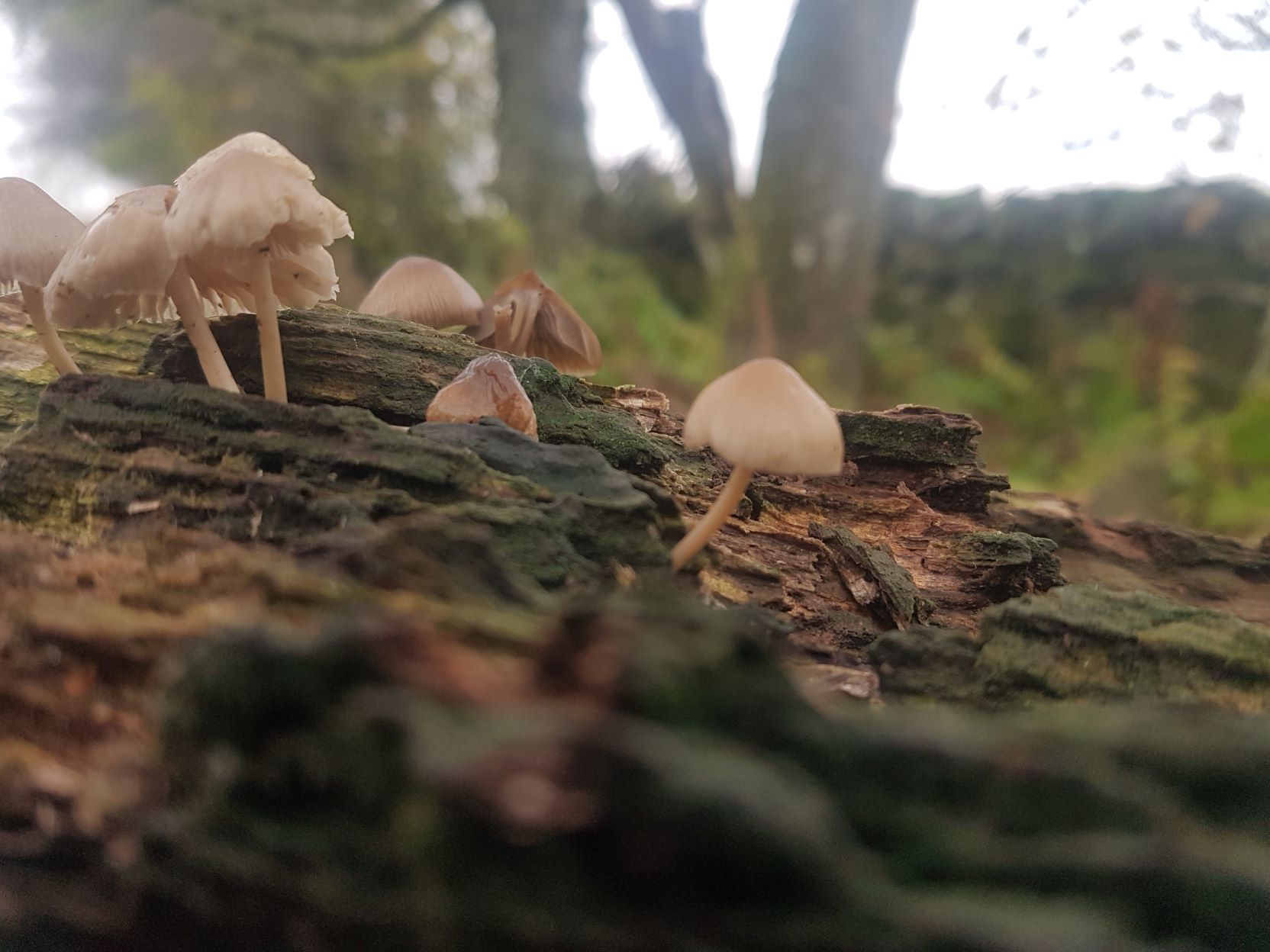
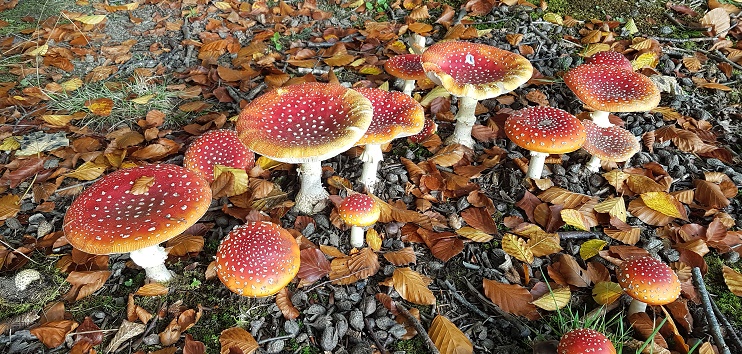
If you are out in the countryside and find a mushroom you think is poisonous, do not panic and trample or kick it to ****. It cannot kill you unless you eat it. It doesn’t even want to kill you and it cannot chase after you either. It is a beautiful organism trying to reproduce itself. Leave it alone. (Oh – and do not eat it) (Photo above is an example – isn’t it lovely!)
If you find a mushroom and you don’t know what it is or if you can eat it or not, see 1. The same applies. If you want to identify it, take a photo and maybe one specimen.
If you find a mushroom, that you 100% know you can eat and you want to, pick – but adhere to these sub-directives: * Don’t pick the whole blooming lot – never more than your personal needs That includes large mushrooms like Chicken of the Woods growing on trees – never take it all * Always leave plenty of young and old (reproducing) specimens behind * If there’s only one or very few, leave them for others to enjoy, including other fungus-eating species such as deer * Keep your big feet from trampling the site and all the ecosystem it holds to bits. Tread lightly and avoid damaging vegetation * If you carry an open-weave basket, your dinner will arrive home in better shape and may even shed some spores along the way
With particular reference to Giant Puffballs: these are not footballs – they are not spherical. Nor are they rugby balls, golf balls, cricket balls or any other species of ball. Therefore, do not treat them as one. If you would like to eat one, pick it carefully, take it home, and share it with like-minded friends before cooking it. This is because if you try to eat a full-sized Giant Puffball on your own, you will be feeling nauseous by day three. They are way too big for one forager.
If you have children, take them foraging and teach them why fungi are so important to life on earth. Let them learn what’s safe to pick and what to leave alone as you do. Introduce them to this appendix to the Countryside Code.
(If you don’t know yet why fungi are so important, Entangled Life by Merlyn Sheldrake is a good read.)
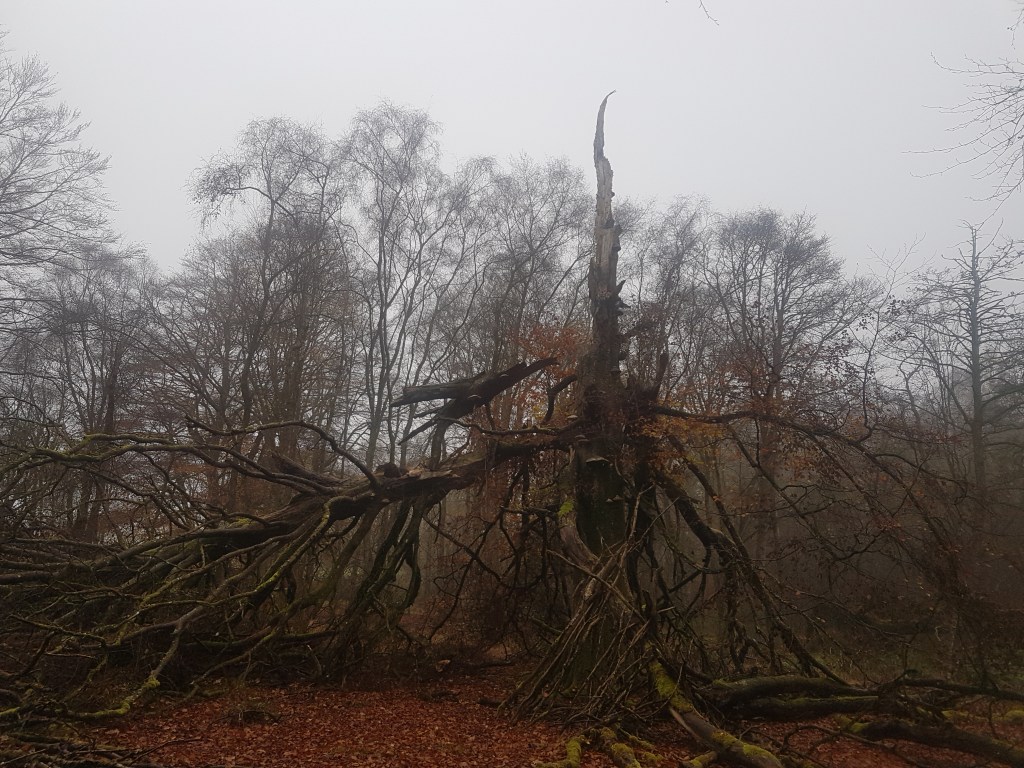
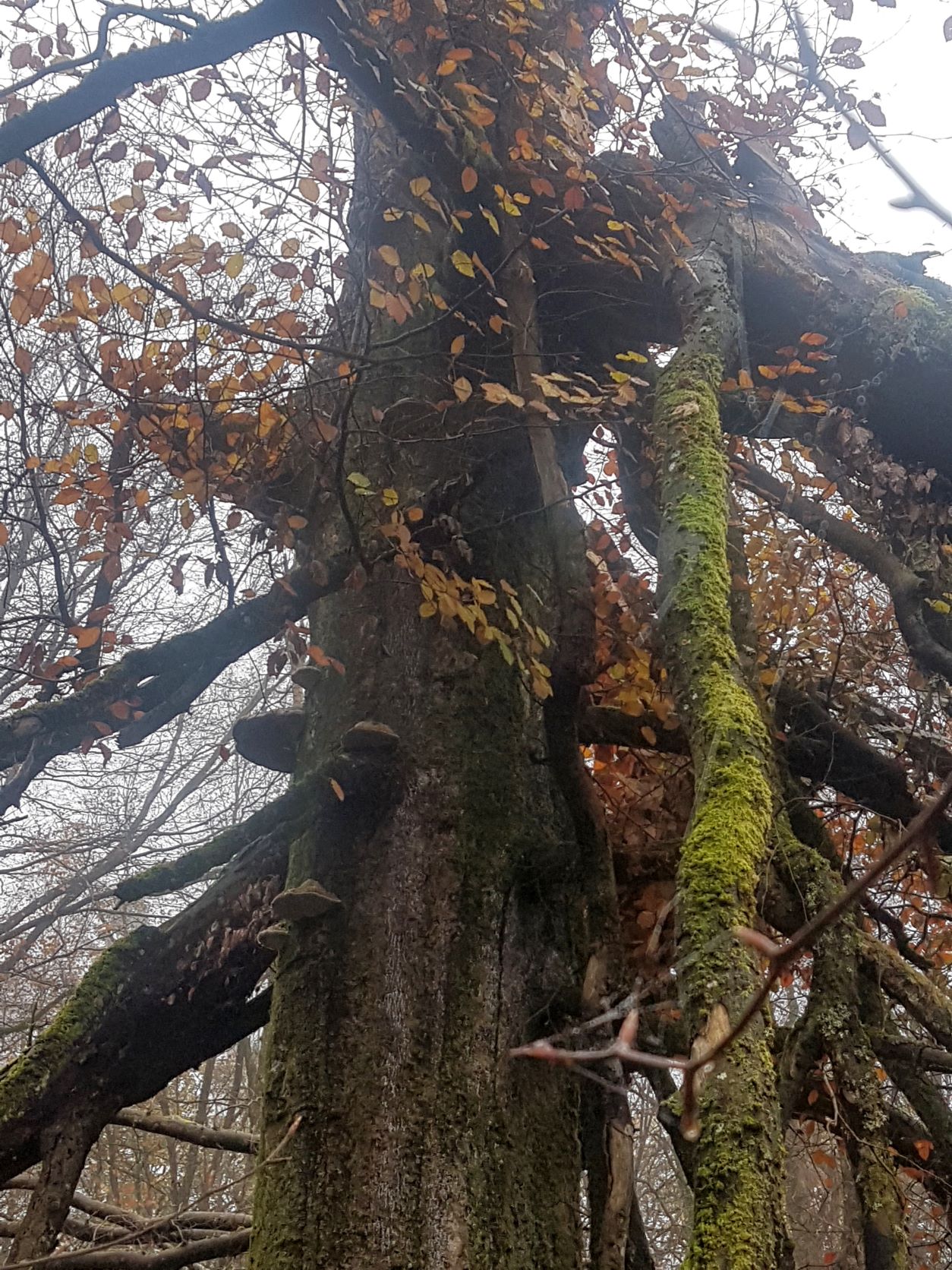
It began by shedding branches in every storm, this multi-stemmed beech tree. Being a beech, whose toxic leaf-litter successfully manages to put off any tree or shrub (even its own offspring) from growing under its canopy, there is plenty of space for the branches to lie. For a few years, it was my go-to place to harvest the beech-specific, edible, incredibly slippery Porcelain Mushroom in late autumn. This year, the fungus appears to have exploited all the suitable fallen branches and moved elsewhere.
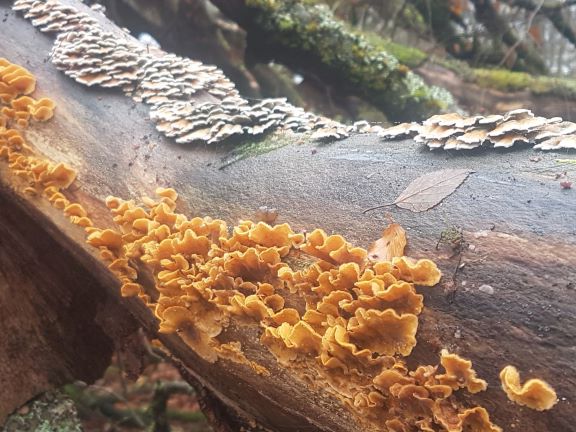
No shortage, though, or other fungi. They peer from behind the remnants of bark, congregate on dead wood, splash colour over the domain of the doomed beech tree. Now, whole trunks are falling, large brackets appear near the snaggy top of the one remaining trunk, piles of branches and fallen debris cover the ground. Meanwhile, leafy twigs still emerge from parts of the tree – it’s not dead yet!
Is a tree ever dead? Though branches crash down, timber decomposes, bark is shed, these are all the signs of a massive construction programme. The mushrooms and bacteria are building soil. The mosses, lichens, ferns and flowering plants are taking hold and creating gardens. Invertebrates in their thousands are moving in, chip-chipping away, getting in, getting under, uprooting, making a tree metropolis. Birds and small mammals home in on the seething busy-ness as if to an urban food-market, finding homes in the piled deadwood and tree-openings. Human foragers like me, and other large animals such as roe deer, visit for breakfast mushrooms. In spring, chickweed wintergreen and wood sorrel will cautiously return to woodland lighter and less toxic.
As the tree slowly, and apparently, dies, it shouts louder and louder with life,
The little wood that lies an easy walking distance from my house is juvenile. It was planted maybe twenty-five years ago, mostly with hazel trees that have grown with multi-stemmed enthusiasm, peppered with birch and rowan, interspersed with tall sycamores and oak trees, now starting to muscle their way above the copse. Blown-in elder, and suckering blackthorn garland the woodland fringes. There are literally thousands of small ash seedlings covering much of the woodland floor; few-to-no surviving older ash trees. I wonder how these babies will fare in the aftermath of ash die-back disease. A large proportion are annually grazed out by deer; there are hares and hedgehogs hanging out in the top part of the wood, and I’ve seen red squirrels using the wood as an aerial highway. They, and other small mammals, feast on the hazelnuts in winter. This year, I heard and saw flashy jays on the rampage, and I’m seeing hazelnut stashes which may be their doing.
I’ve always referred to the wood, with unintentional and misplaced territorialism, as my larder. It contained the best patch of nettle shoots for soups, teas and pesto for miles, though these have now shifted as the shade has increased. In early summer, an army of Common Hogweed supplies me with chunky flower-buds to make my favorite pakoras or to braise as a vegetable. One day, I may be obliged to harvest the seeds to make flour; it’s as well the species is expanding its range. About the same time, elderflowers are picked for cordial or champagne, or just to eat. As summer winds on, the patch of feral raspberries in the clearing start to ripen. This year, they were pretty poor though, as are the ones in the garden. I’m not sure why. Competition from the broom, perhaps, whose yellow flower buds go into my May salad bowl.
I harvest the hazelnuts haphazardly; the trees I used to pick from now bear their nuts too high for me to reach – I either wait for the profligate mammalian and avian foragers to knock them to the ground or I gather from smaller trees, self-seeded from nuts none of us ate, or from trees on the edge. When I have enough and they are shedding their frilly petticoats, I shell and roast them to get the lovely chocolatey smell. Usually, about half the shells are empty.
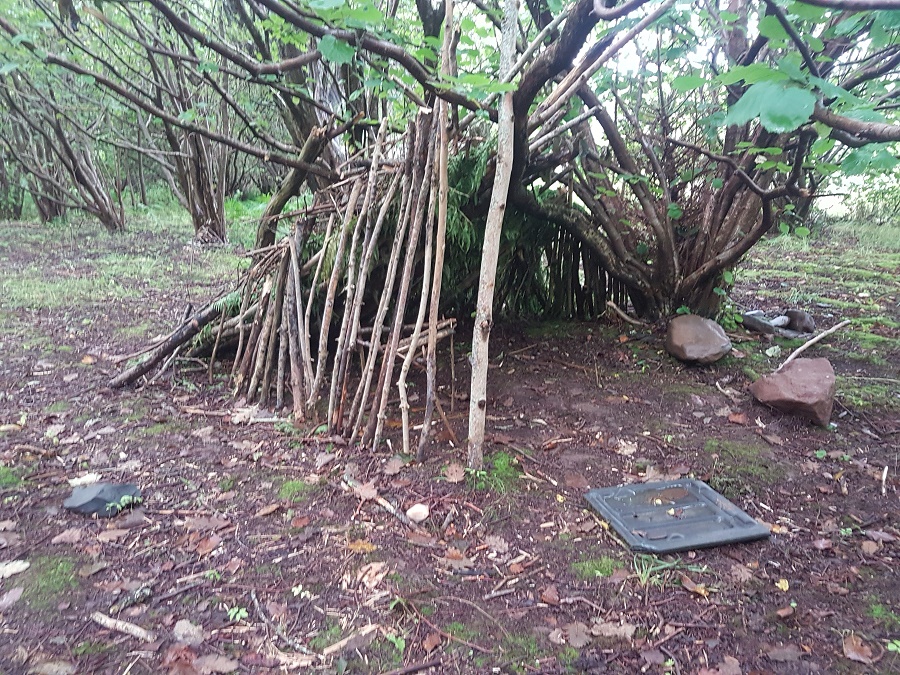
The hazel wood is also the store I visit for the likes of washing-line props, bean-poles, and pea-sticks. No need to cut these poles, as regular storms bring more down; the forest floor is littered with useful sticks for every purpose, not least, lighting the stove. Children collect the long ones and build them into dens.
There are many uses for hazel wands…..
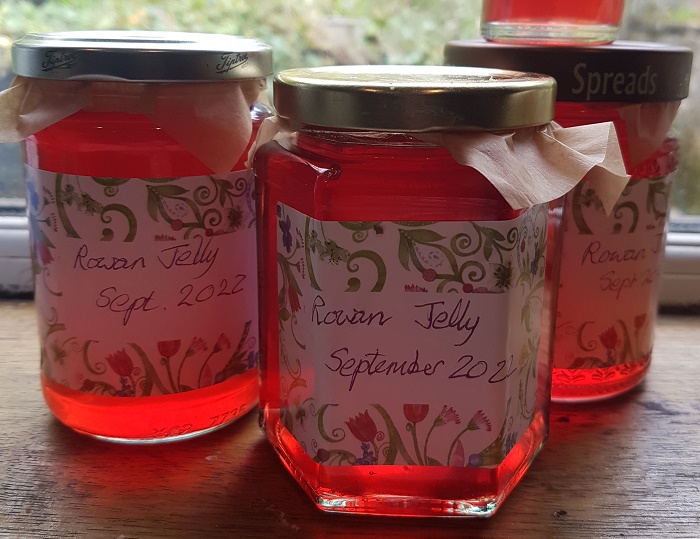
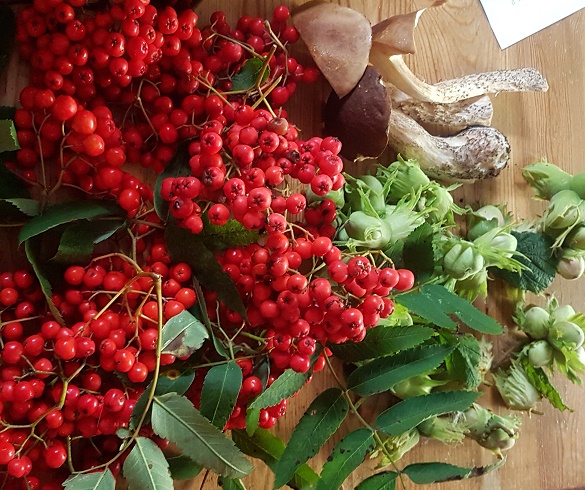
Today, I’m collecting rowan berries for the sharp, rich red jelly we’ve always had as a family to accompany Christmas dinner, and thereafter, everything else. The young rowan trees bear copious fruit, but I have my personal favorite trees, where the berries are larger, a feistier red or more juicy. I note the elderberries are nearly at picking stage, too – a winter essential for medicinal elderberry vinegar, or, mixed with hips from the wild roses along the field edge, a soothing syrup. Likewise, there is a particular hawthorn bush that has fruits large and sweet enough to stop and nibble at while contemplating the sunset or sheltering from a cloudburst. They make good liqueurs.
I gather a couple of Brown Birch Bolete mushrooms as well. It was a fair few years ago now that these edible fungi began to appear around one of the multi-stemmed birch trees. I don’t pick many, and am always watching for new patches of fruiting bodies as the mycelium spreads to other birches. It’s been fascinating watching how the fungal flora in the little wood has gradually established itself as the trees grew, and fungal threads found their roots, to embark on that precious, beneficial relationship that entangles both and is called the mycorrhizae (“fungus-roots”). The species I find have changed over the years, and will continue to do so. I hope more edible species will arrive soon. The Birch Boletes I don’t have for breakfast will be dried for the winter.
Will it be a good year for sloes? There have been crops from the blackthorns on the field edge so fantastic I’ve stopped making sloe gin for a while. Maybe time for another batch. The blossom was there in March, so I’ll check it out. If there are sloes, I’ll wait for the first frosts to make them tingle, and see if the birds have spared me any.
Later, when the leaves fall in tawny profusion, and the rose-bay willow herb from which I selected early shoots in spring for fake asparagus has shed its seeds, when the air starts to nip and my breath makes clouds, I’ll harvest the peace of the woods, the melancholy inertia, the stand-and-stare compulsion of fractal twigs and branches and the patterns on bark.
And perhaps pick curly, frosty old flower-stems of the willow herb to decorate the house for Christmas.
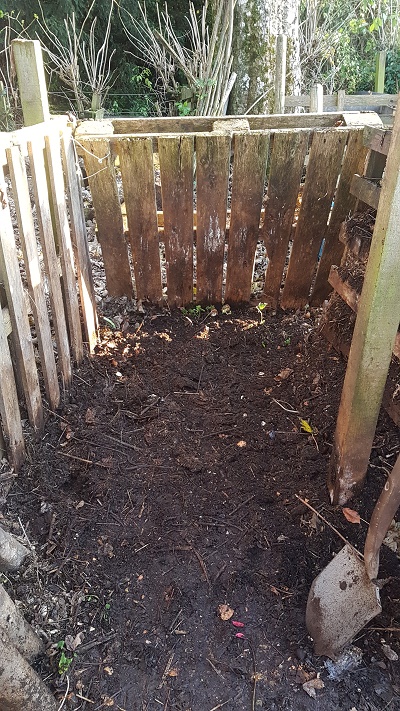
This week my Google Tasks told me I had to turn the compost heap. I assume I told it to tell me that at some point. I have two largish compost bays (minute in comparison to some, such as the magnificent compost-heaps-from-heaven at the community garden at Hospitalfield in Arbroath – you could bury a small house in each of their bays). I also have several bays and bins for leaves, imports of dung, and bulk biodegradeable materials in waiting, but it is the management of these two main piles that coincides with that moment when summer and autumn are subtly but surely dissolving into winter. For many reasons, I see winter as the start of a new year, and turning the compost always signals new beginnings, new plantings.
The first stage, actually, is barrowing and spreading all the finished compost in bay 2 onto beds and borders around the garden. This has been going on in stages for a couple of months, with sticks and undigested material being thrown back into bay 1. Bay 1 is starting to groan under the weight of future compost, as annual vegetable plants, bean and pea debris and a mountain of weeds from tidying up raise the height to almost unreachable. Once bay 2 is empty, everything in bay 1 can be moved over, introducing oxygen and stimulating breakdown. The topmost material is pitchfork stuff – or even just grabbing arms-full of dry debris and chucking it into bay 2. I try to put the most fibrous material in the middle, where the heat will be highest, making it in theory the best place to break everything down. If I can clean out the chickens just after all this top layer has gone on the bottom, the aromatic stew of chicken poo and wood shavings works as an activator.
The middle layer next, and it becomes more interesting. Here the brandling worms that thrive in the warm centre are busy at work, oodles of them, squirming voraciously in the decomposing mire. They are the visible agents of change, but unseen workers include many kinds of fungus and bacterium, at least as important. The middle layer is a seething mass of activity, and I make sure that on transfer to bay 2, the “working layer” maintains most of its integrity. Composter organisms are forgiving, though, and will migrate to the part with the right temperature if they find themselves compromised. Meanwhile, the garden robin and blackbird perch nearby, popping down for a feast of something whenever I pause to straighten and stretch.
Now the two piles are roughly the same height and I get into a rhythm with the pitchfork. The work is easier. I reflect once more how well yoga practice fits me for gardening – turning compost means twisting without injuring your back, and balancing on wobbly compost to reach the stuff at the back and sides of the bay. I work away getting the compost from the cooler edges into the middle and am left standing on a small pinnacle in the middle of bay 1.
Delving down the pinnacle, the number of compost worms decreases, and the ability to combine a twist with a forward bend comes into play…..work is getting harder again and I don’t want to suffer later! I start to turn out large numbers of wonderful centipedes. Centipedes are carnivores, not detrivores – they are not adding to the composting process, but hunting smaller creatures who live on bits of decomposing plant and humus. In the garden they are generally really good news, as they also eat the invertebrates who want to steal our crops. I try to catch one or two for a photo, but they are camera shy, and very, very fast on all those legs – as true hunters should be.
Photo by u0413u043bu0435u0431 u041au043eu0440u043eu0432u043au043e on Pexels.com
So, near the bottom of bay 1, the compost is as complete as it will be, and ready to use without being turned. I start to fill barrows of the good stuff, rejecting some unprocessed bits and pieces but not worrying too much – any unfinished business should happen in situ, over the course of winter. I dump and spread the compost on beds and borders. I don’t dig it in – no need. I have earthworms for that. It isn’t perfect, my compost. Eggshells hang about for ages, for example, and every autumn I dredge up a few well-rooted avocado plants which have grown from stones that never seem to decompose. (Neither do the skins). The heat given off by decomposition enables them to germinate. This year is no exception, and as usual I take pity on one, pot it up and take it into the warm greenhouse, where it will grow into an untidy, straggly, leaf-spotted pot plant with no hope of bearing fruit, and I will start trying to give it away to unsuspecting friends with more optimism than I have about its value.
The last few shovelfuls, the final pitchfork-loads, and lo! I discover that the sticks I placed at the base of bay 1 last autumn because in a whole year they had failed to become compost are still there, barely altered….. I spread them across the base, along with the 3 year old thick cardboard tubes from inside the new polytunnel cover… they ARE biodegradeable, and I WILL win this battle….one day! On the plus side, after years of running a nursery here when thanks to lack of time and the vagaries of some of our volunteers, my compost heaps produced more plastic than a supermarket, this year my accidental plastic input and retrieval is minimal – and I can re-use the two ties and labels. And only one unreconstructed plastic-reinforced tea bag, right at the bottom, since we have found plastic-free brands.
Plastic pollution in decline!
I level the top of bay 2, and cover it with carpet. I know that within weeks, heat will build up and by spring it will be less than half the height it is now.All is done, and so am I, yoga or no yoga. And yet I’m incredibly happy with today’s work. Compost-making is the heart of my gardening life, the most satisfying, the most compulsive work, returning to the earth the things of the earth. I hope I have a good few years of compost-turning left!
There are different kinds of walks-with-mushrooms. My first, fifty years ago, were cataloguing walks, an academic exercise that became an obsession. A specimen of each would be removed and bagged (no smartphones then, and my Kodak Instamatic didn’t really cut the mustard, though I did try), taken home, pored over for hours to try to identify it, and then a spore print taken. This was all in the cause of a college Rural Studies project that I somehow never grew out of.
When I began to differentiate the ones I could eat from the poisonous ones, foraging AND cataloguing walks happened – a basket for the ones I knew I could eat, and another for the unknowns. Many remained – and remain – unknown, something which used to really bother me. However much later when I was regularly leading foraging walks, I realised that so long as I could recognise the “edible and good” fungi and the poisonous and dodgy ones, most people were happy if we could pin the “small brown jobs” down as far as a genus.
I still take huge interest in identifying weird or remarkable specimens that I’ve never seen before, but these days I’ve discovered the pleasure of walks-with-no-purpose-with mushrooms. This walk, meandering along the River Tay from Dunkeld, had no particular object but to be captivated by the surprise and beauty of the fungal kingdom – so often misrepresented, under-valued, the importance of which is not understood by the majority of humans.
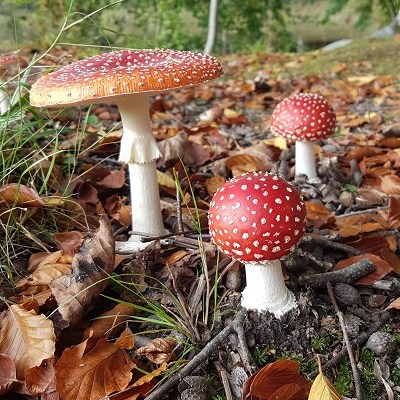
First came a phenomenal display of Fly Agarics, the mushroom of the shamans, too exquisite to pass by, shouting their wares, nestling in ground which was once birchwood. Their mycelium is always entangled with the roots of birch; from the beginnings of plants on dry land they have needed each other. They start as big white crusty buttons, the red skin of the cap breaking through the veil to leave those fairly-tale white “spots”. The cap expands, the spores fall. One was nearly as big as my head.
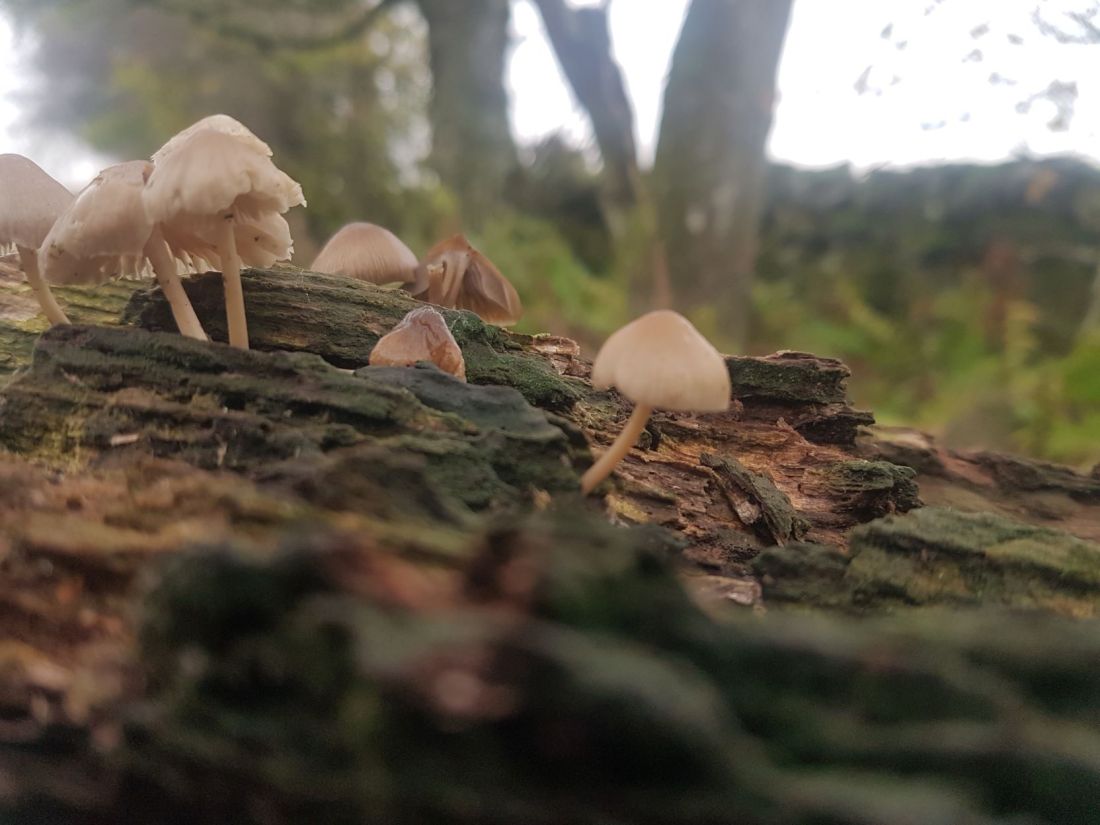
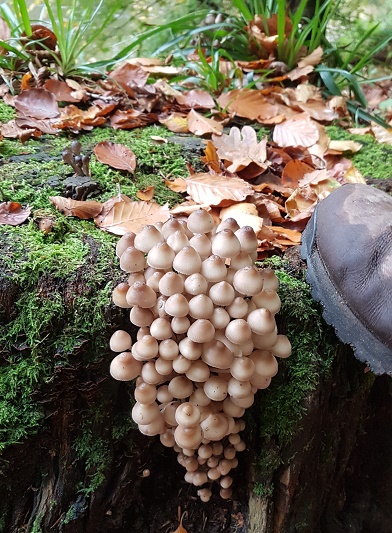
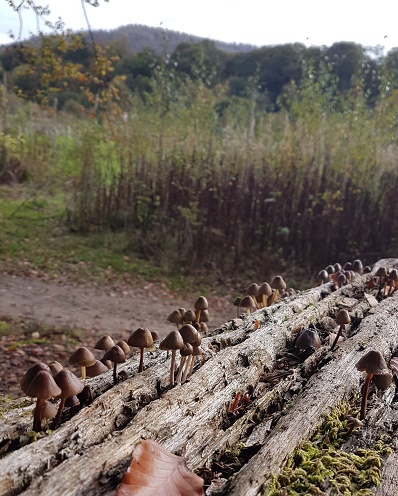
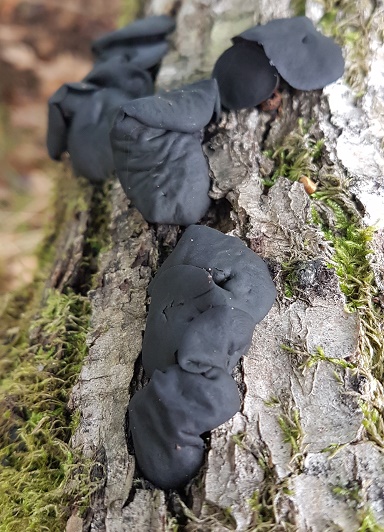
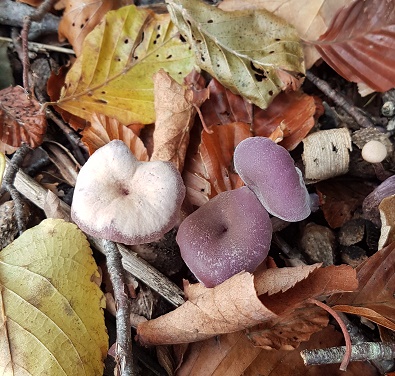
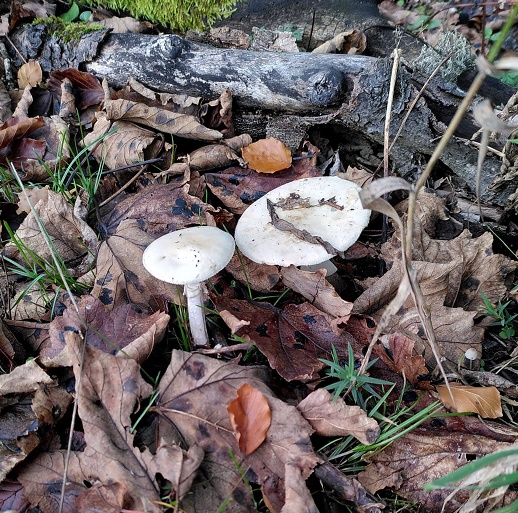
Troops of Bonnet mushrooms, various types, marched over fallen trees and gossiped in crevices of stumps, glistening in the sunlight. Shiny black excrescences of Witch’s Butter erupted from dead wood. Amethyst Deceivers – which I could have picked for eating but didn’t – showed all their colour range from vivid purple to washed-out grey. In the leaf-litter, the Destroying Angel, related to the Fly Agaric but far more deadly, glowed purest white. Such a potent name for a poisonous mushroom!
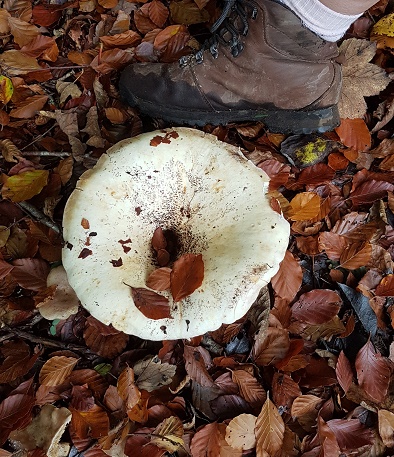
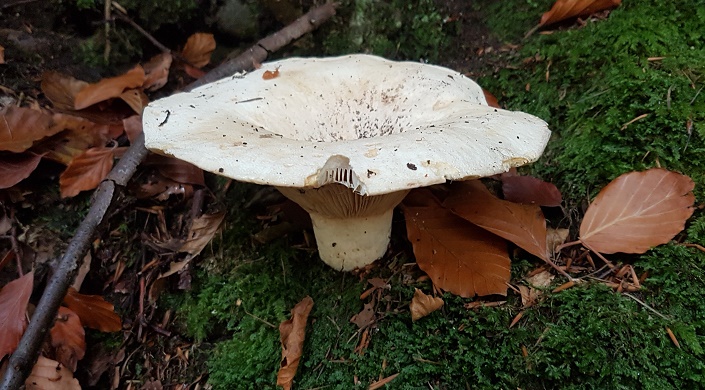
Giant Funnel Cap (Clitocybe gigantea)
Across the track lay a small segment of a huge fairy ring of an enormous mushroom commonly called the Giant Funnel Cap (check the size 8 boot in the photo for scale). This took me immediately back to those student Rural Studies Days, when I first saw this mushroom in local woods, in a ring that was actually measurable. From the fresh fruiting bodies came a strange, un-mushroomy smell. I took one home, identified it easily and, as the book said edible, fried it in slices. It tasted like its smell – like nothing I’d ever encountered. To this day, I’m still trying to work out if I actually like it! But size-wise, they are easy pickings, and it’s fun to estimate the equally astounding diameter of their fairy-rings and plough through the woods to try to find the mushrooms on the other side of it.
This walk wasn’t for foraging, for worrying about what I was looking at, and I haven’t bothered to tease apart the various fairy bonnets. Old habits die hard, but really, I don’t need to know!
The turn of the season is felt, not so much as a drop in temperature or the way the need for warm socks and waterproofs creeps up on you, but in the way the woods smell different. Decaying leaves, leaves still on the trees but for whom decay is imminent: the smell, for me, of being 11 years old and at a new school, where our introduction to Biology was the invitation to compile a Biology Scrapbook over the course of a year. Diligently, I collected all those leaves on the point of rotting, pressed them in encyclopedia volumes, and learned, when I next opened the books to mount them, the subtle distinction between the smell of sycamore, poplar and oak leaves in autumn.
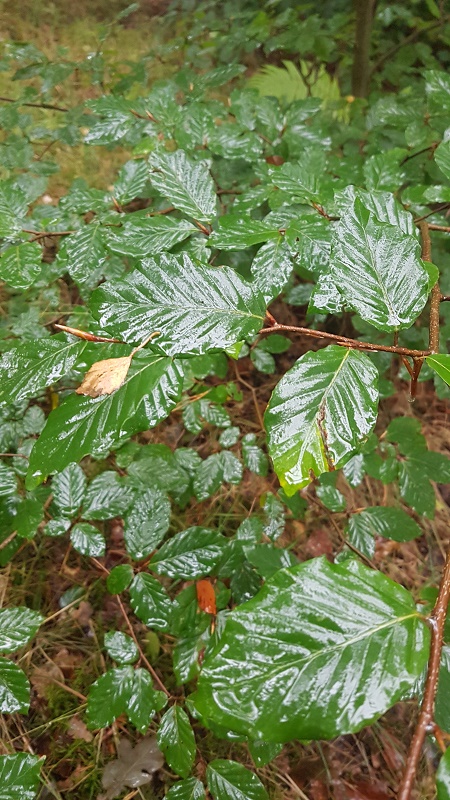
Today, a soggy Saturday in October, Five Mile Wood smells again of the Biology scrapbook. Weaving in and out of the olfactory hamper of autumn comes the odour of wet grass, heavily trodden, and the varied aromas of dozens of species of fungi, seen and unseen. It is raining, softly but insistently, the rain bringing its own subtle influence on how each smell is perceived, like a wash applied over a freshly executed painting. Beech leaves, nowhere near inclined to fall, glisten with rain. I am challenged to keep the rain from running down my neck, challenged by the chill in the air, challenged by the distraction of mushrooms, all of which breathe of magic, and the resulting lack of time that cut this walk a wee bit short.
I won’t bore you with more gratuitous gloating about the basket of edible mushrooms I took home to dry or make into fungus and ale pies, nor with more photos of the ones I can identify! But today, the woods presented me with an excitingly unknown fungus, the likes of which I’d never encountered in decades of mushroom-hunting.
(Actually, the woods do that every time I go foraging, for there are many, many mushrooms I cannot differentiate. But as I know they’re not on the “edible and good” list which is tattooed into my brain, I indolently dismiss them as “small brown jobs”. Which they usually are.)
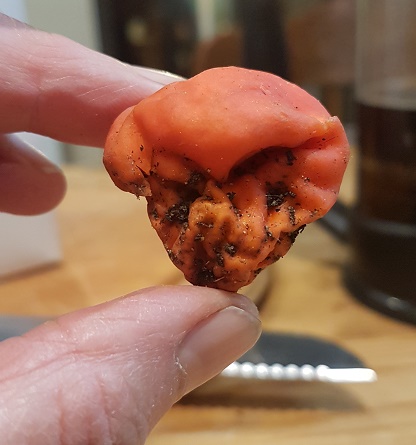
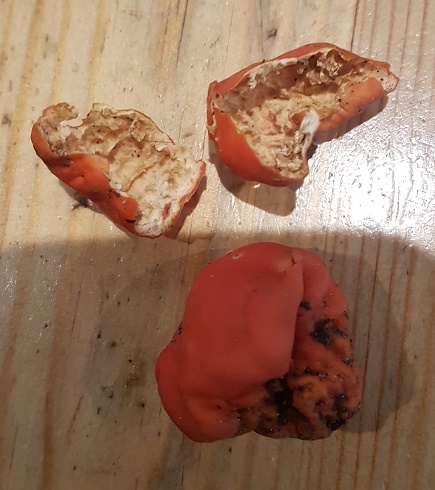
Today’s find was different, a real unknown unknown, to quote Donald Rumsfeld. Bright orange-red balls popping up through the grassy banks between the path and the ditch; I first mistook them for discarded tomatoes. But they were fungi, no question, and when I cut one open to help identify it, it was hollow, with pale coloured ribbing inside. I had never seen anything like it, but as it was so distinctive, I expected identification to be straightforward.
So far, I have not found this species in any of my books, and have drawn a blank from the social media mushroom groups from whom I begged enlightenment. Someone said they’d once seen something similar, but yellow, only got distracted by all the edible ceps nearby. Easily done! I have contacted the Tayside & Fife Fungi Group, and wait in hope. I will find out…. Perhaps someone reading this will have the name, and be laughing at my ignorance?
As soon as I entered Taymount Wood, I smelt mushrooms. Across in the pattering shade of the woods to my left, a family was ducking and diving and exclaiming across the ditches to each other. I could glimpse baskets, a small dog, a child or two.
Great! I thought, people foraging. Good luck! With chanterelles from a previous forage in my fridge, I just wanted to walk without expectations or intent.
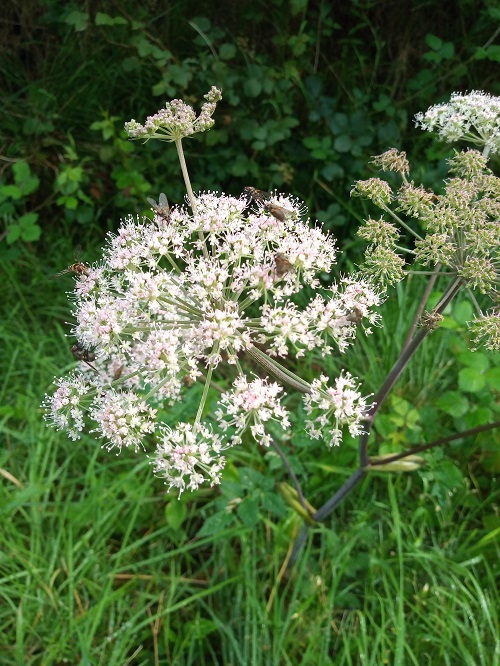
Looking for late summer flowers, I was taken by the large numbers of Wild Angelica growing either side of the path. Each geometrically arranged flowerhead hosted a happy horde of hoverflies and other pollinators. I’m 99.75% certain it is Wild Angelica, an edible plant – but I’ve never foraged it. The quarter of a percent of my brain that says “But wait, it might be Hemlock or one of the other poisonous members of the family out to deceive” prohibits me, despite the smell, season and appearance.
99.75% Wild Angelica
If in doubt, don’t. I no longer take risks with my foraging.
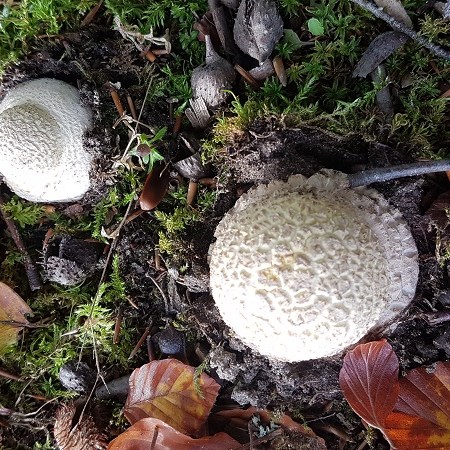
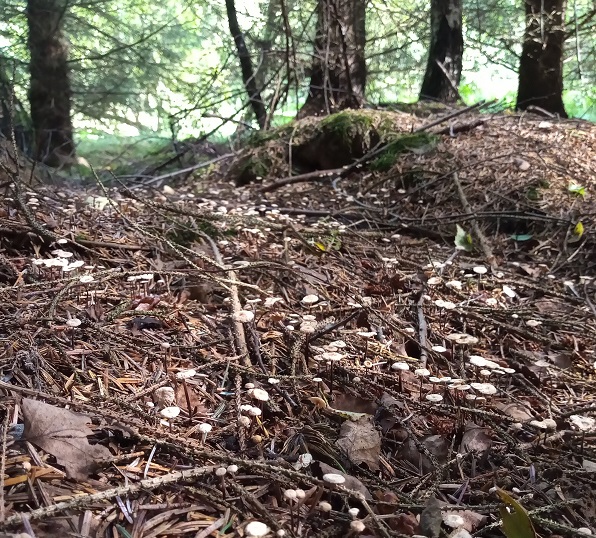
Taymount Wood is the wood that sidetracks me, every time. Up to the right, a sunlit glade. Cross the sleeper bridge to the left – what’s in here? Horse-hair mushrooms (Marasmius androsaceous) swarming up from the pine needles. A collection of puffballs (Lycoperdon perlatum) in mint condition cried out to be selectively foraged. Only firm, young ones are tasty, and leave more behind than you take.
Puffball (Lycoperdon perlatum)
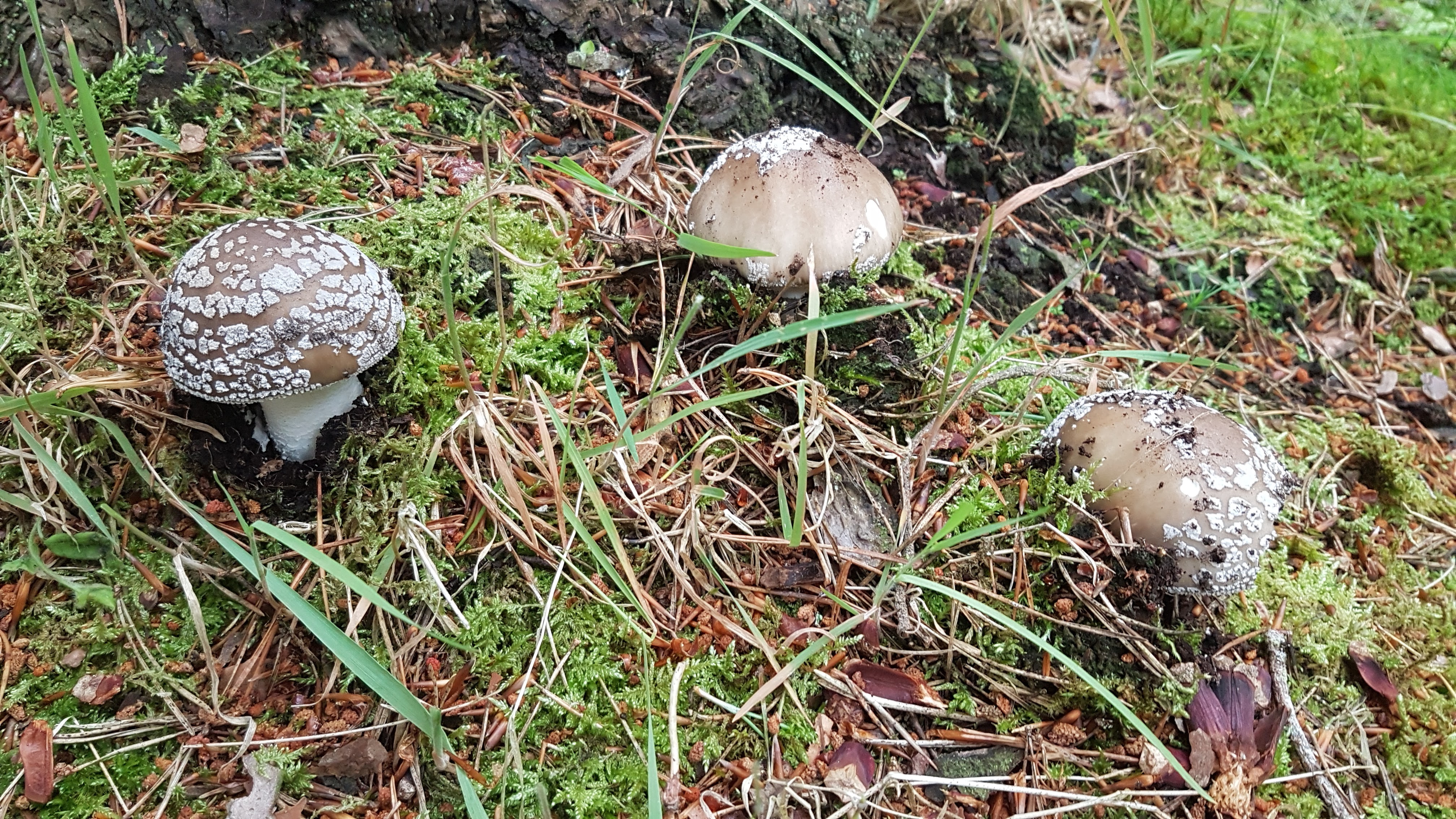
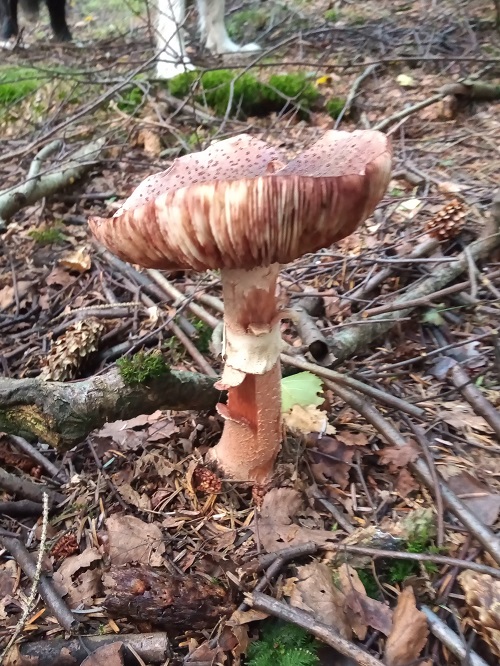
One family of mushrooms of which you have to be wary is Amanita. There are some deadly poisonous members, some only moderately so. Others will send you psychotic. There’s a few edible ones. Taymount Wood today was full of Blushers (Amanita rubescens), one of the edible ones. I have never eaten it, and never will. The flesh bruises pink, which is the indicator of the species – but in other respects it is too like the deadly Panther Cap (A. pantherina). Just suppose a Panther Cap happened to blush one day….. In any case, Blushers are always riddled with worms and maggots before I get near them. Today, both species were growing close to each other and the difference was obvious. I still wouldn’t risk it.
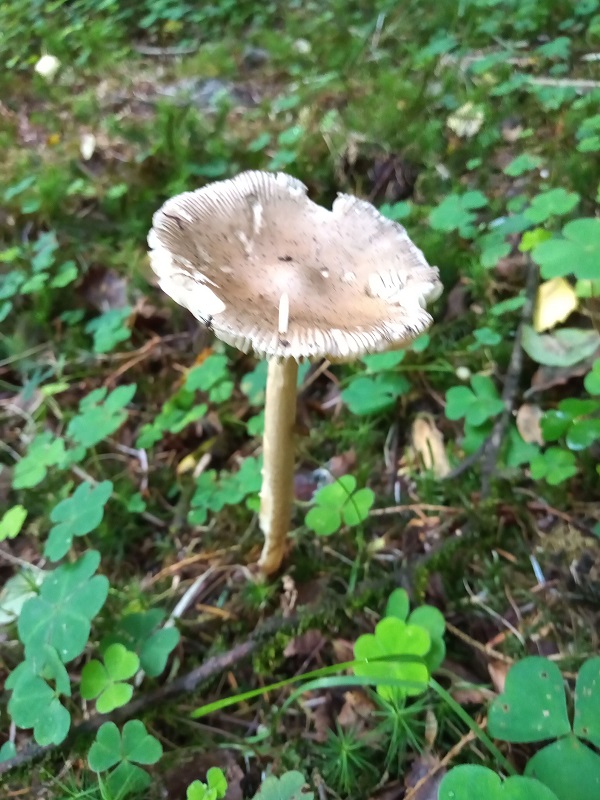
In the photos below, a Blusher on the left, showing the ring; three stages of a Panther Cap; but what do you think is the one on the right? See what I mean?
The Tawny Grisette (A. fulva) I do eat. Unlike most of the family, there is no ring around the stipe, and the edges of the cap are evenly striated as if by a pastry-cook. They were here – but it’s a socially-distanced species that only ever appears singly – and I hate to take the only one.
Tawny Grisette
The stench of death – but not quite death – drew me to the well-named Stinkhorns (Phallus impudica) in the ditch. Most people recoil at eating this mushroom, which exudes a sticky gel smelling like a corpse to attract flies to spread the spores. But I’ve eaten plenty – at a very young stage when they look like eggs protruding from the forest floor. There’s no horrid smell and the jelly surrounding the immature fruiting body is actually delicious. All right, to each her own!
Stinkhorn
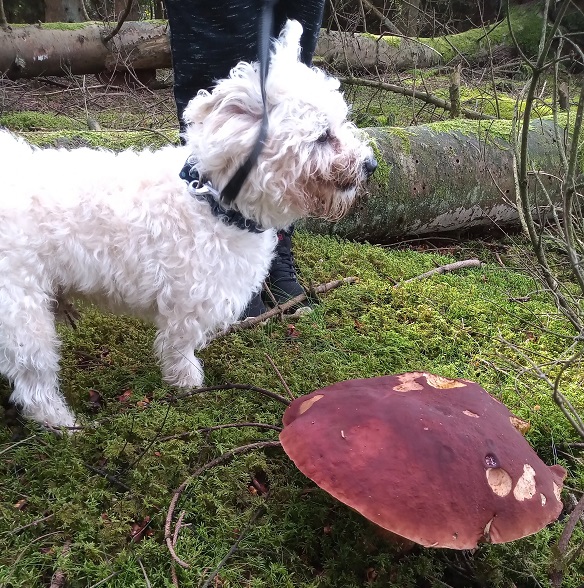
Sidetracked again, I met half the foraging family. Marcin, his young son (and the dog) had just found the biggest Boletus mushroom of the day. We chatted, compared notes, and I admired Marcin’s basket of Ceps, Bay Boletes and others. Marcin learned his mushroom lore from his mother and grandmother in Poland, and their preferences are the Boletus family, chanterelles and Saffron Milk Caps. He loves these woods, and values them for their beauty and food supply. The giant Bolete he said he will not pick, but leave it to spread spores and be admired.
I showed Marcin my collection of puffballs. He looked aghast. “You eat them??” Apparently not a favourite in Poland!
In Anna Tsing’s book The Mushroom at the End of the World*, she tells the story of landscapes ruined – or seemingly ruined – by the greed of human activity. In particular, forests. In one unpromising forest in Oregon USA, where commercial forestry had stripped out all the trees of value and left an empty terrain of broken ground and scrubby volunteer pines, she met some mushroom hunters, refugees from Laos. They were gathering Matsutake, one of the most prized and valuable edible mushrooms in Japan and – allegedly – the first living organisms to appear from the wreckage of Hiroshima after the Bomb.
Matsutake mushrooms, like many fungi, only appear when they can be entangled with the roots of a suitable host tree in a mycorrhizal relationship. They got on very well with those scrubby pines. Tsing tells how the accidental introduction of the Pine Wilt Nematode on a shipment of American Pine into Japan had devastated the Matsutake’s natural host there, hence its rarity. It is not a serious pest of American Pine.
Incidentally, Scots Pine is a good host for Matsutake, too….
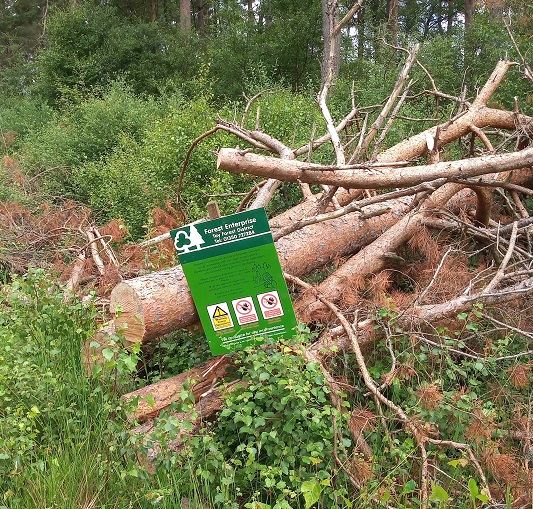
Abandoned remnants of the commercial forest
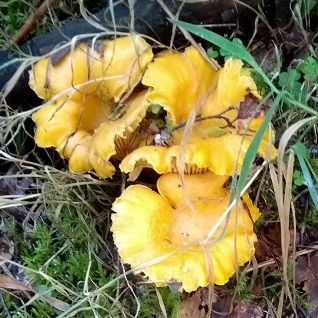
Mushrooms disappearing when a forest changes is familiar to me. All forests and woods are in the process of change, but our two ex-commercial forests, Five Mile and Taymount Woods, are forests in abrupt transition. Before the Commission took out the last valuable trees and wind-throw did for many more, Five Mile Wood was my happy mushroom-hunting ground, the place I’d take people to for foraging walks. I knew exactly where to find the biggest chanterelles, the white Angels’ Wings, the logs where real oyster mushrooms could often break out. The ditches beside the path were home to many fascinating species, including several edible Boletus including the Cep and the maggot-free Bay Bolete – and, of course plenty of highly poisonous examples too. Some years, the tantalisingly similar but inedible False Chanterelle outnumbered the real one – which is exactly what you need when teaching people not to harm themselves by misidentification. One damp corner was an emporium for the delicious Slippery Jack, which turned up in troops like clockwork, every year in late summer and autumn. I used to dry the ones we didn’t fry up right away, and store them in jars.
The biggest chanterelles
The fragile associations which had built up over the decades were shattered by felling. The self-sown birches that are colonising parts of both the woods now will eventually reel in their own, interconnected fungal friends, and the chanterelles will surely re-emerge one day, because birch is their main host tree. But from my experience, it takes at least a decade before mushrooms start to appear in a new wood, and the first arrivals are never the ones you want to eat! The precarity of a habitat for specific mushrooms is alarming – involving water tables, shade, parasitic plants, weather patterns, nematodes, beetles, animals – including mushroom pickers. Tsing’s book includes chapters on the equally precarious lives of the pickers – refugees, indigenous peoples, itinerants. Humans aren’t in control of what the mushrooms will do, because there are so many variables in play. Humans are just part of the landscape, and the landscape is changing because of and despite them.
Another remnant….
So, I can only observe and enjoy the new but mushroom-free habitats in parts of our woods, note the changes, watch new worlds forming out of devastation and realise we are not in charge, not that clever, and maybe, not that important either. I scoured the ditches in Five Mile Wood for boletes recently, and right at the end, I did find a couple of lingering and determined specimens. I left them there.
But who knows what will be the mushroom at the end of the wood? And where is the end of the wood?
*Tsing, Anna Lowenhaupt: The Mushroom at the End of the World – On the Possibility of Life in Capitalist Ruins (Princetown University Press 2015)
Dreich doesn’t begin to cover it. Weeks of rain, sleet or snow, and the wood is wet, dank, chilly. One storm has passed, another is forecast, and a group of multi-stemmed birches, green with lichen and algae, droop and wait despondently.
I take the rutted cycling path that skirts the woodland edge. Under the tall, fiendishly straight Scots Pines, many scattered beech saplings nestle in their winter boleros of retained leaves. Beech mast is everywhere, but I do not see the older tree from which it has fallen. Beech seedlings tend not to come up near a parent tree, but somewhere there must be a Mother.
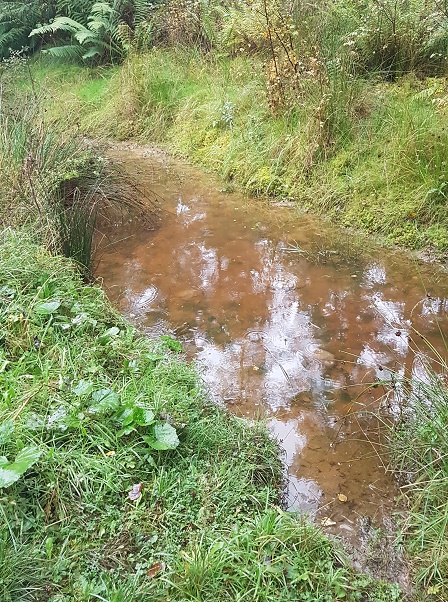
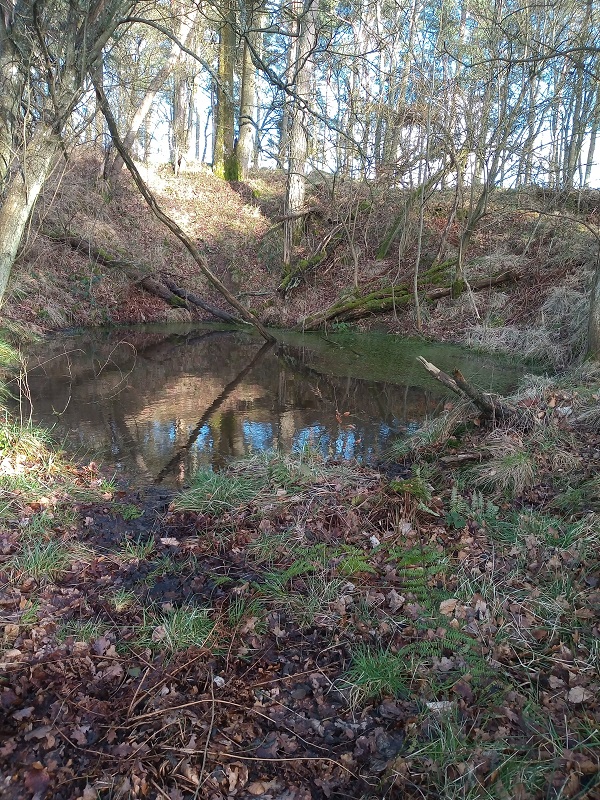
Snow lingers crystalline along the clay-bottomed ditches where black, cold water lurks and trickles. There’s a pond under the pines which so looks like it was formed by an explosion I call it the bomb crater. No signs of frog spawn yet. Several tracks and paths meander where animals come down to drink. Duckweed covers a third of the surface; in the increasing rain thousands of ripples intersect and make diffraction patterns over the other two thirds.
Birds – except for a robin – are silent and glum. A flock of pigeons clatters off towards the field; freshly ploughed, it offers them nothing but the stones that lie heaped in the field corner. How many decades or centuries of cultivation have contributed to this pile? This side of the fence, someone a long time ago arranged stones round a favourite tree, where they remain, moss-covered and half-buried. Larger rocks with wavy patterns etched onto their surface erupt in groups from the forest floor, scarcely distinguishable from the stumps of felled trees. Moss, lichens, algae democratically envelop all.
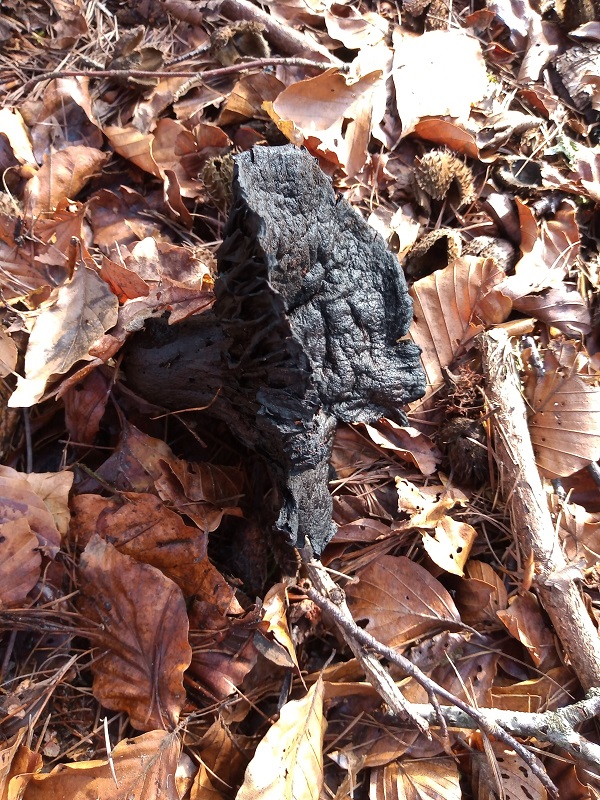
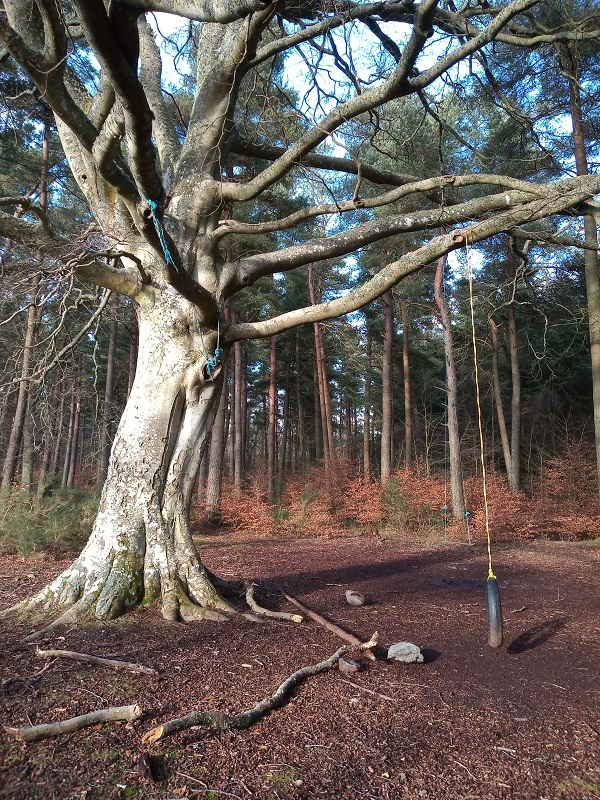
There are charred-looking remains of mushrooms by the path. I think they were Blackening Russulas, an abundance of them. I follow their orbital trail and suddenly find myself under a towering old beech tree, with many spreading branches and a hollowing trunk that makes a chimney of dead wood and fungal rots. Swings hang from two branches; insects and other invertebrates burrow into the soft core of the tree and make their homes. The woodpecker will soon come calling for her dinner, other birds will nest and shout from the canopy. I have found the Mother of Beeches, and of much else besides.
Five Mile Wood and Taymount Wood are former Forestry Commission plantations just north of Perth. They have for a while been transitioning from industrial timber production to a subtle integration with the wild, and people are part of that wild change. The Commission have put them up for sale, and local people have formed West Stormont Woodlands Group. We are hoping to implement a community buy-out. You can find out more about the plans and group activities at http://www.weststormontwoodlandgroup.org.uk Over the coming year, I intend to write a monthly blog post “Words for Our Woods”about the wildness of the woods, in support of WSWG. This is the first.








 Comments on The Nature of the Universe