Not for Eating. Nor Collecting

There are different kinds of walks-with-mushrooms. My first, fifty years ago, were cataloguing walks, an academic exercise that became an obsession. A specimen of each would be removed and bagged (no smartphones then, and my Kodak Instamatic didn’t really cut the mustard, though I did try), taken home, pored over for hours to try to identify it, and then a spore print taken.  This was all in the cause of a college Rural Studies project that I somehow never grew out of.

When I began to differentiate the ones I could eat from the poisonous ones, foraging AND cataloguing walks happened – a basket for the ones I knew I could eat, and another for the unknowns. Many remained – and remain – unknown, something which used to really bother me. However much later when I was regularly leading foraging walks, I realised that so long as I could recognise the “edible and good” fungi and the poisonous and dodgy ones, most people were happy if we could pin the “small brown jobs” down as far as a genus.

I still take huge interest in identifying weird or remarkable specimens that I’ve never seen before, but these days I’ve discovered the pleasure of walks-with-no-purpose-with mushrooms. This walk, meandering along the River Tay from Dunkeld, had no particular object but to be captivated by the surprise and beauty of the fungal kingdom – so often misrepresented, under-valued, the importance of which is not understood by the majority of humans.
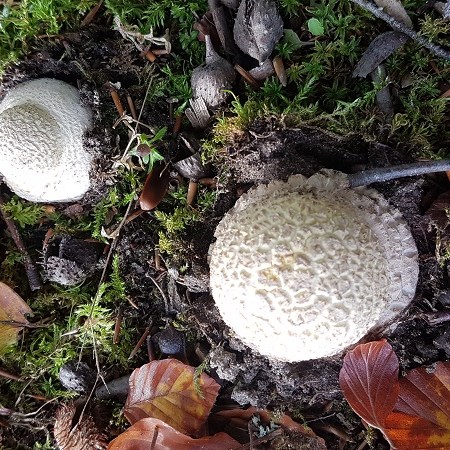
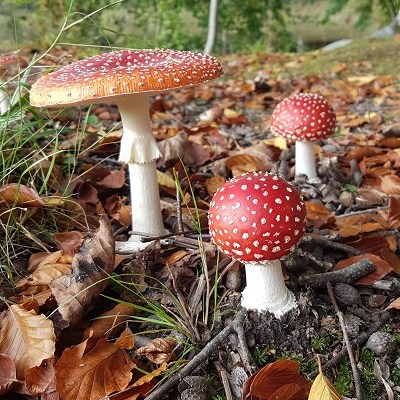
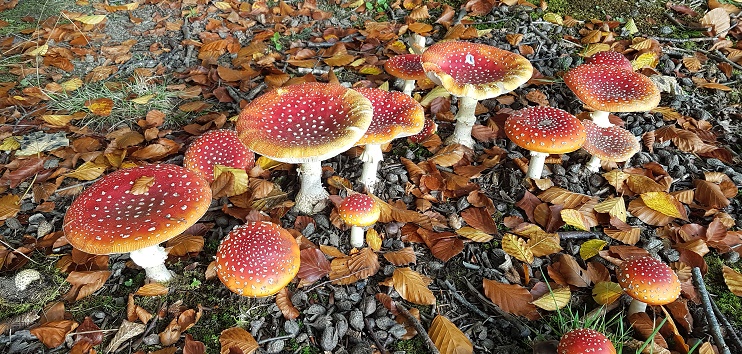
First came a phenomenal display of Fly Agarics, the mushroom of the shamans, too exquisite to pass by, shouting their wares, nestling in ground which was once birchwood. Their mycelium is always entangled with the roots of birch; from the beginnings of plants on dry land they have needed each other. They start as big white crusty buttons, the red skin of the cap breaking through the veil to leave those fairly-tale white “spots”. The cap expands, the spores fall. One was nearly as big as my head.
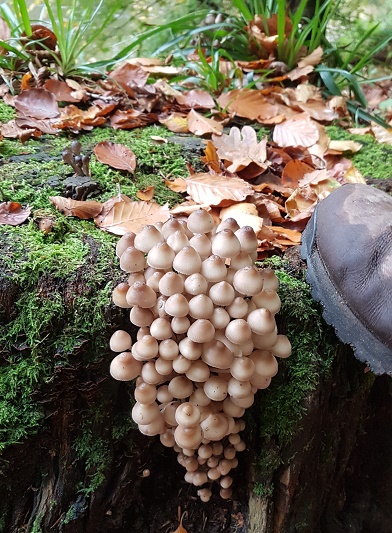
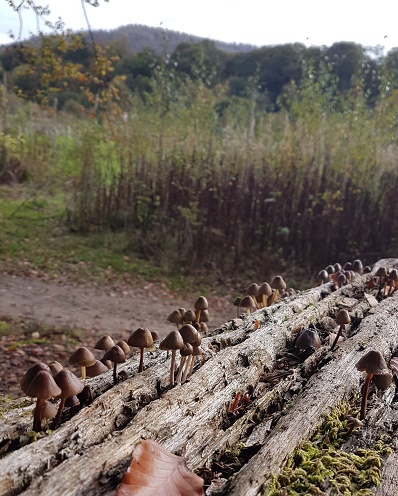
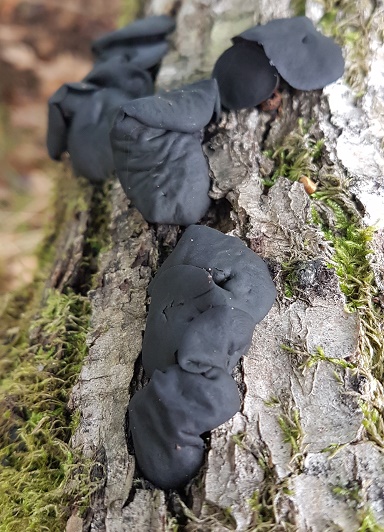
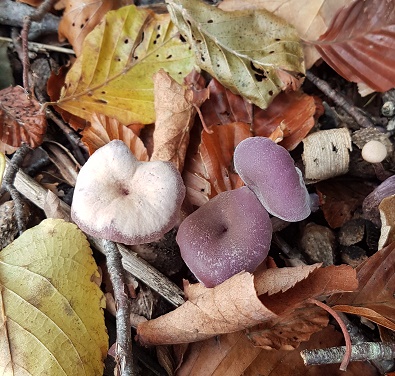
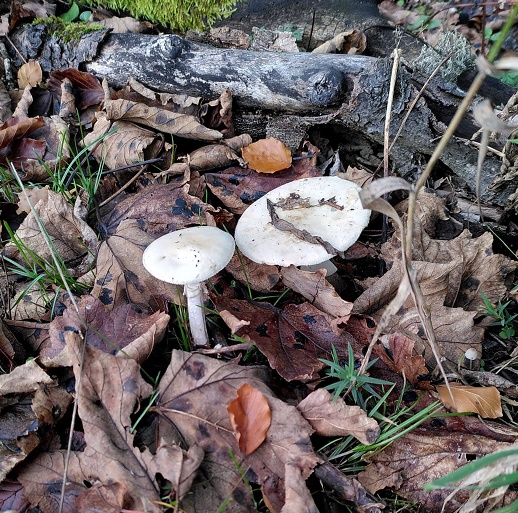
Troops of Bonnet mushrooms, various types, marched over fallen trees and gossiped in crevices of stumps, glistening in the sunlight. Shiny black excrescences of Witch’s Butter erupted from dead wood. Amethyst Deceivers – which I could have picked for eating but didn’t – showed all their colour range from vivid purple to washed-out grey. In the leaf-litter, the Destroying Angel, related to the Fly Agaric but far more deadly, glowed purest white. Such a potent name for a poisonous mushroom!
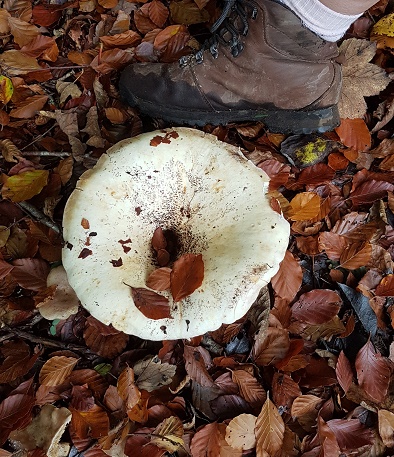
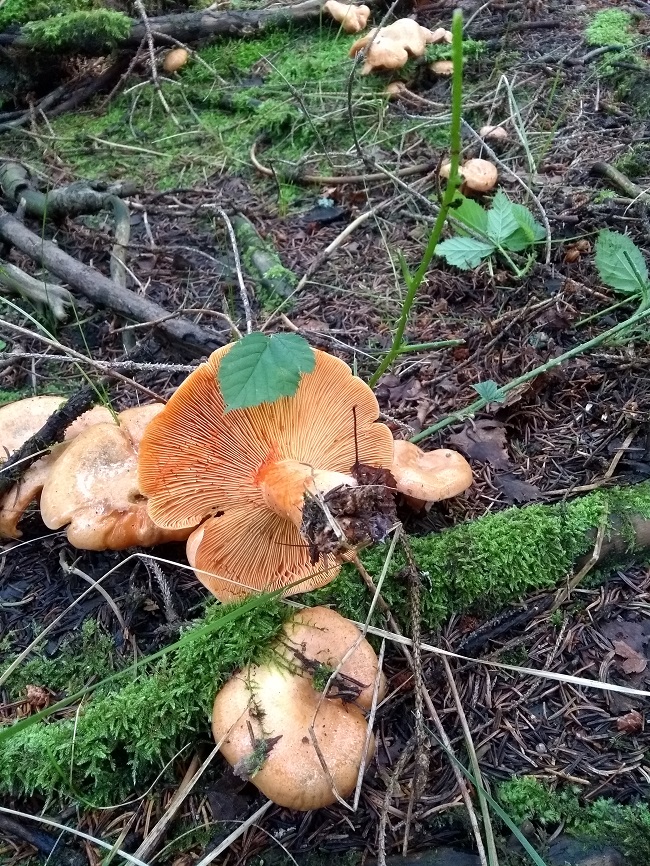
Giant Funnel Cap (Clitocybe gigantea)

Across the track lay a small segment of a huge fairy ring of an enormous mushroom commonly called the Giant Funnel Cap (check the size 8 boot in the photo for scale). This took me immediately back to those student Rural Studies Days, when I first saw this mushroom in local woods, in a ring that was actually measurable. From the fresh fruiting bodies came a strange, un-mushroomy smell. I took one home, identified it easily and, as the book said edible, fried it in slices. It tasted like its smell – like nothing I’d ever encountered. To this day, I’m still trying to work out if I actually like it! But size-wise, they are easy pickings, and it’s fun to estimate the equally astounding diameter of their fairy-rings and plough through the woods to try to find the mushrooms on the other side of it.
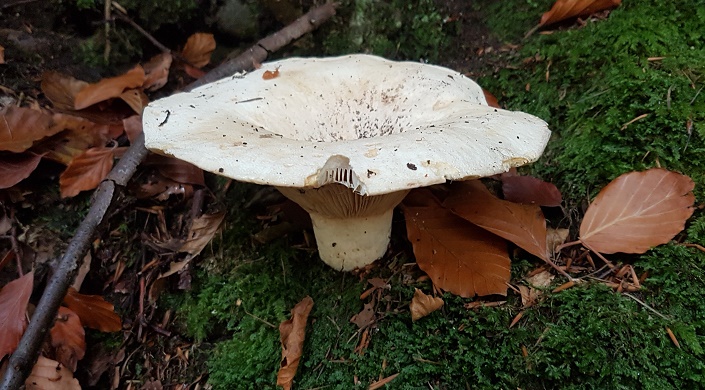
This walk wasn’t for foraging, for worrying about what I was looking at, and I haven’t bothered to tease apart the various fairy bonnets. Old habits die hard, but really, I don’t need to know!
When you know winter is coming…

The turn of the season is felt, not so much as a drop in temperature or the way the need for warm socks and waterproofs creeps up on you, but in the way the woods smell different. Decaying leaves, leaves still on the trees but for whom decay is imminent: the smell, for me, of being 11 years old and at a new school, where our introduction to Biology was the invitation to compile a Biology Scrapbook over the course of a year. Diligently, I collected all those leaves on the point of rotting, pressed them in encyclopedia volumes, and learned, when I next opened the books to mount them, the subtle distinction between the smell of sycamore, poplar and oak leaves in autumn.

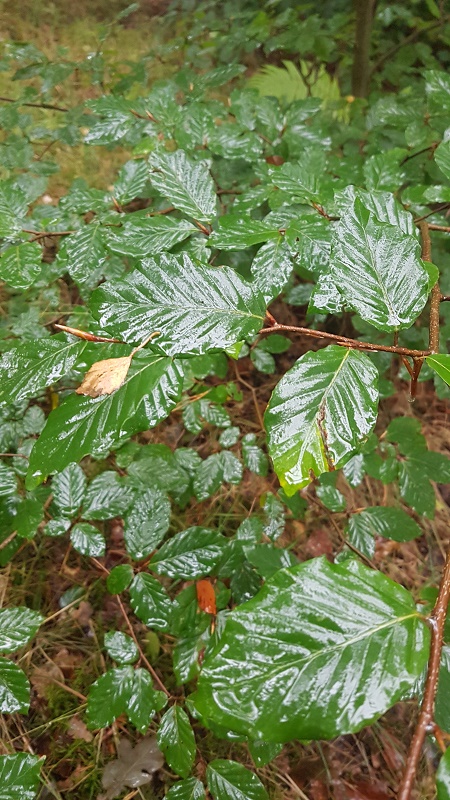
Today, a soggy Saturday in October, Five Mile Wood smells again of the Biology scrapbook. Weaving in and out of the olfactory hamper of autumn comes the odour of wet grass, heavily trodden, and the varied aromas of dozens of species of fungi, seen and unseen. It is raining, softly but insistently, the rain bringing its own subtle influence on how each smell is perceived, like a wash applied over a freshly executed painting. Beech leaves, nowhere near inclined to fall, glisten with rain. I am challenged to keep the rain from running down my neck, challenged by the chill in the air, challenged by the distraction of mushrooms, all of which breathe of magic, and the resulting lack of time that cut this walk a wee bit short.

I won’t bore you with more gratuitous gloating about the basket of edible mushrooms I took home to dry or make into fungus and ale pies, nor with more photos of the ones I can identify! But today, the woods presented me with an excitingly unknown fungus, the likes of which I’d never encountered in decades of mushroom-hunting.

(Actually, the woods do that every time I go foraging, for there are many, many mushrooms I cannot differentiate. But as I know they’re not on the “edible and good” list which is tattooed into my brain, I indolently dismiss them as “small brown jobs”. Which they usually are.)

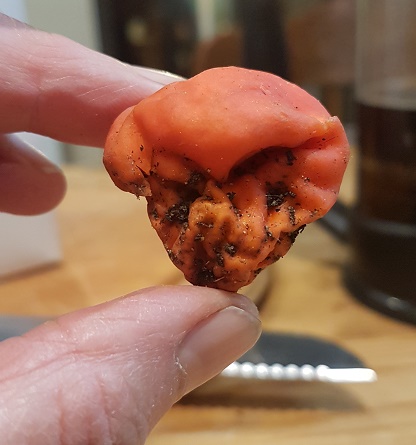
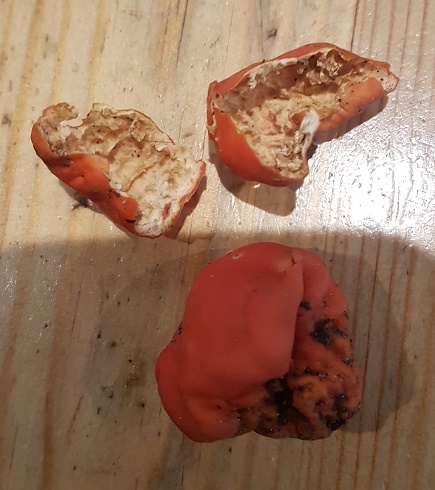
Today’s find was different, a real unknown unknown, to quote Donald Rumsfeld. Bright orange-red balls popping up through the grassy banks between the path and the ditch; I first mistook them for discarded tomatoes. But they were fungi, no question, and when I cut one open to help identify it, it was hollow, with pale coloured ribbing inside. I had never seen anything like it, but as it was so distinctive, I expected identification to be straightforward.

So far, I have not found this species in any of my books, and have drawn a blank from the social media mushroom groups from whom I begged enlightenment. Someone said they’d once seen something similar, but yellow, only got distracted by all the edible ceps nearby. Easily done! I have contacted the Tayside & Fife Fungi Group, and wait in hope. I will find out…. Perhaps someone reading this will have the name, and be laughing at my ignorance?

Inside and out….

The Mushroom at the End of the Wood

A Post for West Stormont Woodland Group

Larch Boletes in Five Mile Wood

In Anna Tsing’s book The Mushroom at the End of the World*, she tells the story of landscapes ruined – or seemingly ruined – by the greed of human activity. In particular, forests. In one unpromising forest in Oregon USA, where commercial forestry had stripped out all the trees of value and left an empty terrain of broken ground and scrubby volunteer pines, she met some mushroom hunters, refugees from Laos. They were gathering Matsutake, one of the most prized and valuable edible mushrooms in Japan and – allegedly – the first living organisms to appear from the wreckage of Hiroshima after the Bomb.

Matsutake mushrooms, like many fungi, only appear when they can be entangled with the roots of a suitable host tree in a mycorrhizal relationship. They got on very well with those scrubby pines. Tsing tells how the accidental introduction of the Pine Wilt Nematode on a shipment of American Pine into Japan had devastated the Matsutake’s natural host there, hence its rarity. It is not a serious pest of American Pine.

Incidentally, Scots Pine is a good host for Matsutake, too….

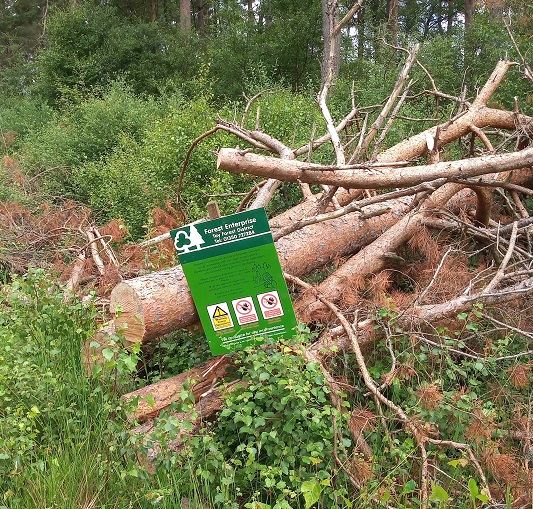
Abandoned remnants of the commercial forest

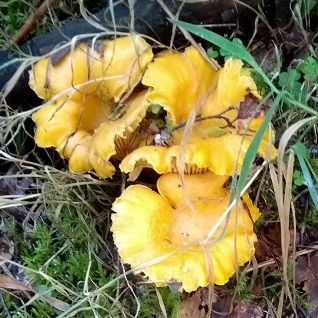
Mushrooms disappearing when a forest changes is familiar to me. All forests and woods are in the process of change, but our two ex-commercial forests, Five Mile and Taymount Woods, are forests in abrupt transition. Before the Commission took out the last valuable trees and wind-throw did for many more, Five Mile Wood was my happy mushroom-hunting ground, the place I’d take people to for foraging walks. I knew exactly where to find the biggest chanterelles, the white Angels’ Wings, the logs where real oyster mushrooms could often break out. The ditches beside the path were home to many fascinating species, including several edible Boletus including the Cep and the maggot-free Bay Bolete – and, of course plenty of highly poisonous examples too. Some years, the tantalisingly similar but inedible False Chanterelle outnumbered the real one – which is exactly what you need when teaching people not to harm themselves by misidentification. One damp corner was an emporium for the delicious Slippery Jack, which turned up in troops like clockwork, every year in late summer and autumn. I used to dry the ones we didn’t fry up right away, and store them in jars.

The biggest chanterelles

The fragile associations which had built up over the decades were shattered by felling. The self-sown birches that are colonising parts of both the woods now will eventually reel in their own, interconnected fungal friends, and the chanterelles will surely re-emerge one day, because birch is their main host tree. But from my experience, it takes at least a decade before mushrooms start to appear in a new wood, and the first arrivals are never the ones you want to eat! The precarity of a habitat for specific mushrooms is alarming – involving water tables, shade, parasitic plants, weather patterns, nematodes, beetles, animals – including mushroom pickers. Tsing’s book includes chapters on the equally precarious lives of the pickers – refugees, indigenous peoples, itinerants. Humans aren’t in control of what the mushrooms will do, because there are so many variables in play. Humans are just part of the landscape, and the landscape is changing because of and despite them.

Another remnant….

So, I can only observe and enjoy the new but mushroom-free habitats in parts of our woods, note the changes, watch new worlds forming out of devastation and realise we are not in charge, not that clever, and maybe, not that important either. I scoured the ditches in Five Mile Wood for boletes recently, and right at the end, I did find a couple of lingering and determined specimens. I left them there.

But who knows what will be the mushroom at the end of the wood? And where is the end of the wood?

*Tsing, Anna Lowenhaupt: The Mushroom at the End of the World – On the Possibility of Life in Capitalist Ruins (Princetown University Press 2015)

The Unseen World beneath Troops and Rings

First off, let’s be clear. There is no such thing as “mushrooms and toadstools”. Really. They are all just different species of a particular group of fungi. The “mushrooms” you buy are developed from a species called Agaricus bisporus. There are lots of other “mushrooms” in the genus Agaricus, including the tasty Field Mushroom, Horse Mushroom and The Prince of the Woods. There’s at least one poisonous “mushroom” in the Agaricus group – the Yellow Staining Mushroom.

They could all just as easily have been labelled toadstools.

Resemblance, or relationship, to a nice safe shop mushroom is no guarantee of edibility. I’m going to call all of them mushrooms in this post. That doesn’t mean you should eat them if you find them. That’s the public health warning over.

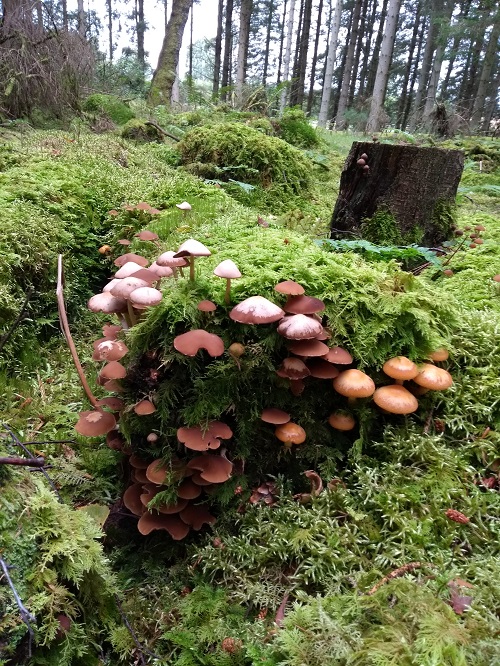
Whichever species or type of fungus you have spotted and admired in woods and fields this autumn, you’ll have noticed that many of them appear to like being in a crowd. A nicely-rotting stump (that’s another fungus, by the way, assisting with the rotting process), may be festooned with troops of mushrooms, all of the same species. They can be mushroom-shaped:

troops3 troops4

Or completely bizarre:

troops1


But it is obvious they are “growing on” the stump.

troops2

Often a troop of mushrooms appears to be just coming from the soil, and you wonder, if that’s the case, why they have all congregated together in a wavy line, like an army on the march. If you were to dig them up (please don’t!), you’d probably find a buried root of a tree, living or dead. What appears to be lots of different mushrooms of the same type is actually all one organism. Inside the wood, fine, tangled threads called hyphae join to make the main “body” of the organism (the mycelium). And the mycelium naturally runs up or down the host – in many cases a root or buried stump, or dead branch. When the conditions are right for reproduction, the mycelium sends up the fruiting bodies (the mushrooms!), to form and shed spores. (Roots, flowers and seeds is the usual analogy).

Fungal mycelium can grow through all sorts of media, not just wood. Dead leaves and grasses, straw, manure of all kinds. Some are bizarre: ripening grain (Ergot of Rye), human skin (ringworm and athlete’s foot), bread (penicillin), caterpillars (long Latin name I’ve forgotten), potatoes (blight), other mushrooms (Boletus parasiticus, related to the gourmet delight Cep or Penny Bun).  Toilet rolls and paperback books – oh you haven’t lived unless you’ve harvested your breakfast Oyster Mushrooms off a toilet roll! (unused, of course). In the course of its life, fungal mycelium also forms mutually beneficial associations with the roots of trees and other plants. Without fungi, it’s unlikely that our planet would support vegetation – and thus animal life – in the way that it does. You may have heard of these associations. They’re called Mycorrhizae (fungus-root), and gardeners can even buy them in bottles to get their favourite trees off to a good start.

fairy ring

The other thing the mycelium does, or appears to do, is grow in rings. All fungi grow like this, I think. Well, most of them anyway. Why do you think ringworm got its name? Think of the lovely (well, to a mycologist) concentric rings of Brown Rot on apples or plums. There’s huge variation in size and scale of course, but they all start as some kind of joined up patch, and grow outward, making a bigger and bigger circle. The fruiting bodies appear on the edges of the circle. With mushrooms, this gives you a “fairy ring”. Where the mycelium is decomposing on the inside part of the ring, nitrogen is given off. Nitrogen is really good for green plants; and if we’re talking a lawn, you’ll find that the grass just inside the ring of mushrooms will be lush and dark green. Once the organism has grown out the way, the centre dies off. (Sometimes the grass does, too, which is why fairy ring mushrooms are not viewed with approval by greenkeepers and the likes of folk who treasure lawns of even and controlled green-ness and height.)

Fairy rings will just keep on growing outwards, unless something happens to kill off the entire organism, and push up mushrooms on an annual basis. Each year, they’ll be further apart. Some can stretch across the landscape for miles (though it gets harder to track the ring of mushrooms) – but it is still all one organism.

Always look – or think – below the surface!


The Morning After

unicorn mushrooms

The morning after the march I went mushrooming again. There were no mushrooms of any kind left in the fridge. I nearly didn’t bother, because I was dog tired, and, after all, I would pass at least three supermarkets in the afternoon.

But something about the air that morning was irresistible. Cool, zinging with the promise of sunshine; light, ethereal and just a little autumnal; dust motes and electrons dancing a jig. The dam and the woods and clearings energised and soothed simultaneously – an antidote to the adrenaline that had kept me up and awake till gone 2am, head birling with ideas and reflections and hope no anxiety could dampen.

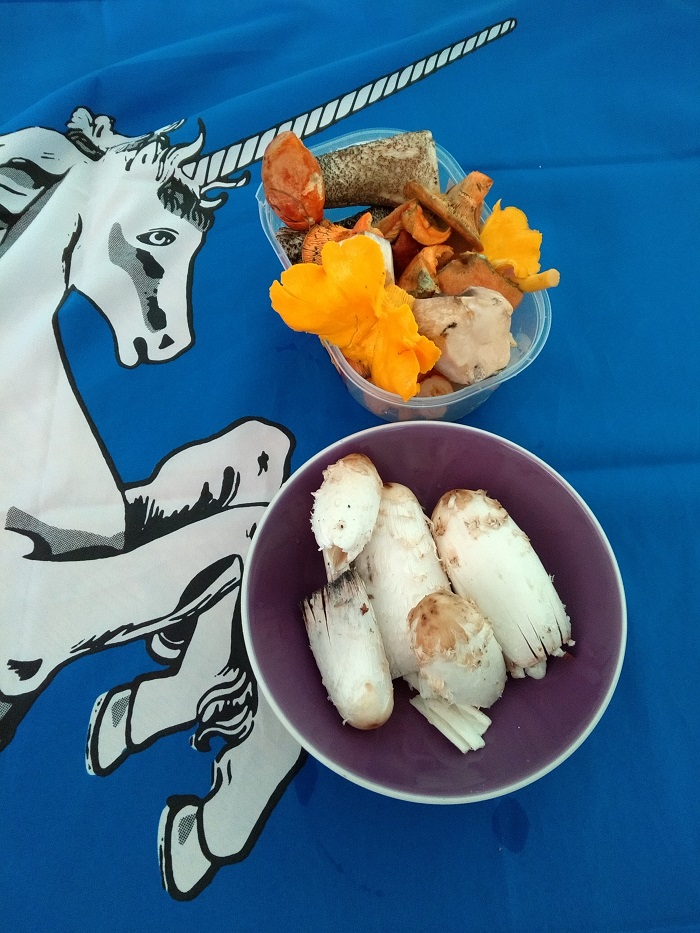
Every secret hollow, bank and bog in my regular itinerary yielded something edible. Shaggy Inkcaps standing like soldiers, Hedgehog Mushrooms like tiny undercooked loaves, spiny as urchins beneath, chunky Orange Birch Boletes that go alarmingly black when you cut the flesh but taste divine. And a few late Saffron Milk Caps, only slightly infested.

jed Rohallion

The sunny gold of Chanterelles glistened like the yolk of a happy hen’s egg. Deer came skipping coquettishly out from the wood and crossed in front of me, one of them practically pirouetting in her glee – anticipating perhaps, the rutting season nearly upon us.

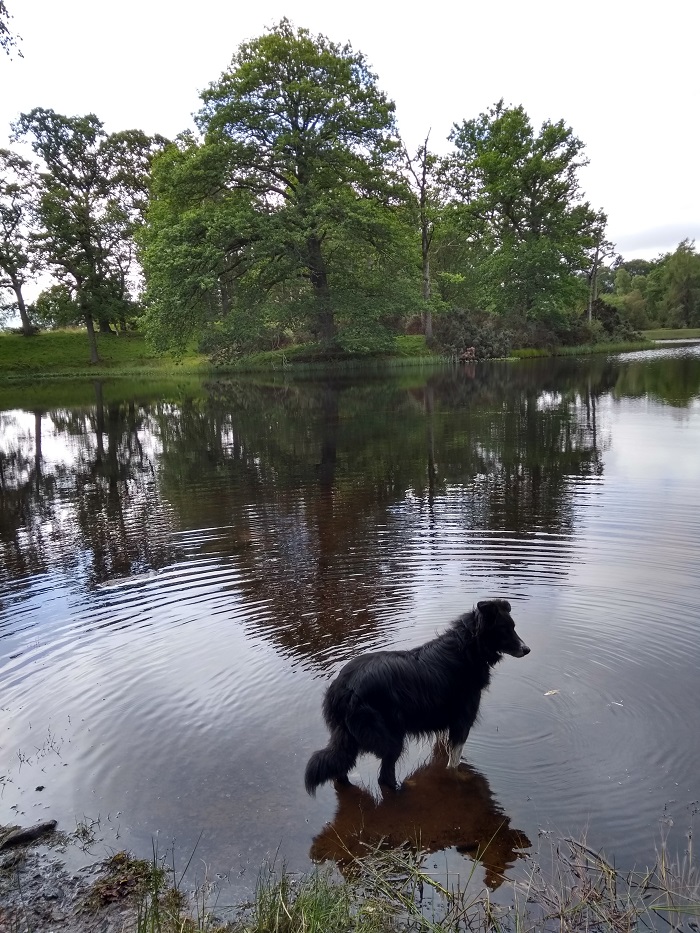
From my dog gazing lovingly at his stick floating away on the loch to the shafts of sudden sun on the ripples he makes, from the happy brown collie and his owner to the mute swans and their big grey babies – the morning after, all of Scotland seems to be smiling at me.

Mushroom-hunting, between Lowlands and Highlands

mushrooms1A full evening, two nights and two days of rain. Humidity hangs in the air, the soil beneath my feet pulses damply, the mosses are full and green. Raindrops still coat every flower of grass and frond of bracken, but the sun is shining. The timing is right.
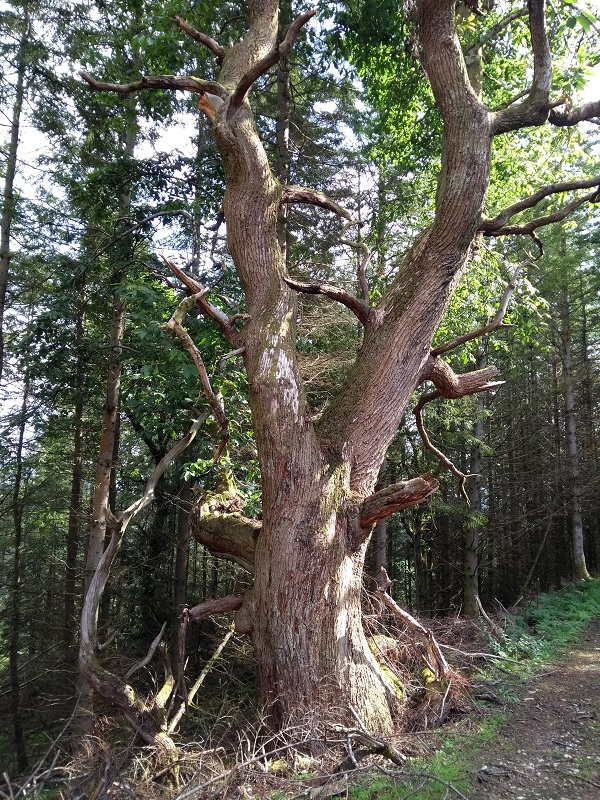
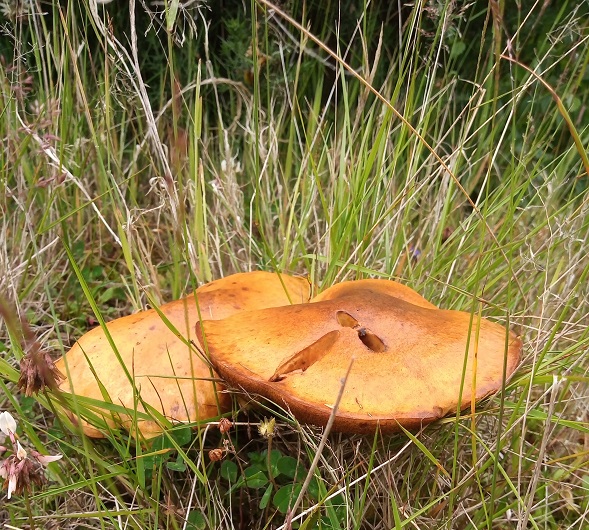
I go for mushrooms in the place where the Highlands meet the Lowlands, where the land is rent by fault-lines and rainbow-coloured slate out-crops and erupts. I pass the court hill where outlaws were tried and hung from the oak trees of Birnam Wood, three hundred years after Macbeth was king of this nation. I stalk through the devastation where the larches were, before they got phytophthera and were felled. There is nothing there now. But in the crowded wood beside the path, one big larch has been missed, and the sun shines in tawny patches upon last year’s fallen needles. It catches on a small group of Larch Boletes, glistening and tawny themselves in their cosy cohabitation with the tree. I take one. A deadly Panther Cap smirks nearby and I ignore it.

Broken and battered, an old sweet chestnut tree ismushrooms3 surviving the metallic blundering of the foresters’ vehicles, harvesters and forwarders, along the track. How did it get here? Not a native tree, so planted a long time ago, when this haphazard forest was occupied in a different way. Who planted it? Did they hope for chestnuts to roast on autumn fires?
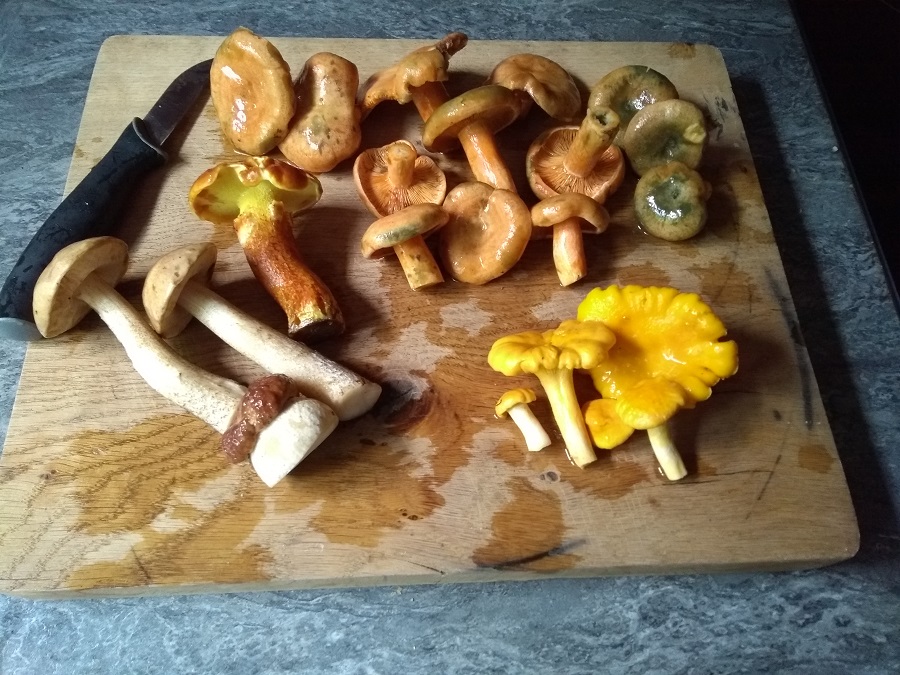
I follow the hint of a track down a slope towards the thicket where rhododendron is making its usual bid for world domination. No more than a wisp of trodden grass and bent fern, my path diverges and peters out at a crop of the biggest chanterelles I’ve mushrooms2ever seen, tucked into the side of a rugged bank that oozes water. Was this path made by a human who knew where to look, or by another animal? Someone told me yesterday that the best chanterelles are on banks and slopes because the deer can’t graze them there.

I’m always competing with other animals for my dinner. But I’ve had lots of chanterelles this summer and there is still a dish at home in the fridge. I take a couple. I have rules when I’m foraging. Never take more than I need, only take a percentage of whatever I find, leave old mushrooms to sporulate, leave young ones for tomorrow, for the next predator or none, for others just to see and love.

Under birch, I acquire some young Brown Birch Boletes and a single Cep. Ploughing through forest, I note the tiny horsehair mushrooms are up and about, trooping on twigs and the needles of conifers. I ignore, too, the many “wee brown jobs” of mushrooms that once I diligently took home as single specimens to try to identify with hand lens and spore print. Some I succeeded in pinning down, too, only to forget them altogether until I came across them again in another wood, another year. Life’s too short now, I am focused on my prey.mushrooms4

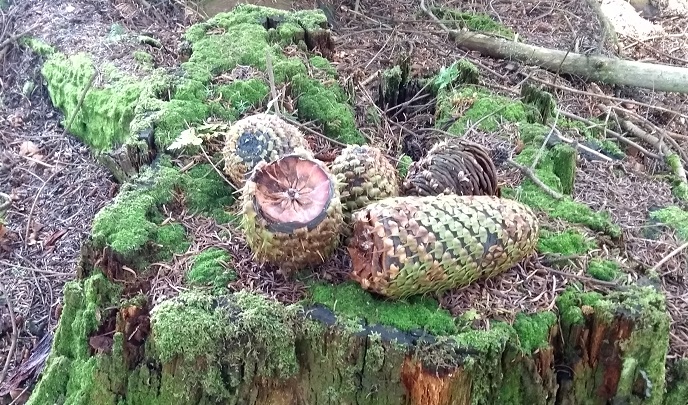
Huge shaggy mushrooms shout out to me as I pass another grove of conifers and I am lured in. But they are the uneaten halves of massive fir cones – red squirrels have eaten the succulent tops from every one, and laugh at me from the tree tops.

They cluster in the fallen forest by the dam, the new flush of Saffron Milk Caps, just where I thought they’d be, and just at the right stage before the fungus gnats lay their eggs. They are sound, and plentiful and could make a wonderful painting, with their improbable colours of orange, cream and khaki-green. But they won’t, for I take my portion and weave them into a spell of dinner.

mushrooms 5