Reeds, Rushes and the Spaces between Trees

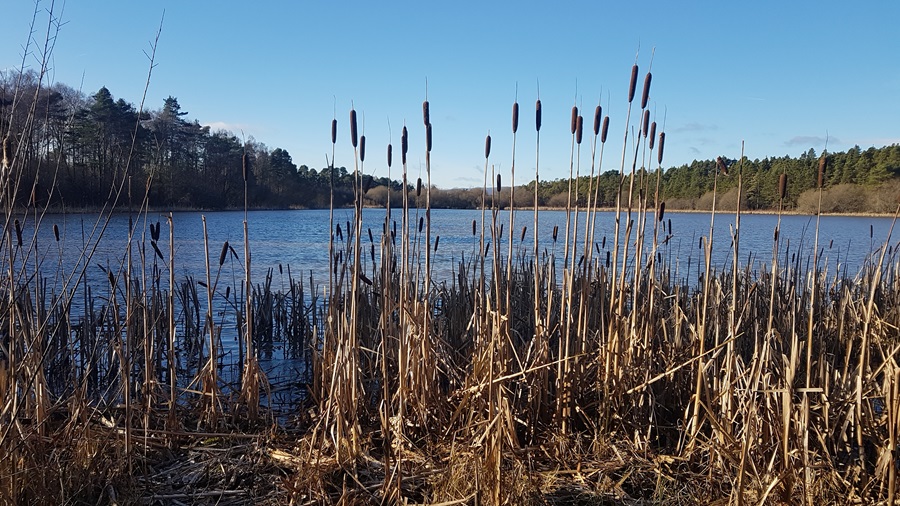
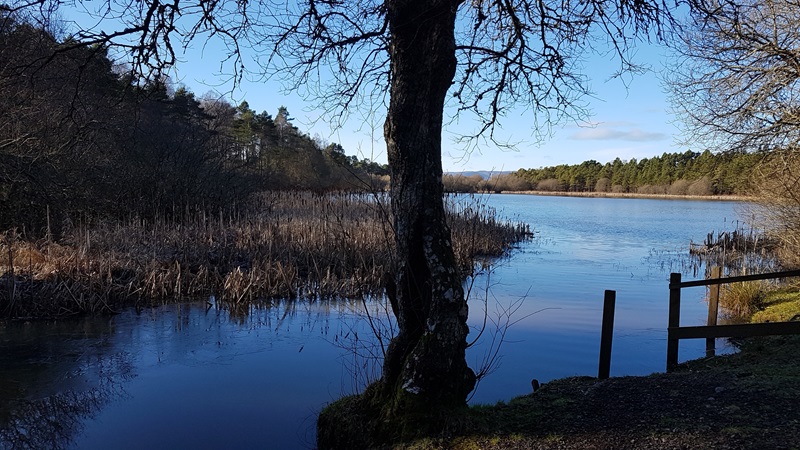
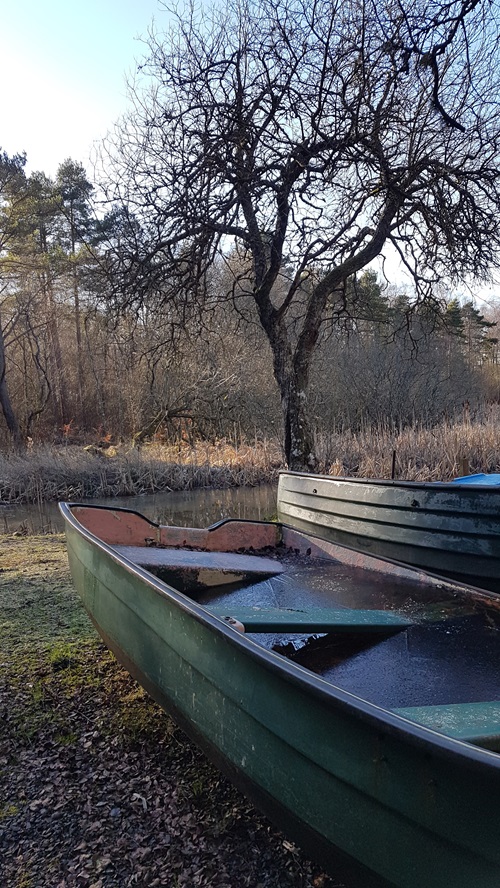
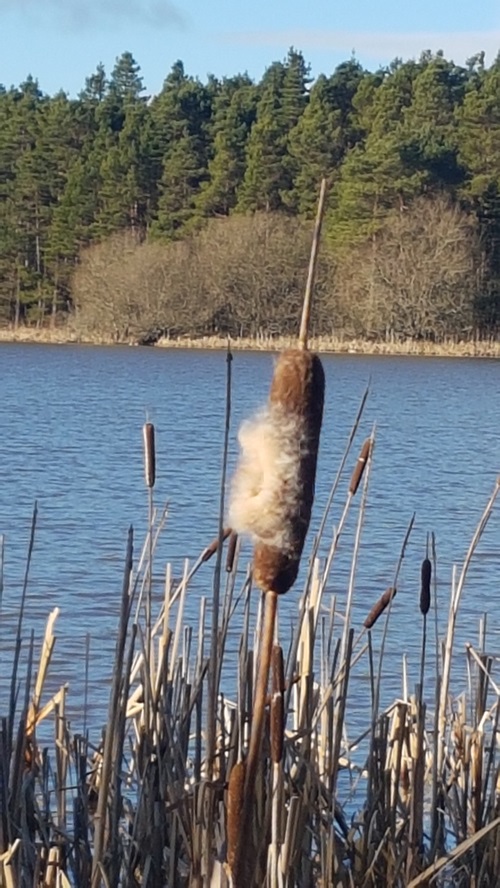
On a quiet day of winter sun and muted activity from woodland birds, I arrive at King’s Myre again. Reed Mace flowerheads from last year cluster around the watery margin, clogging the channel by the little jetty where the boats wait and fill with rain. We used to call them “bulrushes” where I grew up, and it wasn’t till Mr. Illesley, in Rural Studies, enlightened us all about the differences between reeds, rushes, sedges and grasses that I ever learned their proper name– or that Reed Mace is related, but none of these anyway!
It is the same plant known as cattails in America, and valued throughout its distribution for its edibility. The rhizomes – root like underground stems, or underwater ones in the case of this plant – are starchy and filling when baked. They can also be dried and ground into flour, though I never have. The pollen from the male flowers can be used as flour too, or to thicken sauces and soups. It has many medicinal uses. But the best part is the emerging shoot – which will be appearing above water level any time now. Cut, cleaned, steamed, baked, sauteed – it is a lovely spring vegetable to rivals asparagus or bamboo shoots for flavour and versatility. You can keep eating the shoots until the flower spikes start to emerge, you don’t need waders to forage it, and, as Reed Mace is actually quite an invasive plant, it’s pretty sustainable to nibble bits off the clump! Last year’s flowers are starting to burst apart now, revealing the dense, cottony-fluffy seedheads inside.
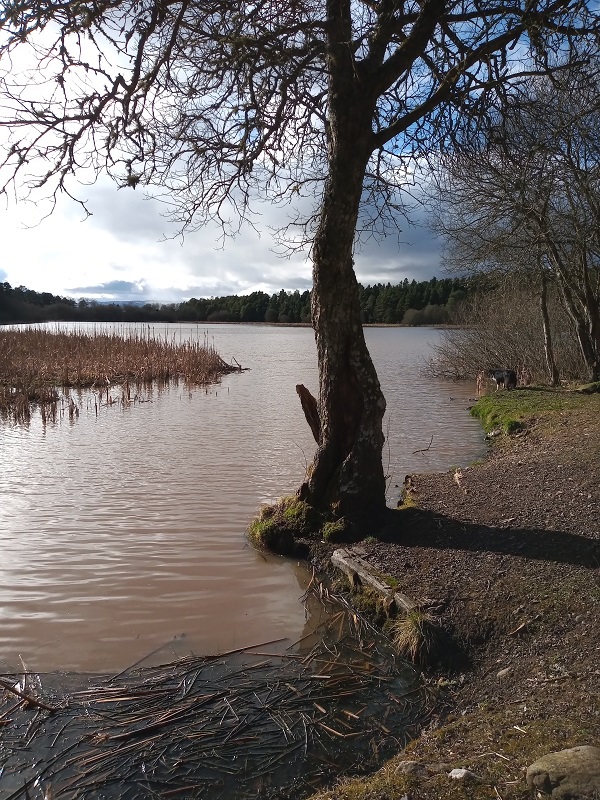
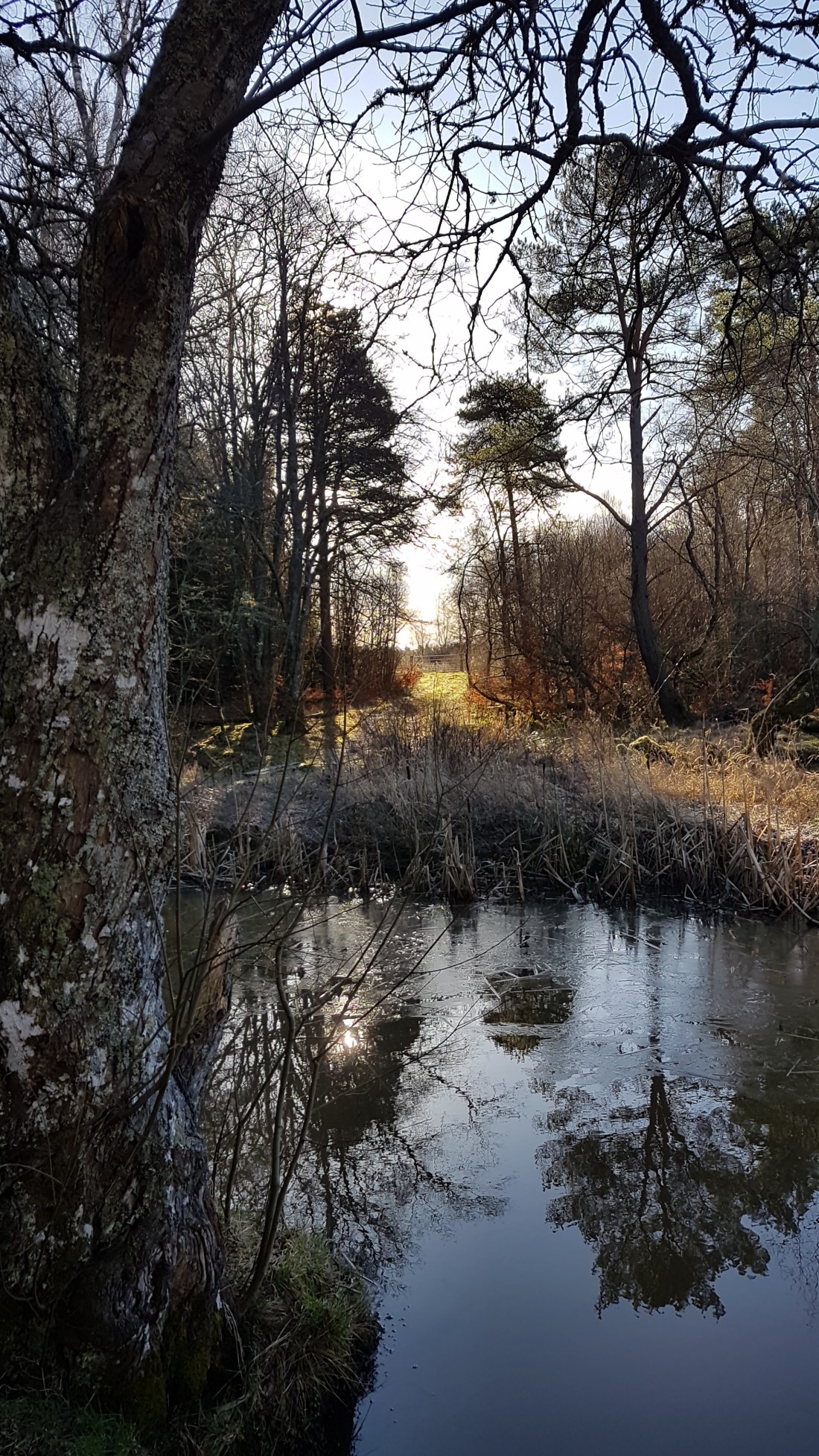
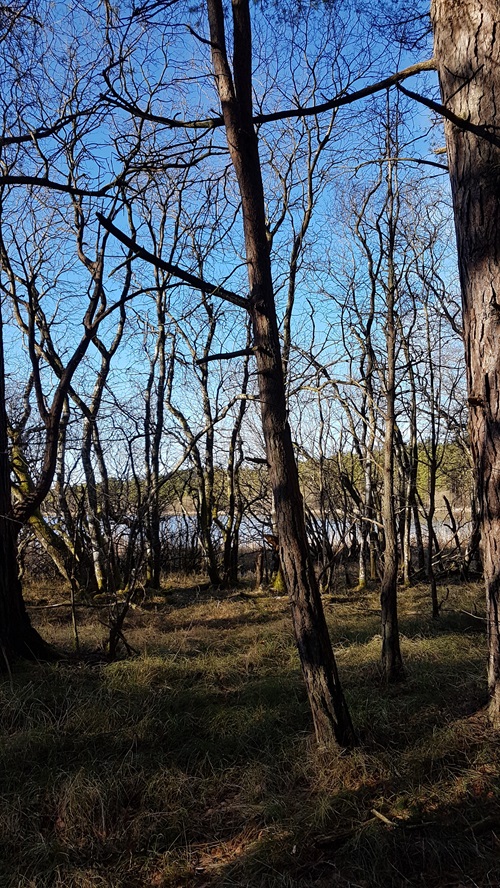
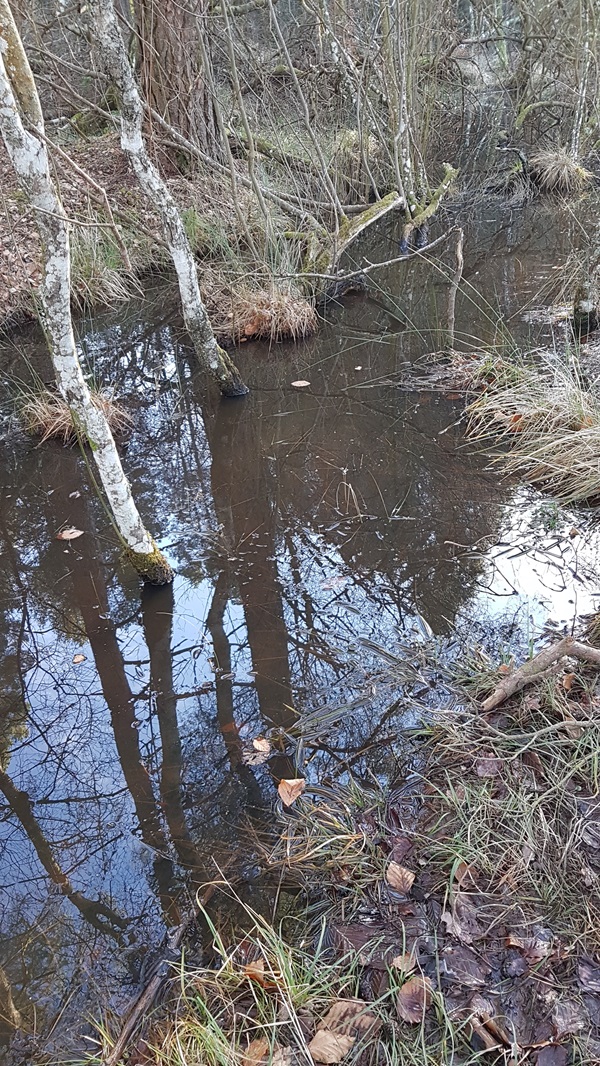
I creep through the spongy, saturated margins of the little loch at the heart of the King’s Myre, to peer through the cattails to see what wintering birds are on it today. Goldeneye, a few gadwall, mallards, a coot, typically swimming against the tide of the rest, intent on his own adventure. No sign of the swans, too early for the osprey to be home yet. In the damp woodland, waterlogged alcoves and scrapes, from which spiky, angular trees grow erratically, wait for frogs and toads to arrive for spawning. Between bare branches, multiple trunks and stems and a storm of tiny twigs, the blue sky seeps as if caught in a vast, arboreal net, reflected in patches of water.
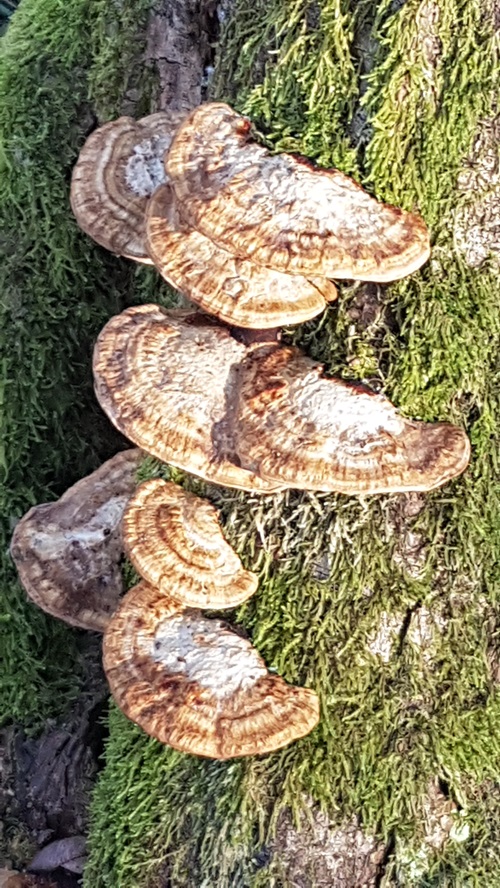
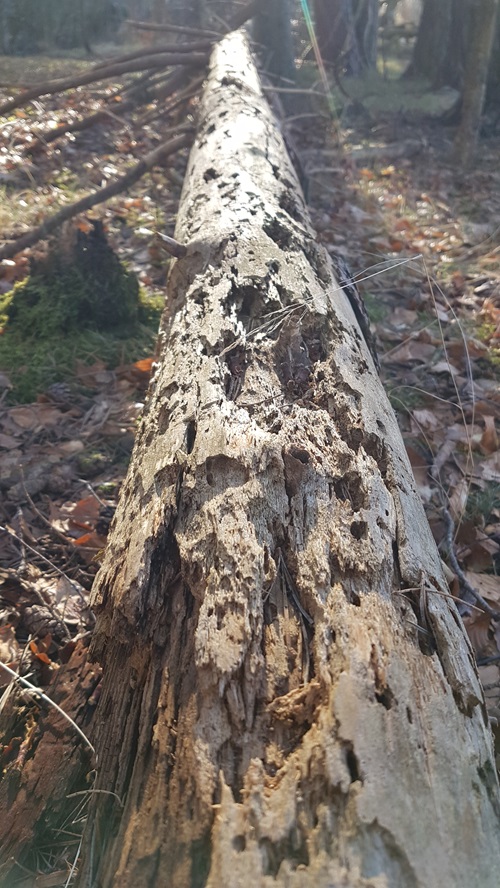
Bracket fungi show off their smug Cornish-pasty smiles of concentric bands, on wood they share with moss and lichen, and a thousand invertebrates. Spread across the leaf-carpeted floor, long-dead logs, un-barked, silvery, yielding, are home to thousands and thousands more, riddled with holes and channels and hidden tunnels in the fungus-softened wood. On cue, somewhere in a dead tree, a woodpecker begins his first tentative drumming and drilling.
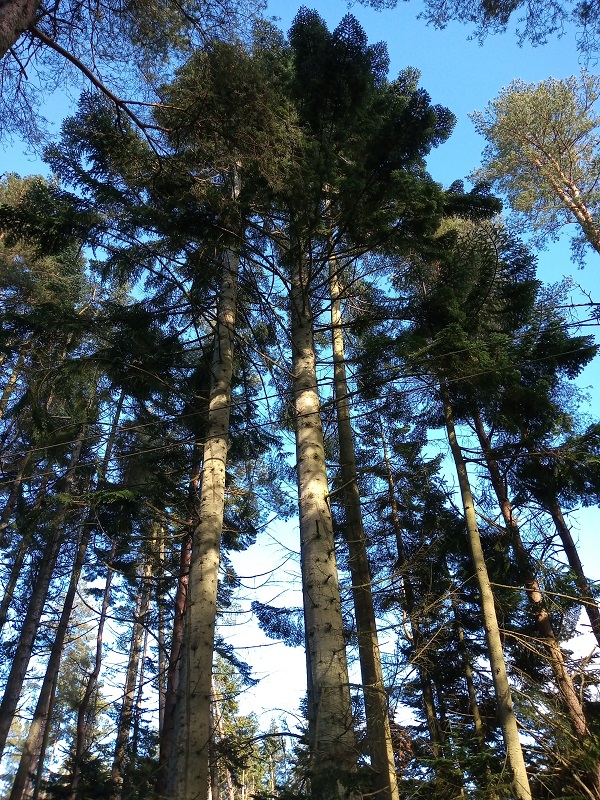
I look up into the Scots Pines, their narrow crowns dancing around each other like polite or nervous teenagers, and see the shapes of jagged sashes of sky, so clear, so blue….
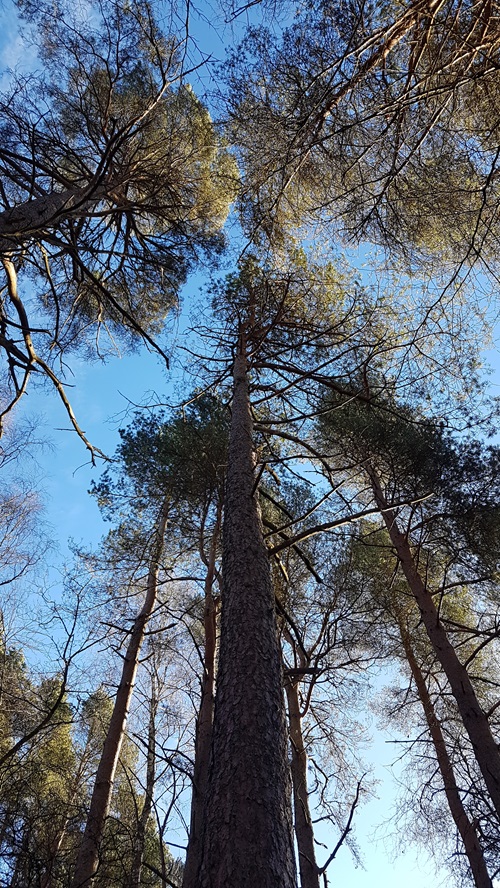
Look up, look through, look between – there is much to see. Or is there only sky?
The Long Way Round to Taymount Wood

The Pathfinder

We met up at the Taymount Wood car park, Linda and I, put on our boots and turned away, not into the gate. This was to be the long road to the woods, a circular walk via the disused railway line which once ran as a ponderous branch from Stanley across the River Tay to Coupar Angus. The embankment is reached from the Taymount Mains farm track, and you then head towards Kinclaven and Ballathie, across open country, under disused bridges and past a little railwaymen’s shed made of sleepers with a brick chimney still in place. Although today’s challenge for us was to find and walk the narrow path through the northern finger of the wood, the line itself offered a few challenges – a chilly wind and stretches of water where the rains of March hadn’t percolated the poorly-drained soil.

You turn north-west away from the line before you get to the grounds of Ballathie Hotel, crossing the road and continuing north up a rough track beside the Old Smiddy. The track goes past several houses and in the past, we’d stuck to it, until it vanishes at a farmhouse. Then we’d scrambled witlessly through fields and fences and bits of scrub till we arrived, somehow, on a track in Taymount Wood. This time, we were determined to find the “proper” path. So, we left the comfy track when it turned the bend and continued up to the edge of the wood. People had been this way, but not many, and it wasn’t clear how far in we should go before we turned left. Google satellite was remarkably unhelpful.

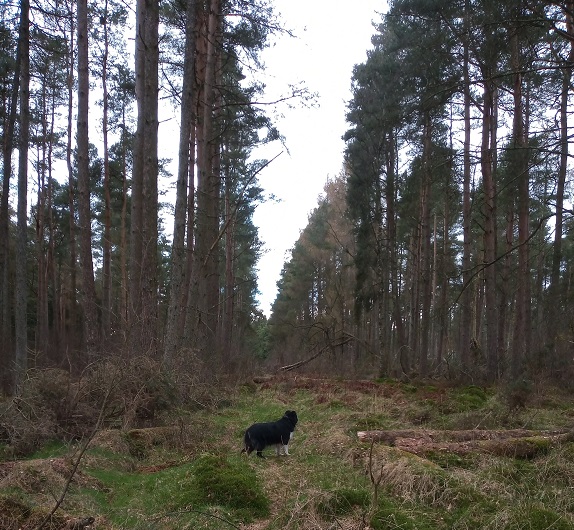
Dogs have many uses. Everyone thinks of companionship, protection and exercise machine, but an intelligent dog is a wonder at Finding the Path. While we stood wondering and wafting around, Jed set off into the unruly herbage with a look of collie dog purpose, nose to the ground. Sure enough, when we followed, there were the vestiges of a footpath. It doesn’t take many human footprints – and barely one canine print – to inform Jed this is The Way to Go. We continued, scrambling after him, and he didn’t lead us into any blind alleys. At times, we were on the point of losing faith, but then the path would reappear, on the other side of a boggy stretch or a tangle of bramble and brushwood.

There is a path here somewhere….

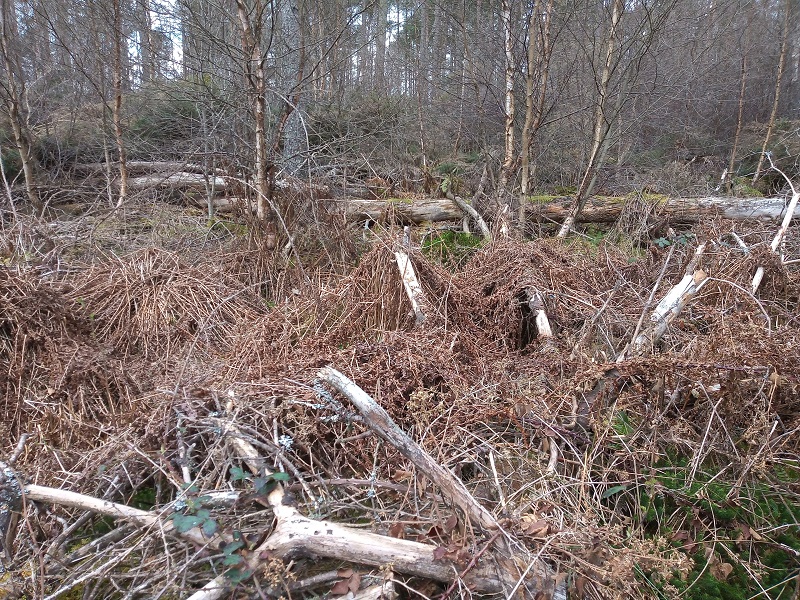
Wind-throw had put up many of the barriers that challenged us. I discovered I’m at an age where I’m a bit stiff for limbo-dancing under fallen trees, and my sense of balance (never my strong point) for climbing over them was precarious to say the least. There were points when we even doubted the dog, but then to our great surprise we encountered someone going the other way – an ecologist doing a survey of small mammals for West Stormont Woodland Group no less – who assured us that a. we were on the path and b. it was passable, if a tad wet in places. Well, we certainly found the wet places and finally stumbled out onto the hard forestry track that would eventually take us through the main wood and back to the car park. The challenge wasn’t quite over – several metres of scratchy, mean-minded gorse had colonised the track to meet in the middle, and we suffered quite a few scratches and tears before we were through it – noting jealously how impervious the coat of a collie dog is just about anything.

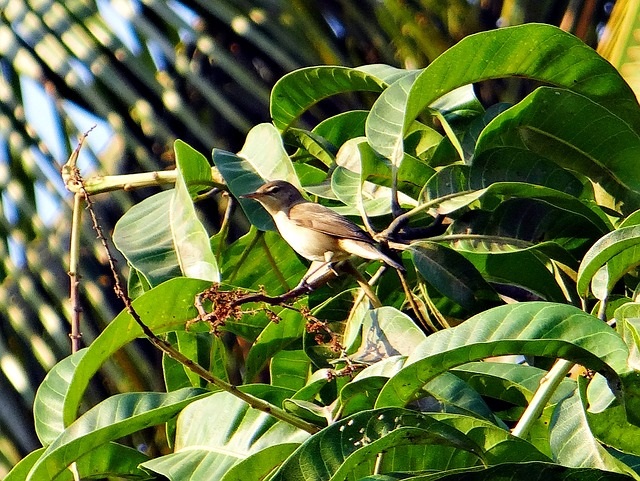
Common Chiffchaff (photo Bishnu Sarangi, Pixabay)

And the gift from today’s walk? There were lots – newly unfurling larch leaves, frogspawn in a drowning bit of track, skeletons of last year’s ferns, the beautiful vertical grandeur of the trees that hadn’t blown down, some chestnut brown bracket fungi left from the autumn. But as soon as we entered the wood on our optimistically rediscovered path, we heard the chiff-chaff call nearby. The earliest of our summer warblers to arrive, this is a small brown job of a bird, indistinguishable from willow and wood warblers unless it keeps still and stays a metre away from you. This one didn’t – they never do – but the call, exactly like the bird’s name, sets it apart. We never saw our little warbler, but the mocking “chiff-chaff-chiff-chiff-chaff” was never far away. It was, I am sure, laughing its little head off, but we chose to find it encouraging. When we found ourselves safely “out of the woods” and into the wood, it went off to scoff at something else. It made us appreciate all over again the wide range of habitats the woods provide for many bird species, residents and summer or winter visitors. I look forward to more birdsong in Taymount Woods this spring.

Find out more about WSWG and out hopes for community ownership of the woods at weststormontwoodlandgroup.scot

Whose Woods are These? I think I know….*

(This is the first in a new series of posts for West Stormont Woodland Group. From fear or repeating myself, I thought I’d write about the fact that each month, the woods have a Gift for us. And every month, there is at least one challenge that faces us – whether physical, philosophical or organisational – in contemplation of owning woodland as a community.)

FEBRUARY’S GIFT: GORSE FLOWER TEA

Of course, there are gorse bushes in flower in February in Five Mile Wood. There are gorse bushes in flower in the woods every month of the year, providing pollen and nectar for insects out too early or too late in the season. Some ancient lecher noticed this and spawned the saying “When gorse is not in flower, then kissing’s out of season.”

Gorse in flower in a cold and clenching winter such as this of 2021 is a real gift. It’s too cold to detect the rich coconut smell from them which can be almost overpowering in high summer, but the gold dazzles against the grey landscape of February or keeks through the smothering snow. Gorse has been used for many purposes, from feeding tough-mouthed horses in winter to sweeping chimneys. It’s a nitrogen fixing plant, like all the pea family, and imparts fertility to the soil. Burn it, and the alkaline ash is good for cleaning soiled linen.

The flowers themselves are used to make a yellow dye, and whether it worked or not, some dairies insisted that feeding gorse to milking cows made for a rich yellow butter. I don’t use gorse for any of these, but I do make gorse flower tea. It looks wonderful swirling around a glass teapot and you might catch a breath of that coconut smell. Don’t expect to taste it; it’s a very subtle (or absent!) taste. If you look hard you may find early shoots of nettle in the woods to give the tea some substance.

But don’t pass the gorse on to anyone else – allegedly, making a gift of gorse guarantees you’ll end up fighting. It’s the woods’ gift to me in February, and I will have no quarrel with the woods.

A CHALLENGE FOR FEBRUARY: WHOSE WOODS ARE THESE?

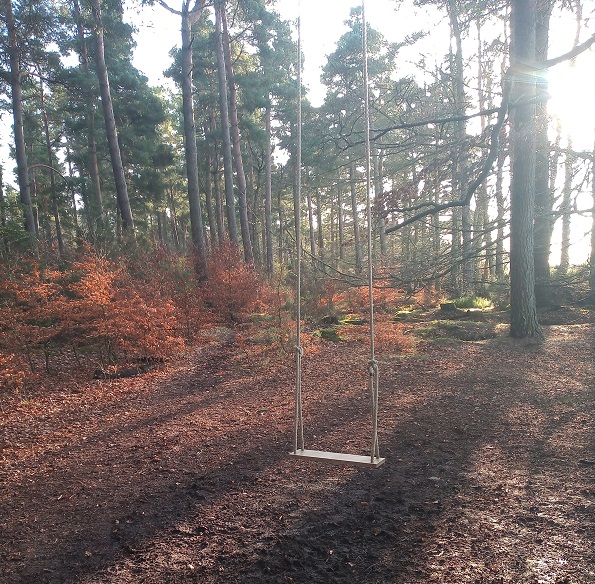
I think the woods are used more now than I remember in over twenty years, Evidence for that lies not just in who you meet, but in new tracks veering off, in small acts of clearance, in scattered pieces of art, in well-maintained articles of recreation like the new swing in the picture. Using the woods implies a sense of ownership, a vested interest, a certainty of relationship. A future.

But are we all buying into this? And will that feeling of belonging translate into an actual belonging? If Five Mile and Taymount Woods are to be taken into community ownership, it’s essential that community identifies itself, makes itself heard and provides the evidence of its existence that will count.

This month, West Stormont Woodland Group will begin a Community Consultation on the proposals the group has been working on for the two woods (or, as it’s widely seen, the one wood with a gap in the middle). Of course, Covid restrictions have forced the consultation to be mostly online, but this shouldn’t be seen as a problem – taking an event online in my recent experience amplifies and multiplies its reach and scope. There is a new website dedicated to the consultation, which launches on 22nd February; details can be found at http://www.weststormontwoodlandgroup.scot ,on Facebook, or by emailing contact@weststormontwoodlandgroup.scot

The challenge is to get you, me, all members, all non-members local to the communities around the woods, all of us starting to think these woods might be ours, to contribute to the consultation. Spread the word!

*Quoted from the opening lines of “Stopping by Woods on a Snowy Evening” by Robert Frost.

Last Leaves Falling

A Post for West Stormont Woodland Group

I pause on my way through the woods, quieting my breathing, keeping as still as I can. There is no sound, there is no wind. There should be no movement. Yet within the vascular systems of the broadleaved trees that bound the track, small enzyme changes are at work, invisible changes that lead to letting go, abscission, leaf-fall.

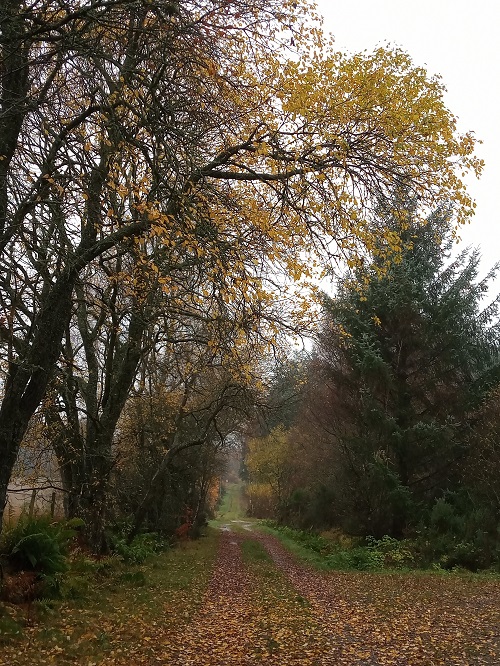
And down they come, silent, slow, like snowflakes in a still winter’s night. There is no flurry, no sound of wind through dry foliage, just the falling. Just the peace. Some trees are bare already. Birches are among the first to blaze golden and lose their leaves. Oaks keep hold of theirs till the last, but then they are usually the last to open in spring. Mature trees abscise before young ones. Young trees, and trees that have been pruned, will produce what’s known as juvenile growth, one feature of which being that the processes of leaf-fall are delayed. That’s why beech trees are so popular for hedges, the dry, crackly leaves slipping from gold to brown and staying in place till spring.

Young beeches, self-sown among the conifers at Taymount Wood’s dark heart, shine like tawny beacons.

They coat the ground, these last leaves, slick with last night’s rain and the condensing sweat of mist that loiters in motionless, tangled branches. Small sweeps of the already fallen lie around sedges and rushes, in hidden puddles and ditches. What else do they conceal?

A small brown toad lurks unmoving as the day, camouflaged among old birch leaves at the path edge. Then he moves, lopes distractedly into the grass, and is visible.

I like the emergence into visibility of the toad, and I enjoy the wood revealing its secrets as the leaves fall. The bizarre jutting side-branch of a fir tree, and the even more inexplicable branch that has fallen over it like a necktie, and somehow grown into an A shape. The filigree, waterfalling twigs of bare birch trees. The holes in trunks and large branches, the red squirrel’s aerial expressway from tree to tree. When leaves fall, I see that some trees are still richly clothed, decked in lichens and mosses so profusely you can’t see the wood, and decorated with the jewels of fruit and fungi. Food, forage and habitat here for small creatures that depend on the woods through the winter.

By the King’s Myre, the stillness of the day is magnified by the strange open vastness of this stretch of water. Reeds and trees and overhanging trees are reflected; birds are absent or silent. In the boats drawn up to the jetty, the leaves lie in rain that’s collected there, the sky bounces back, grey, metallic, motionless. There are no wafting clouds; it is all cloud, all greyness. And more leaves unhook themselves from life, drift down soberly against the small frictions of the early winter air.

On twigs and branches, wherever a leaf falls, a small tight bud, wrapped unnoticed in its winter coat, remains and waits.

What we Choose to Eat from the Woods

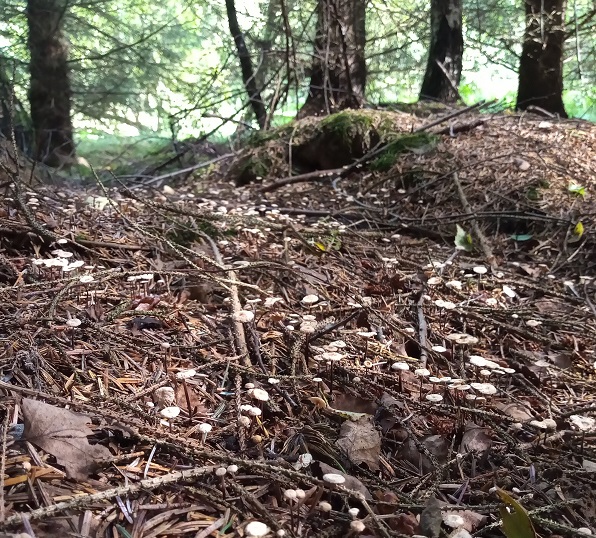
Horsehair Mushroom swarm

As soon as I entered Taymount Wood, I smelt mushrooms. Across in the pattering shade of the woods to my left, a family was ducking and diving and exclaiming across the ditches to each other. I could glimpse baskets, a small dog, a child or two.

Great! I thought, people foraging. Good luck! With chanterelles from a previous forage in my fridge, I just wanted to walk without expectations or intent.

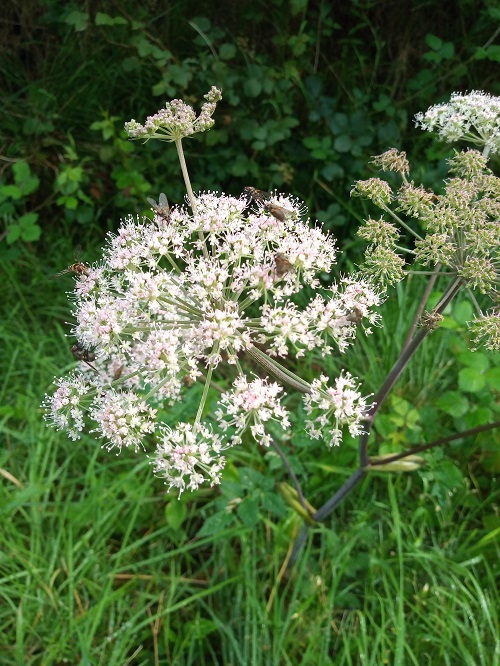
Looking for late summer flowers, I was taken by the large numbers of Wild Angelica growing either side of the path. Each geometrically arranged flowerhead hosted a happy horde of hoverflies and other pollinators. I’m 99.75% certain it is Wild Angelica, an edible plant – but I’ve never foraged it. The quarter of a percent of my brain that says “But wait, it might be Hemlock or one of the other poisonous members of the family out to deceive” prohibits me, despite the smell, season and appearance.

99.75% Wild Angelica

If in doubt, don’t. I no longer take risks with my foraging.

Taymount Wood is the wood that sidetracks me, every time. Up to the right, a sunlit glade. Cross the sleeper bridge to the left – what’s in here? Horse-hair mushrooms (Marasmius androsaceous) swarming up from the pine needles. A collection of puffballs (Lycoperdon perlatum) in mint condition cried out to be selectively foraged. Only firm, young ones are tasty, and leave more behind than you take.

Puffball (Lycoperdon perlatum)

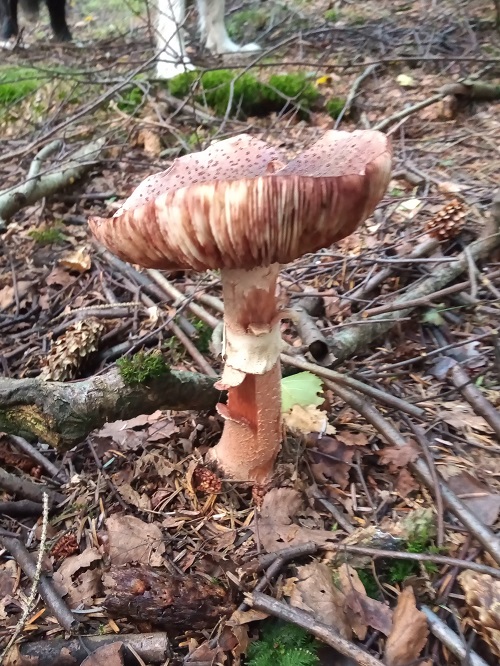
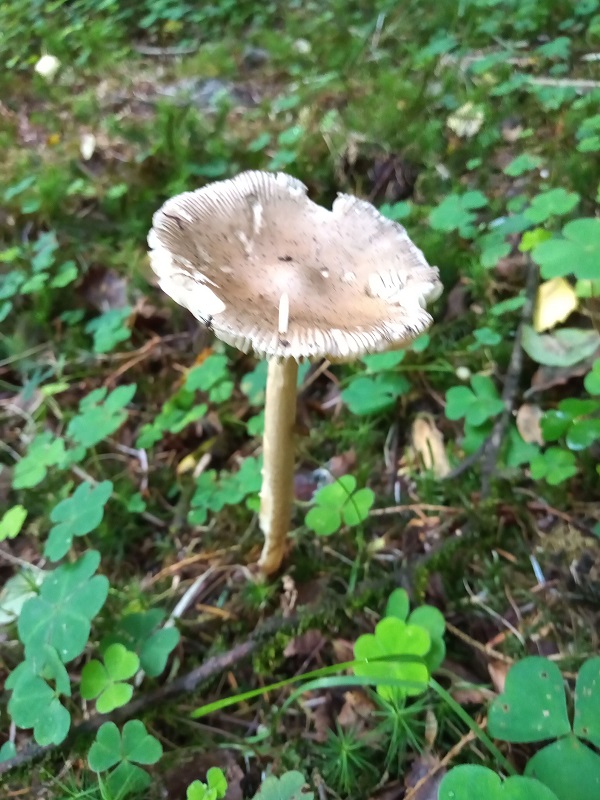
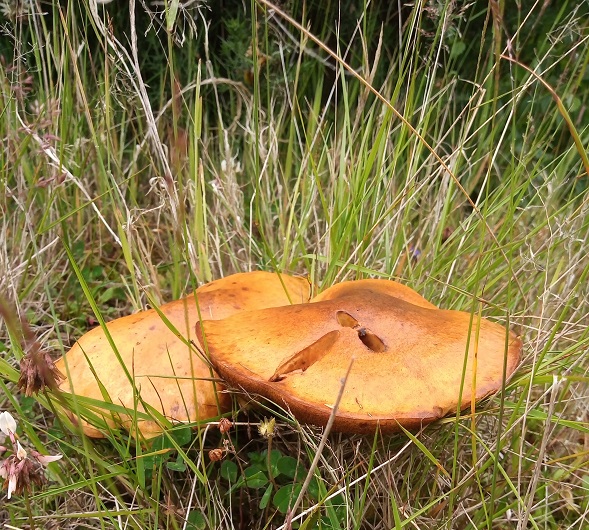
One family of mushrooms of which you have to be wary is Amanita. There are some deadly poisonous members, some only moderately so. Others will send you psychotic. There’s a few edible ones. Taymount Wood today was full of Blushers (Amanita rubescens), one of the edible ones. I have never eaten it, and never will. The flesh bruises pink, which is the indicator of the species – but in other respects it is too like the deadly Panther Cap (A. pantherina). Just suppose a Panther Cap happened to blush one day….. In any case, Blushers are always riddled with worms and maggots before I get near them. Today, both species were growing close to each other and the difference was obvious. I still wouldn’t risk it.

In the photos below, a Blusher on the left, showing the ring; three stages of a Panther Cap; but what do you think is the one on the right? See what I mean?

The Tawny Grisette (A. fulva) I do eat. Unlike most of the family, there is no ring around the stipe, and the edges of the cap are evenly striated as if by a pastry-cook. They were here – but it’s a socially-distanced species that only ever appears singly – and I hate to take the only one.

Tawny Grisette

The stench of death – but not quite death – drew me to the well-named Stinkhorns (Phallus impudica) in the ditch. Most people recoil at eating this mushroom, which exudes a sticky gel smelling like a corpse to attract flies to spread the spores. But I’ve eaten plenty – at a very young stage when they look like eggs protruding from the forest floor. There’s no horrid smell and the jelly surrounding the immature fruiting body is actually delicious. All right, to each her own!

Stinkhorn

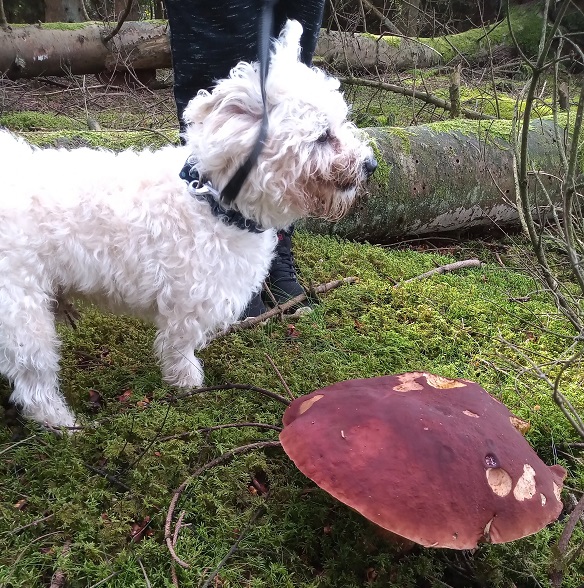
Sidetracked again, I met half the foraging family. Marcin, his young son (and the dog) had just found the biggest Boletus mushroom of the day. We chatted, compared notes, and I admired Marcin’s basket of Ceps, Bay Boletes and others. Marcin learned his mushroom lore from his mother and grandmother in Poland, and their preferences are the Boletus family, chanterelles and Saffron Milk Caps. He loves these woods, and values them for their beauty and food supply.  The giant Bolete he said he will not pick, but leave it to spread spores and be admired.

I showed Marcin my collection of puffballs. He looked aghast. “You eat them??” Apparently not a favourite in Poland!

This post was written for West Stormont Woodland Group https://www.weststormontwoodlandgroup.org.uk/

The Mushroom at the End of the Wood

A Post for West Stormont Woodland Group

Larch Boletes in Five Mile Wood

In Anna Tsing’s book The Mushroom at the End of the World*, she tells the story of landscapes ruined – or seemingly ruined – by the greed of human activity. In particular, forests. In one unpromising forest in Oregon USA, where commercial forestry had stripped out all the trees of value and left an empty terrain of broken ground and scrubby volunteer pines, she met some mushroom hunters, refugees from Laos. They were gathering Matsutake, one of the most prized and valuable edible mushrooms in Japan and – allegedly – the first living organisms to appear from the wreckage of Hiroshima after the Bomb.

Matsutake mushrooms, like many fungi, only appear when they can be entangled with the roots of a suitable host tree in a mycorrhizal relationship. They got on very well with those scrubby pines. Tsing tells how the accidental introduction of the Pine Wilt Nematode on a shipment of American Pine into Japan had devastated the Matsutake’s natural host there, hence its rarity. It is not a serious pest of American Pine.

Incidentally, Scots Pine is a good host for Matsutake, too….

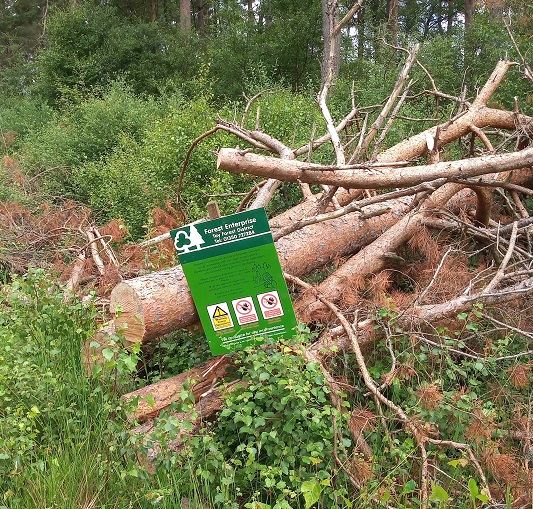
Abandoned remnants of the commercial forest

Mushrooms disappearing when a forest changes is familiar to me. All forests and woods are in the process of change, but our two ex-commercial forests, Five Mile and Taymount Woods, are forests in abrupt transition. Before the Commission took out the last valuable trees and wind-throw did for many more, Five Mile Wood was my happy mushroom-hunting ground, the place I’d take people to for foraging walks. I knew exactly where to find the biggest chanterelles, the white Angels’ Wings, the logs where real oyster mushrooms could often break out. The ditches beside the path were home to many fascinating species, including several edible Boletus including the Cep and the maggot-free Bay Bolete – and, of course plenty of highly poisonous examples too. Some years, the tantalisingly similar but inedible False Chanterelle outnumbered the real one – which is exactly what you need when teaching people not to harm themselves by misidentification. One damp corner was an emporium for the delicious Slippery Jack, which turned up in troops like clockwork, every year in late summer and autumn. I used to dry the ones we didn’t fry up right away, and store them in jars.

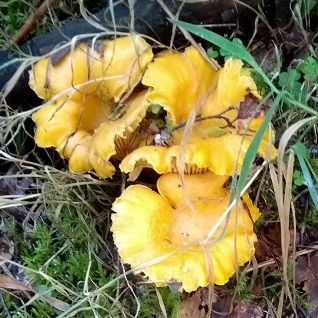
The biggest chanterelles

The fragile associations which had built up over the decades were shattered by felling. The self-sown birches that are colonising parts of both the woods now will eventually reel in their own, interconnected fungal friends, and the chanterelles will surely re-emerge one day, because birch is their main host tree. But from my experience, it takes at least a decade before mushrooms start to appear in a new wood, and the first arrivals are never the ones you want to eat! The precarity of a habitat for specific mushrooms is alarming – involving water tables, shade, parasitic plants, weather patterns, nematodes, beetles, animals – including mushroom pickers. Tsing’s book includes chapters on the equally precarious lives of the pickers – refugees, indigenous peoples, itinerants. Humans aren’t in control of what the mushrooms will do, because there are so many variables in play. Humans are just part of the landscape, and the landscape is changing because of and despite them.

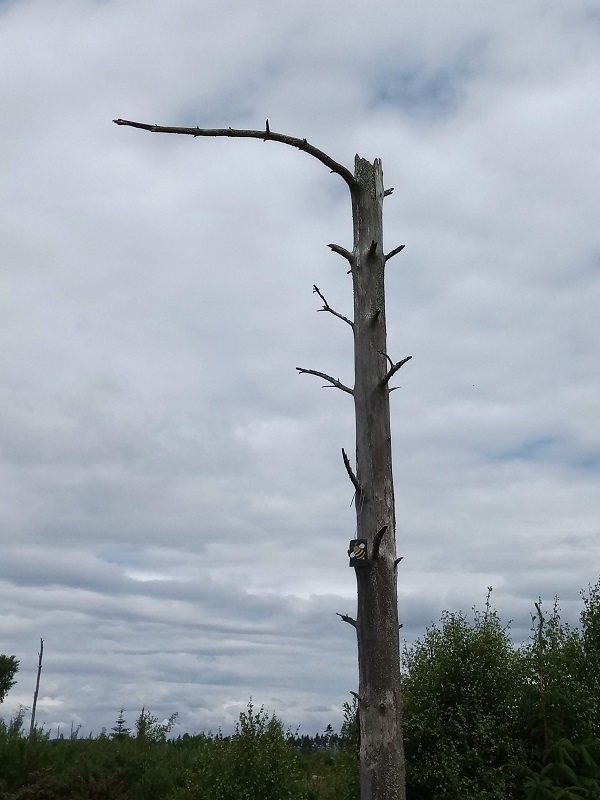
Another remnant….

So, I can only observe and enjoy the new but mushroom-free habitats in parts of our woods, note the changes, watch new worlds forming out of devastation and realise we are not in charge, not that clever, and maybe, not that important either. I scoured the ditches in Five Mile Wood for boletes recently, and right at the end, I did find a couple of lingering and determined specimens. I left them there.

But who knows what will be the mushroom at the end of the wood? And where is the end of the wood?

*Tsing, Anna Lowenhaupt: The Mushroom at the End of the World – On the Possibility of Life in Capitalist Ruins (Princetown University Press 2015)

Creeping Up On King’s Myre

TWfeet

Hot, sunshine, slight breeze – a day to cycle to a cool and shady place. We’d often thought about walking into Taymount Wood by the core footpath from Airntully, but before lockdown hadn’t considered cycling all the way from Bankfoot. We left the village on the Stewart Dairy road, in normal times screeching with haring rat-runners with no conception of cyclists or passing places, and up the steep Barns Brae. This we accomplished without pause for breath, thanks to the electric bikes! We were caught out at the top by two “proper” cyclists who had stopped to recover, and who tried very hard, in a typical show of pandemic goodwill, not to look supercilious.

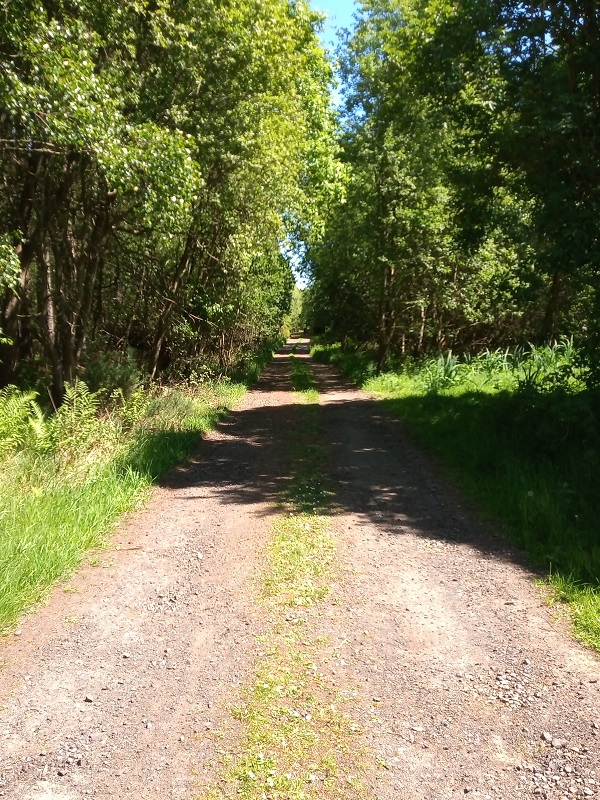
From the hamlet of Airntully, with its handy share-and-donate community phone box, we entered a shady tunnel of hedgerow elms, that enclosed our path. A shivering mosaic of sunlight hovered over the blue of speedwells, the pink of purslane. The path quickly led across a road and over the main line level crossing, straight to the fringes of Taymount wood.

TWlevel xing

In contrast to our last visit in March, most trees were in full leaf. Violets flowered happily in the shade. It was now drowsy midday, and – again in contrast to March – the birds were silent, save for a welcoming chiff-chaff.

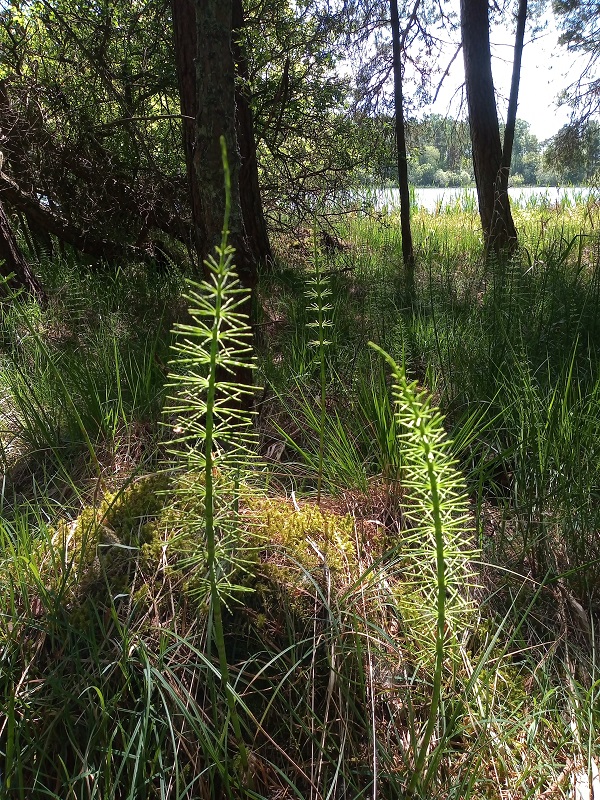
The silver line of King’s Myre appeared through the trees on our right. Parking the bikes, we took a small deer path between the trees towards the water.  You cannot “go to” King’s Myre, nor can you arrive. There is no division in this habitat, between wet and dry, no shoreline, no edge. You have to creep up on it, with the stealth of an amphibian or a mudskipper. The ground underfoot grew softer, violets gave way to arching horsetails, until the trees petered out into scraggy bog willow and the soil became sphagnum moss. If I stood still, water came over my shoes.

TWhorsetails

Under the last tree, whose roots appeared to have made a spot dry enough for tormentil to grow, we sat down to picnic and observe. An osprey, also in search of lunch, circled the lochan. Fluffy seed of the reedmace bowled about the water margin like tumbleweed. Blue damselflies hovered, veering abruptly as if skating on air. Red damselflies were better camouflaged, except the one that alighted briefly on my knee!

TWorchid

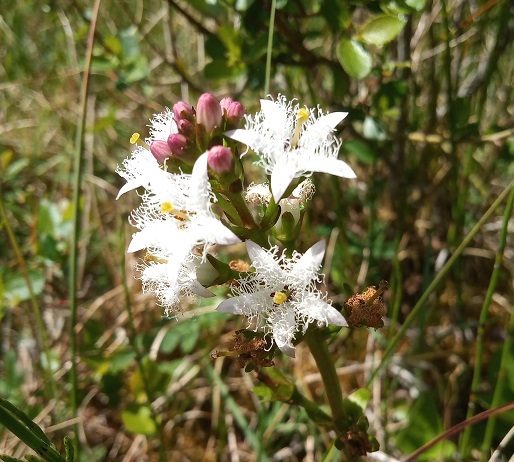
There were many small, dark solitary bees. Where they were foraging? They ignored the yellow tormentil, and I could see no other flowers. But a squelchy walk among the bog willows revealed several orchids, probably marsh but I’m hopeless on orchids, and the staggeringly lovely fringed flowers of the bogbean (Menyanthes trifoliata), just coming out.

TWbogbean

Back to the bikes, and on through the wood to the main entrance on the KInclaven road, streaming away on downhill paths through heady clouds of coconut scented gorse. By the time we reached the birch trees, the birds were singing again. We returned via Airntully phone-box for a book to while away the rest of the afternoon.

TW1

This post was written for West Stormont Woodland Group, in support of the plan for community buy-out and wider community use of local woodland and landscape.


Ambushed by Birdsong in Taymount Wood

“Much laid plans” and all that. I knew exactly what I was going to write about in my second post for West Stormont Woodland Group. It involved walking quickly and without distraction to King’s Myre in Taymount Wood.

But on this sunny, yet briskly chilly morning in March, the birds had other plans for me. We hadn’t got far when the dog was infuriated by an ear-piercing whistling made, apparently, by a bush. Eventually a tiny bit of the bush detached itself and was revealed as the smallest bird with the loudest voice – the wren, bustling ahead of us from twig to twig. The dog hates wrens. They scold, scoff, and shout at him, warning everyone he’s about.

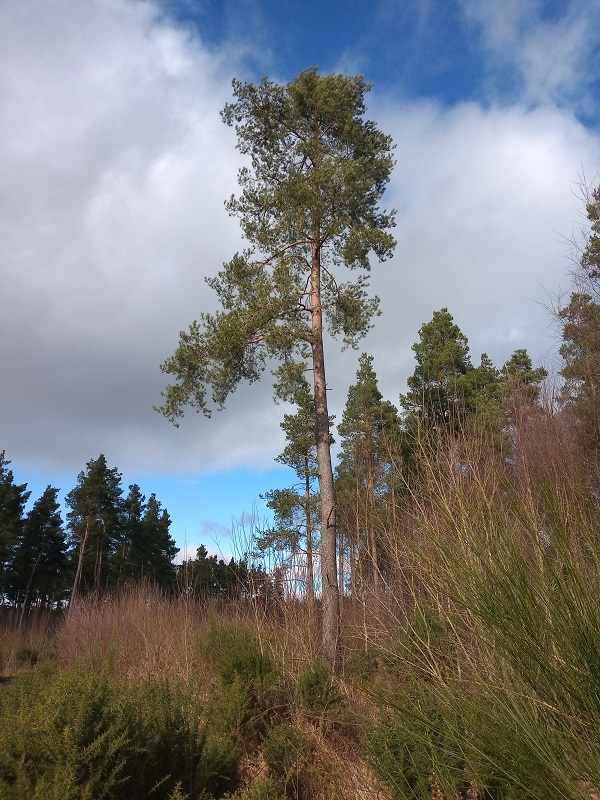
TW scotspine

We dawdled on. Taymount contains a fair variety of tree species for a plantation. Tall Scots Pines lifted their crowns to the sun. Here and there, where selective felling had left a pine with elbow room, the narrow confines of its growth could be seen morphing into the mighty spread of the Caledonian pines. Larger clearings now host dense, self-seeded birch, through which a flock of greenfinches scurried. Brown bracken, unusual in this wood, lay beneath, thick enough to bed a herd of beasts.

TW bracken

We were on the cusp of spring. Robins proclaimed territories sweetly, compellingly, from field walls. We saw and heard shrill blue-tits, piping long-tails, busy coal-tits, always on the go. Great tits were most strident, high in the trees. “I’m yours! Look at me!” they seemed to cry in their repetitive, compulsive mating calls. Gazing up focused my attention on the trees, too, as silver firs soared into the blue sky. We fantasised about crested tits, one day, coming here.

TW silver fir

We came to some Sitka Spruce which had evaded felling. Sitka is a splendid, statuesque tree when grown as a specimen. If it has no place in the Scottish ecosystem, tell that to the coal-tits. These spruces were laden with dangling ginger cones and coal tits moved systematically from branch to branch, eating the seeds. Then a spotted woodpecker, who’d been ever-present with his drumming, exploded out of hiding and passed right over our heads, a massive spruce cone gripped in his bill.

By the time we got to King’s Myre, we just enjoyed the sunshine by the loch. Another day for that tale!

TW kingsmyre1